

What Does Athletic Mindset Mean for Peak Performance
An athletic mindset is defined as a trainable mental framework that drives consistent performance through deliberate preparation, present-moment focus, and honest self-evaluation. This is not a personality type you are born with. It is a skill set you build. Psychologist Carol Dweck’s growth mindset research laid the foundation for understanding how athletes develop this mental edge. Dr. Paul McCarthy’s work on self-efficacy and Earn the Edge Performance’s mental training framework have since expanded it into a practical system. Whether you compete on a field or chase goals in everyday life, the athletic mindset is the mental operating system behind every breakthrough.
What does athletic mindset mean at its core?
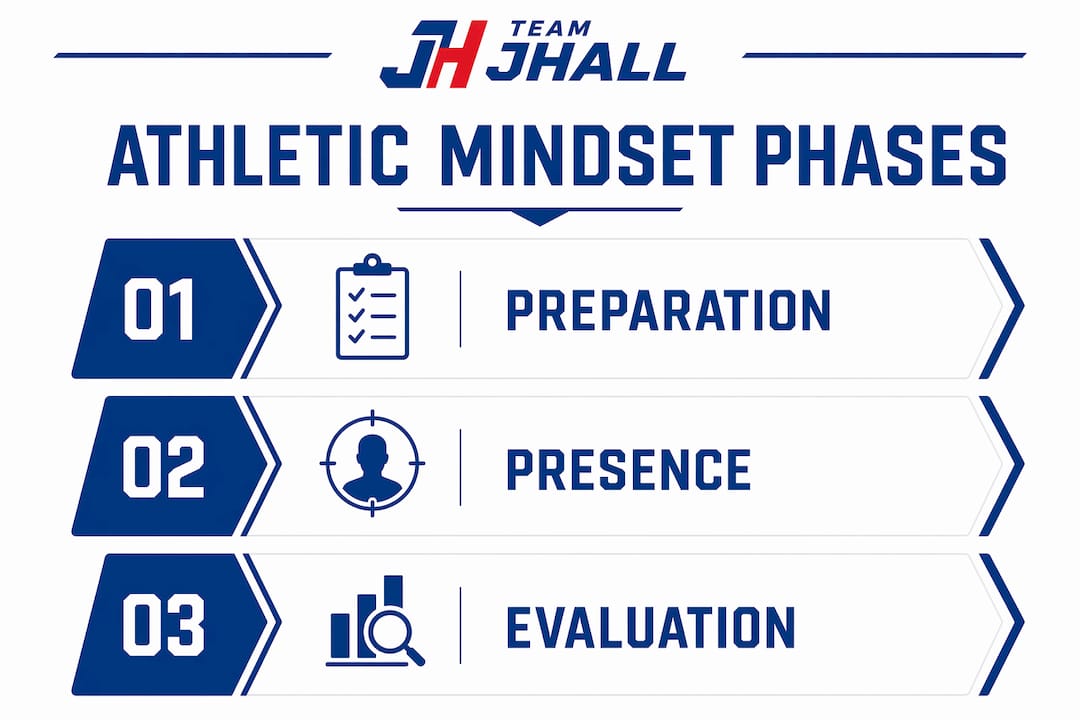
The definition of athletic mindset centers on three phases: preparation, presence, and evaluation. Experts describe this three-phase framework as the foundation for optimizing performance across any competitive environment. Each phase serves a distinct purpose. Preparation builds confidence before competition. Presence keeps focus locked during it. Evaluation extracts learning after it.
What separates this from generic motivation is specificity. A winning mindset is not about feeling pumped up before a game. It is about having a repeatable mental process that holds up when the pressure peaks. Athletes who train this framework perform more consistently because they are not relying on emotion to carry them through. They rely on structure.
The athletic mindset also aligns directly with Carol Dweck’s growth mindset philosophy. Growth mindset thinking treats mistakes as learning opportunities rather than fixed failures. That shift in perspective is what separates athletes who plateau from those who keep improving year after year.
What are the core characteristics of an athletic mindset?
Five core pillars define the athletic mindset: process focus, self-talk regulation, resilience, coachability, and confidence construction. These are not fixed personality traits. They are trainable behaviors, which means every athlete can develop them with consistent practice.
- Process focus means directing attention to what you can control right now, not the scoreboard or the outcome.
- Self-talk regulation means catching negative internal dialogue and redirecting it toward useful cues.
- Resilience means bouncing back from errors without letting them compound into a mental spiral.
- Coachability is a trained response, not a personality trait. Coachability accelerates learning and builds trust with coaches faster than raw talent alone.
- Confidence construction means building stable self-belief through preparation and experience, not through hollow affirmations.
Each pillar reinforces the others. An athlete who regulates self-talk performs with more process focus. An athlete who stays coachable builds confidence faster because feedback becomes fuel rather than criticism.
Pro Tip: To develop coachability as a behavior, write down one piece of feedback from each practice and act on it the next session. This turns passive listening into active improvement.
How does athletic mindset differ from mental toughness myths?
Mental toughness is widely misunderstood. Most people picture a stoic, emotionless competitor who never shows doubt. That image is wrong, and chasing it actually hurts performance.
The athletic mindset is built on psychological flexibility, not emotion suppression. Athletes manage negative thoughts rather than eliminate them. The goal is not to feel nothing. The goal is to keep negative thoughts from controlling your actions.
One of the most important distinctions in sports psychology is the difference between a challenge mindset and a threat mindset. A challenge mindset triggers physiological responses that increase blood flow and sharpen focus. A threat mindset does the opposite. It floods the body with cortisol and narrows attention at exactly the wrong moment. The same high-pressure situation produces two completely different biological outcomes depending on how the athlete frames it.
“High-level athletes shift the internal dialogue from ‘What is wrong with me?’ to ‘What did I learn?’ to sustain improvement.” — Athletes and Mindset
That reframe is not toxic positivity. It is a deliberate cognitive tool that keeps the athlete in a productive mental state after a mistake.
Pro Tip: Before a competition, replace “I hope I don’t mess up” with “I am ready to compete.” That single language shift moves your brain from threat mode to challenge mode.
What practical methods do athletes use to develop an athletic mindset?
The three-phase framework of preparation, presence, and evaluation gives athletes a repeatable system for mental training. Each phase has specific tools attached to it.
| Mental technique | Physical training equivalent |
|---|---|
| Visualization before competition | Warm-up drills before practice |
| Self-talk regulation during performance | Form checks during a lift |
| Post-performance evaluation | Film review after a game |
| Reset routines under pressure | Active recovery between sets |
| Positive reframing after errors | Technique correction after a miss |
Visualization is not daydreaming. It is a structured mental rehearsal where the athlete runs through specific scenarios with full sensory detail. Self-talk regulation works the same way during live competition. The athlete catches a negative thought, labels it, and replaces it with a performance cue.

Reset routines like deep breathing or adjusting gear help athletes regain focus and manage pressure in real time. These are not superstitions. They are attention-control tools that interrupt a mental spiral before it affects execution.
Positive reframing boosts performance by 20% under pressure, according to Dr. Paul McCarthy’s research. That number reflects what happens when an athlete stops fighting their mental state and starts working with it instead.
Pro Tip: Build a 60-second pre-performance routine using three steps: two deep breaths, one process cue (“stay low,” “drive through”), and one reset word. Repeat it before every rep, every set, and every game.
How does an athletic mindset improve sports and everyday life?
The benefits of the athletic mindset extend well beyond the field. Athletes with strong self-efficacy are 15% more likely to persist through challenges. Persistence is the single most reliable predictor of long-term achievement in any domain.
Mindset training builds awareness, regulation, and focus that improve performance consistency under pressure. That same skill set transfers directly to school, work, and relationships. The student who regulates self-talk during a test performs better. The professional who frames a setback as data rather than failure recovers faster.
Here is what the athletic mindset produces across life domains:
- Improved emotional regulation under stress and uncertainty
- Greater resilience after failure, rejection, or injury
- Stronger motivation that comes from internal standards, not external validation
- Better coachability in any learning environment, from classrooms to boardrooms
- Long-term confidence built through consistent action and honest self-evaluation
Neglecting mindset training leads to burnout and suboptimal development, even for physically gifted athletes. The mental side is not a bonus feature. It is the foundation that physical training sits on. Building a performance lifestyle means treating mental and physical development as one integrated system, not two separate tracks.
Key Takeaways
An athletic mindset is a trainable mental framework built on preparation, presence, and evaluation that drives consistent performance in sports and life.
| Point | Details |
|---|---|
| Athletic mindset is trainable | It is not a fixed trait. Anyone can develop it through deliberate practice and repetition. |
| Five core pillars drive it | Process focus, self-talk regulation, resilience, coachability, and confidence construction are all learnable behaviors. |
| Challenge mindset beats threat mindset | Framing pressure as a challenge triggers better physiology and sharper focus than viewing it as a threat. |
| Mental and physical training are inseparable | Neglecting mindset leads to burnout. Both systems must be trained together for sustained performance. |
| Benefits transfer beyond sports | Emotional regulation, resilience, and persistence built through athletic mindset practices improve every area of life. |
The mental side is the side most athletes skip
I have watched talented athletes stall out not because they lacked physical ability but because they never trained their mind. They worked harder on their body every single week and spent zero time on how they thought, how they talked to themselves, or how they processed failure.
The biggest mistake I see is confusing mindset with motivation. Motivation is a feeling. It comes and goes. Mindset is a system. It shows up whether you feel like it or not. When you build the habits of process focus, reset routines, and honest evaluation, you stop depending on a good day to perform well.
The other trap is thinking emotional regulation means being cold or robotic. The best competitors I have been around feel everything. They just do not let their feelings make the decisions. Confidence built through experience and preparation is far more durable than confidence built on a good mood. Train the mind the same way you train the body. Show up for it every day, even when it is uncomfortable.
— Jason
Train your mind and your look with Teamjhall
Teamjhall was built for athletes who understand that performance starts before the first rep. The brand combines premium athletic apparel with a movement rooted in confidence, faith, loyalty, and consistency. Every piece is designed for competitors, creators, and everyday athletes who refuse to separate how they train from who they are.

When your gear fits right and feels right, your focus stays where it belongs. The TJH Women’s Athletic Tank and the TJH Men’s Performance Tee are built for the athlete who trains with intention. Gear up, lock in, and bring the mindset to match at the Teamjhall store.
FAQ
What does athletic mindset mean in simple terms?
An athletic mindset is a trainable mental framework that helps athletes prepare, stay focused, and learn from every performance. It is built on five pillars: process focus, self-talk regulation, resilience, coachability, and confidence construction.
Is mental toughness the same as an athletic mindset?
No. Mental toughness is often misunderstood as emotionless stoicism. An athletic mindset is about psychological flexibility, managing negative thoughts rather than eliminating them, and framing pressure as a challenge rather than a threat.
How do you develop an athletic mindset?
Use the three-phase framework of preparation, presence, and evaluation. Add specific tools like visualization, reset routines, and self-talk regulation to each phase. Practice them consistently, just like physical skills.
Can an athletic mindset help outside of sports?
Yes. The same skills that drive sports performance, including emotional regulation, resilience, and persistence, transfer directly to school, work, and personal development. Athletes with strong self-efficacy are more likely to persist through challenges in any domain.
How long does it take to build an athletic mindset?
There is no fixed timeline. Like physical training, mindset development is ongoing. Consistent daily practice of mental skills produces noticeable improvements in focus and resilience within weeks, with deeper gains building over months and years.