

Benefits of Functional Fitness for Sports Performance
Functional fitness is a training method that builds strength, coordination, and injury resilience by mimicking the real movements athletes perform in competition. Unlike isolated machine exercises, functional training works multiple joints and muscle groups at once, priming the neuromuscular system for sport-specific demands. A 2026 systematic review of 25 randomized controlled trials covering 10,124 athletes confirmed that integrative neuromuscular training reduces injury risk by about 27% while producing significant gains in jump height, sprint speed, change of direction, and dynamic balance. The benefits of functional fitness for sports are not theoretical. They are measurable, repeatable, and backed by the strongest research available.
1. How does functional fitness reduce injury risk in athletes?
Functional fitness reduces injury risk through neuromuscular adaptations, not just muscle size. When athletes train with balance drills, plyometrics, agility work, and compound strength movements, the nervous system learns to control joint position more accurately. That sensorimotor control is what prevents the awkward landings and sudden direction changes that cause most non-contact injuries.
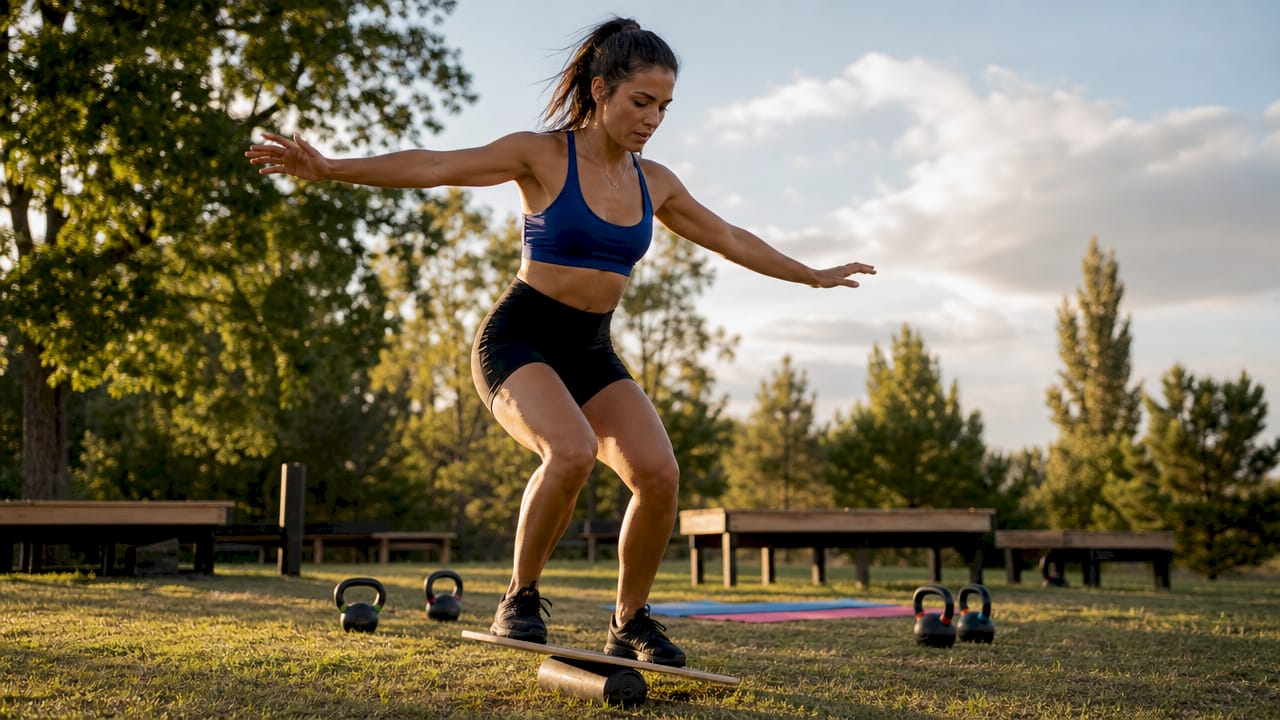
A 2026 meta-analysis of 16 randomized controlled trials found that multicomponent injury prevention programs reduce overall sports injuries by 35% in adolescent team sport athletes. The strongest effects appeared in lower extremity injuries, which are the most common and most costly injuries in team sports.
The key training elements linked to injury prevention include:
- Balance and proprioception work to improve joint stability and postural reflexes
- Plyometric drills to train landing mechanics and reactive strength
- Agility exercises to develop controlled deceleration and direction change
- Compound strength movements to build the muscular support around vulnerable joints
A separate 2026 meta-analysis of 37 trials covering 36,385 participants found that functional stability training reduces lower limb injury risk by about 30%. That same analysis found that each 10% increase in program adherence corresponds to an additional 10% reduction in injury risk. Consistency is not a soft recommendation. It is a measurable performance variable.
Pro Tip: Build functional fitness sessions into your existing warm-up rather than treating them as separate workouts. Athletes who embed these sessions into practice routines show higher adherence rates and better injury outcomes than those who schedule them as standalone blocks.
2. What performance improvements can athletes expect from functional training?
Functional training produces measurable gains across every major athletic performance domain. The 2026 systematic review of integrative neuromuscular training reported a standardized mean difference of 0.97 for change-of-direction performance, which is a large effect by research standards. That means athletes who follow structured functional programs move laterally and reactively at a significantly higher level than those who do not.
Balance improvements are equally striking. A meta-analysis of 15 randomized controlled trials covering 609 athletes found that neuromuscular training produces a standardized mean difference of 1.48 for dynamic balance gains. Dynamic balance is the ability to control your body while moving, and it directly affects performance in basketball, soccer, football, and virtually every other team sport.
Sprint performance also responds to functional training, but with an important condition. A 2026 systematic review clarified that sprint improvements in team sports are most consistent when strength training combines high-intensity or eccentric loading with sprint-specific, biomechanically related tasks. Hypertrophy-focused lifting alone does not transfer as reliably to sprint speed.
Specific functional exercises that translate directly to sport movements include:
- Single-leg Romanian deadlifts for hamstring strength and hip stability during sprinting
- Box jumps and depth jumps for explosive power and landing control
- Lateral band walks for hip abductor strength critical in cutting movements
- Medicine ball rotational throws for core power transfer in throwing and striking sports
Pro Tip: Match your functional exercises to the force angles and movement patterns of your sport. A basketball player and a soccer player both need lateral power, but the hip angles and contact surfaces differ. Specificity drives transfer.
3. Which functional fitness components are most effective for enhancing sports outcomes?
The most effective functional fitness programs combine multiple training components rather than relying on any single method. Research consistently shows that multicomponent programs outperform single-modality approaches for both injury prevention and performance.
| Training component | Primary benefit | Recommended dose |
|---|---|---|
| Multi-joint compound movements | Strength, coordination, and force production | 2 or more sessions per week at 80% or more of 1RM for strength |
| Balance and proprioception drills | Postural control, joint stability, sensorimotor accuracy | 3 or more sessions per week for dynamic balance gains |
| Plyometric exercises | Explosive power, stretch-shortening cycle efficiency | 2 to 3 sessions per week with progressive intensity |
| Agility and change-of-direction drills | Reactive ability, deceleration control | 2 or more sessions per week integrated with sport practice |
| Eccentric strength work | Sprint speed, hamstring resilience, injury resistance | 2 sessions per week combined with sprint-specific tasks |
Multi-joint compound movements form the foundation. Exercises like squats, deadlifts, and pull-ups train the nervous system to coordinate multiple muscle groups simultaneously, which is exactly what sport demands. Functional strength training primes muscles and the nervous system for agility by enhancing the ability to react to rapid position changes.
Balance and proprioceptive training deserve more attention than most athletes give them. The research on neuromuscular balance improvements shows that dynamic balance gains are maximized with three or more sessions per week. Static balance also improves, with a standardized mean difference of 0.89, but dynamic balance produces the larger effect and the more direct sport application.
For resistance training specifically, a 2026 American College of Sports Medicine overview synthesizing 137 systematic reviews covering more than 30,000 participants confirmed that two or more weekly sessions at loads of 80% or more of one-repetition maximum produce the strongest strength and power adaptations. Moderate loads in the 30% to 70% range also improve power output. Both loading zones have a place in a well designed functional program.
4. How to implement functional fitness efficiently within an athlete’s training schedule
Short, frequent sessions outperform long, infrequent ones for both injury prevention and performance. The 2026 meta-analysis on adolescent athletes found that programs using sessions under 20 minutes produced the strongest injury reduction effects. That finding matters because it removes the most common excuse athletes give for skipping functional work: lack of time.
A practical implementation approach follows four steps:
- Attach functional sessions to existing practice. Use the first 15 to 20 minutes of every practice as a structured functional warm-up covering balance, plyometrics, and agility. This builds habit without adding schedule burden.
- Train at least twice per week. The research on functional stability training is clear that twice-weekly sessions represent the minimum effective dose for injury prevention. Three sessions per week maximizes balance and neuromuscular gains.
- Match exercises to your sport’s movement demands. A swimmer needs shoulder stability and rotational core strength. A soccer player needs single-leg power and lateral hip control. Generic programs produce generic results.
- Progress systematically. Start with body weight movements and stable surfaces, then add load, instability, or speed over four to six weeks. Jumping straight to advanced plyometrics without a strength base increases rather than decreases injury risk.
The most common implementation mistake is inconsistency. The adherence research00129-5/abstract) is unambiguous: every 10% drop in adherence costs athletes roughly 10% of their injury prevention benefit. A simple program done consistently beats a complex program done sporadically every time. Athletes who treat functional fitness as optional will not see the results that athletes who treat it as non-negotiable do.
Balancing functional fitness with traditional strength training requires honest scheduling. Functional sessions work best as warm-ups or on lighter training days. Placing high-intensity plyometric work the day before a heavy squat session or a game creates unnecessary fatigue. Sequence matters as much as content.
Key takeaways
Functional fitness delivers its greatest sports benefits through consistent, multicomponent training that targets neuromuscular control, balance, and sport-specific movement patterns.
| Point | Details |
|---|---|
| Injury risk drops significantly | Functional programs reduce lower limb injury risk by 27% to 35% across youth and adult athletes. |
| Performance gains are measurable | Change-of-direction and dynamic balance show large effect sizes from neuromuscular training. |
| Short sessions work best | Programs under 20 minutes integrated into warm-ups produce the strongest injury prevention results. |
| Adherence drives outcomes | Each 10% increase in program adherence adds roughly 10% more injury risk reduction. |
| Specificity matters for sprinting | Sprint gains require eccentric and high-intensity strength work paired with sprint-specific drills. |
Why I think most athletes are training the wrong way
Most athletes I have worked with and observed spend the majority of their gym time on isolated exercises. Bicep curls, leg extensions, machine chest presses. Those movements build muscle, but they do not build the neuromuscular connections that sport actually demands. You cannot train your body in pieces and then expect it to perform as a whole.
The research on functional training specificity confirms what experienced coaches have known for years: the body adapts to the exact demands placed on it. If you train in straight lines with stable surfaces, you will perform well in straight lines on stable surfaces. Sport does not work that way. Sport is chaotic, reactive, and multi-directional.
What changed my thinking was seeing how quickly athletes respond when you shift their training toward integrated, multi-joint work. Balance improves within weeks. Reaction time sharpens. Athletes who used to look stiff and mechanical start moving with fluidity. That is not a coincidence. That is the nervous system adapting to smarter training stimulus.
The other thing most athletes underestimate is the injury prevention side. Nobody thinks they will get hurt until they do. A torn ACL or a chronic hamstring strain does not just cost you a season. It changes your career trajectory. The evidence that consistent functional programs cut injury risk by 27% or more should be enough to make every athlete take this seriously. If you are an everyday athlete chasing longevity and performance, functional fitness is not optional. It is the foundation.
— Jason
Gear built for athletes who train with purpose
Athletes who commit to functional fitness need gear that keeps up with the demands of multi-directional, high-intensity training. Teamjhall designs performance apparel specifically for competitors and everyday athletes who take their training seriously.

The Teamjhall store carries a full range of training gear built for movement: men’s performance tees, women’s athletic tanks, padded sports bras, and training shorts engineered for comfort during dynamic workouts. Whether you are running agility drills, working through plyometric circuits, or grinding through compound lifts, the right gear reduces distraction and keeps you focused on the work. Teamjhall apparel is built on the same values that drive great athletes: confidence, consistency, and showing up ready to compete.
FAQ
What is functional fitness?
Functional fitness is a training approach that uses multi-joint, compound movements to build strength, balance, and coordination that transfer directly to sport and daily activity. It prioritizes neuromuscular control over isolated muscle development.
How much does functional fitness reduce injury risk?
Research shows functional fitness programs reduce overall sports injury risk by 27% to 35%, with the strongest effects on lower extremity injuries. Adherence is the biggest predictor of how much protection athletes actually receive.
How often should athletes do functional fitness training?
At least twice-weekly sessions represent the minimum effective dose for injury prevention benefits. Three or more sessions per week maximize dynamic balance and neuromuscular performance gains.
Does functional fitness improve sprint speed?
Functional training improves sprint speed most effectively when it combines eccentric or high-intensity strength work with sprint-specific, biomechanically matched drills. General hypertrophy training alone does not transfer reliably to sprint performance.
Can functional fitness benefit athletes of all ages?
Yes. Research covering athletes from age 10 through adult populations shows consistent injury prevention and performance benefits. Adolescent athletes show particularly strong responses to multicomponent functional programs integrated into team practice schedules.