

Real Compression Leggings Benefits for Athletes
Compression leggings genuinely help with recovery, reduced swelling, and perceived muscle support. They do not meaningfully improve race times or endurance. That’s the honest summary from a 2025 review synthesizing 51 studies on compression garments, and it’s the most useful thing to know before you spend money on a pair.
The strongest evidence points to three situations:
- Post-workout recovery: Reduced delayed-onset muscle soreness (DOMS) and faster subjective recovery in the 8–72 hours after hard exercise
- Travel and prolonged standing: Measurably less leg swelling and heaviness during long flights or extended shifts
- Psychological readiness: A real, if underappreciated, boost in confidence and perceived support that can improve training adherence
One medical note before going further: if you have venous disease, peripheral arterial disease, certain neuropathies, or pregnancy complications, check with a clinician before using compression garments. The pressure that helps a healthy athlete can be harmful in those conditions.
Key Takeaways
Compression leggings deliver consistent, evidence-backed benefits for recovery and swelling reduction, but they do not meaningfully improve race times or endurance performance.
| Point | Details |
|---|---|
| Best use case | Wear compression leggings post-workout and during travel, not primarily to run faster. |
| Pressure level matters | Moderate compression (15–30 mmHg) offers the best balance for most athletes and recovery use. |
| Fit is non-negotiable | The garment should feel like a gentle hug; a restrictive waistband negates circulatory benefits. |
| Safety first | Remove immediately if you feel numbness, tingling, or worsening pain; consult a clinician if you have vascular conditions. |
| Teamjhall option | Teamjhall compression leggings use graduated pressure mapping and breathable performance fabric for athletes who train seriously. |
Table of Contents
- How do compression leggings actually work on your body?
- What the research actually shows about compression leggings
- When do compression leggings help most?
- Compression leggings vs regular leggings: what actually differs
- How to choose the right compression leggings
- How long to wear them, and who should be cautious
- Simple ways to get more from your compression leggings
- What to expect from Teamjhall compression leggings
- When I actually recommend compression leggings
- Teamjhall compression leggings: built for athletes who train seriously
- Sources
How do compression leggings actually work on your body?
The term “graduated compression” describes a specific pressure design where the pressure is tightest at the ankle and progressively lighter toward the thigh. That gradient matters because it works with your body’s natural venous return, pushing blood upward toward the heart rather than letting it pool in the lower legs.
Three mechanisms drive most of the benefits:
- Venous return and lymphatic drainage: The pressure gradient accelerates blood flow back toward the heart and supports lymphatic clearance, which is why graduated compression reduces leg swelling during prolonged sitting or standing.
- Reduced soft-tissue vibration: Every footstrike sends a shockwave through your calf and quad. Compression fabric dampens that vibration, which may reduce microtrauma to muscle fibers and lower perceived soreness over time.
- Proprioceptive feedback: The snug fit increases sensory input from the skin and underlying tissue, giving your nervous system more information about limb position. Many athletes describe this as feeling more “locked in” during lateral movements.
Statistic callout: Clinical and physiological studies confirm that graduated compression improves venous return and reduces edema in the lower limbs during prolonged inactivity, a finding that holds across multiple controlled conditions.
Lactate clearance is a related benefit worth understanding. During intense exercise, lactate accumulates in muscle tissue. Improved circulation from compression may accelerate its removal, which is one reason some trials show faster heart-rate recovery after high-intensity bouts.
Pro Tip: Graduated compression only works if the pressure actually grades from ankle to thigh. A legging that is uniformly tight throughout provides uniform pressure, not graduated compression. Check the product specs before buying.
What the research actually shows about compression leggings
The evidence base is larger than most people realize, and more nuanced than most marketing copy admits.
Multiple meta-analyses and peer-reviewed trials report reduced DOMS and improved subjective recovery markers in the 8–72 hour window after exercise. Creatine kinase levels, a blood marker of muscle damage, also tend to be lower in compression conditions across several protocols, suggesting reduced physiological stress on muscle tissue.
Pressure level matters more than most buyers realize. A randomized crossover trial found that moderate-pressure compression pants produced the best balance of agility, lactate clearance, and heart-rate recovery compared with both non-compressive and higher-pressure conditions. High pressure helped in very short explosive tasks like vertical jumps but compromised sustained anaerobic power in some conditions, likely because excessive pressure restricts microvascular flow.
What the research does NOT support:
- Large improvements in VO2 max or race pace
- Meaningful fat loss from wearing compression
- Significant endurance gains in trained athletes
- Consistent performance improvements across all sports and pressure levels
Study quality is worth flagging. Many trials use small samples, short durations, and recreational rather than elite athletes. Effect sizes for recovery benefits are real but modest. The practical takeaway is that compression leggings are a useful adjunct, not a training intervention.
The psychological dimension is also real. Experts note that feeling supported and “geared up” can improve motivation and session intensity. That’s not a placebo dismissal; it’s a legitimate contributor to training adherence.
When do compression leggings help most?
Knowing the right situations saves you from expecting too much and missing the genuine value.
Where the evidence is strongest:
- Post-hard workout recovery, especially after leg-heavy sessions like squats, sprints, or trail runs
- Long flights or road trips where prolonged sitting causes leg swelling and heaviness
- Extended standing shifts (nurses, retail workers, coaches on the sideline)
- High-impact sports where vibration reduction improves comfort during the session
- Return from minor soft-tissue injuries, under clinician guidance, where support and proprioceptive feedback aid confidence
Where benefits are limited or unclear:
- Expecting faster race times in competition
- Using them as a substitute for adequate sleep or nutrition in recovery
- Very low-intensity activity where circulation is already well-supported
Pro Tip: Try compression leggings during your recovery days first, not your hardest training sessions. You’ll get a cleaner read on how they affect your soreness and comfort without confounding variables from workout intensity.
Experts distinguish between two practical garment categories: therapeutic compression for active use and supportive compression for recovery or travel. Choosing the right type for the right task matters. A high-pressure training garment worn on a long flight may be uncomfortable; a lighter recovery garment worn during a hard interval session may not provide enough support.
Compression leggings vs regular leggings: what actually differs
The functional gap between purpose-built compression and a standard tight legging is real, but it’s not always obvious from looking at them.
| Feature | Compression leggings | Regular leggings |
|---|---|---|
| Pressure design | Graduated (ankle > thigh) | Uniform or none |
| Measured pressure | Typically 15–30 mmHg | Not measured |
| Primary purpose | Circulation, recovery, support | Coverage, comfort, style |
| Construction | Reinforced panels, mapped zones | Standard stretch fabric |
| How they feel | Firm, snug, supportive | Soft, flexible, relaxed |
The key word is graduated. A regular legging might feel tight, but without a calibrated pressure gradient, it does not drive venous return the same way. Fit is critical: compression should feel like a gentle hug, not a tourniquet, and the waistband must not dig in or restrict blood flow at the hip.
When is a regular legging fine? Low-impact yoga, casual walks, or any activity where circulation support is not the goal. When do you need true compression? Post-workout recovery, travel, high-impact training, or any situation where swelling or soreness is a real concern.
How to choose the right compression leggings
Pressure level is the first decision, and it’s the one most buyers skip.
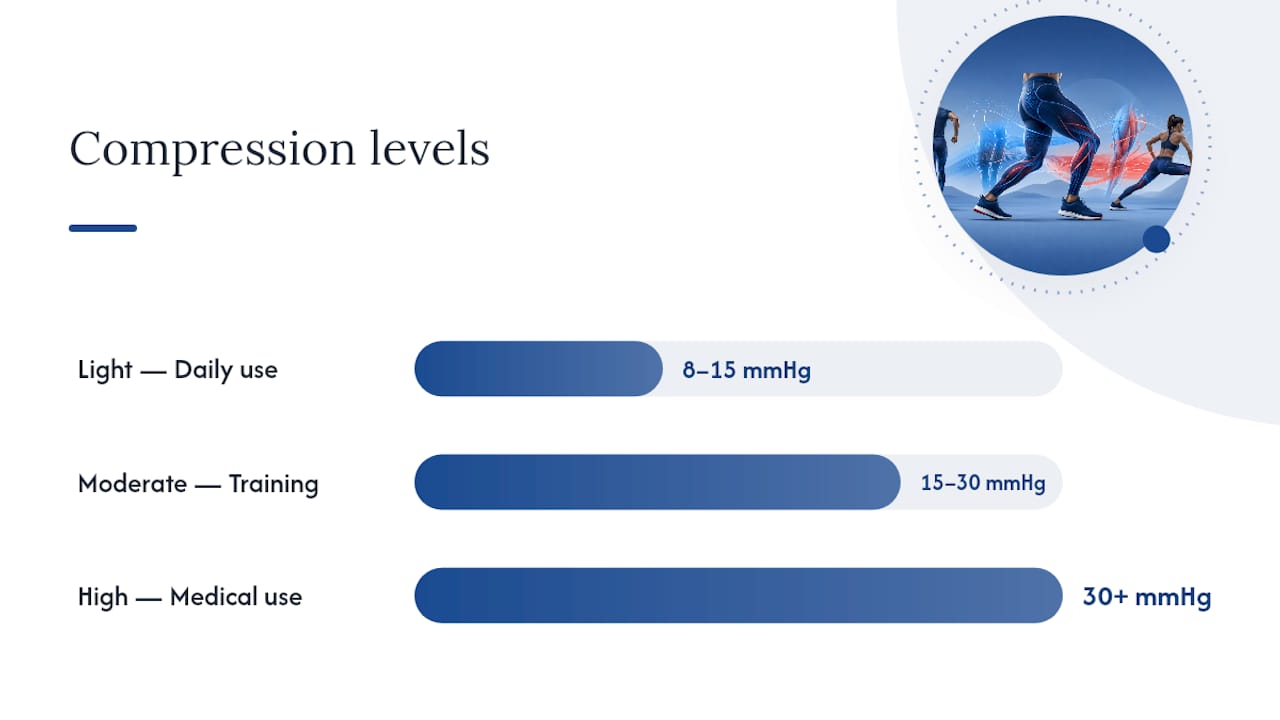
mmHg ranges and practical guidance:
- Light (8–15 mmHg): Everyday wear, mild fatigue, light activity. Good starting point for first-time wearers.
- Moderate (15–30 mmHg): The range most sport-focused products target. Best balance for training support, recovery, and travel. Supported by the crossover trial evidence above.
- High (30+ mmHg): Medical-grade territory. Requires clinician guidance; not appropriate for general athletic use without a prescription or professional recommendation.
Fit checklist before you buy:
- Measure your ankle circumference, calf at the widest point, and hip/waist
- Cross-reference the brand’s size chart, not just your usual legging size
- The garment should feel snug throughout but never painful
- Waistband should sit flat with no rolling or digging
- Toes should not tingle or go numb when you stand
Material and construction features worth prioritizing:
- Moisture-wicking, breathable fabric (polyester/spandex blends with mesh panels)
- Flatlock or reinforced seams to prevent chafing during long sessions
- A gusset for full range of motion
- Fabric weight appropriate for your climate and activity
Care to preserve compression: Machine wash cold, inside out, on a gentle cycle. Skip the fabric softener, which degrades elastic fibers. Air dry rather than tumble dry. Replace the garment when the fabric no longer bounces back quickly after stretching.
| Compression level | Best use case | Who it suits |
|---|---|---|
| Light (8–15 mmHg) | Daily wear, mild activity | New users, light training |
| Moderate (15–30 mmHg) | Training, recovery, travel | Most athletes |
| High (30+ mmHg) | Medical conditions | Clinician-directed only |
Pro Tip: Try a moderate-pressure pair during a lighter training week before committing to wearing them every session. Your comfort response at rest and during movement tells you more than any spec sheet.
For broader athletic gear selection principles, fabric quality and construction consistency matter as much as the compression rating itself.
How long to wear them, and who should be cautious
For most healthy athletes, wearing compression leggings during a workout session or for several hours post-exercise is safe and well-tolerated. All-day wear is generally fine for light to moderate compression, provided the fit is correct and you’re not experiencing any warning signs.
Remove them immediately if you notice:
- Numbness or tingling in the feet or legs
- Skin color changes (redness, mottling, or pallor)
- Increasing pain or pressure rather than relief
- Swelling that worsens rather than improves
Conditions that require clinician clearance before use:
- Advanced peripheral arterial disease (PAD)
- Severe peripheral neuropathy
- Active skin infections or open wounds on the legs
- Certain types of deep vein thrombosis (DVT) — compression can help or harm depending on the clinical picture
- Pregnancy with complications (standard pregnancy compression use may be fine; complications change the calculus)
The waistband deserves specific attention. An overly tight waistband can restrict blood flow at the hip and negate the circulatory benefits the rest of the garment provides. If the waistband leaves a deep indentation or feels restrictive when you sit, the fit is wrong regardless of the compression level.
Simple ways to get more from your compression leggings
Timing and pairing matter more than most people realize.
When to wear them:
- During moderate to high-impact sessions for vibration reduction and proprioceptive support
- Immediately post-workout for the recovery window (the 8–72 hour period where soreness and swelling peak)
- During long travel or standing shifts to manage swelling
Pair compression with these recovery practices for best effect:
- Light movement (walking, easy cycling) rather than complete rest keeps circulation active while the garment works
- Adequate hydration supports lymphatic clearance
- Sleep is where the real recovery happens; compression is a complement, not a substitute
- Foam rolling or massage before putting on compression leggings can improve initial circulation
Care habits that preserve compression function:
- Wash after every use; sweat degrades elastic fibers faster than washing does
- Never use fabric softener or dryer heat
- Inspect the fabric periodically; if it no longer springs back quickly after stretching, the compression has degraded and the garment needs replacing
Pro Tip: Alternate compression levels across training cycles. Use moderate compression during hard training blocks for recovery support, then drop to light compression during deload weeks. This prevents your body from adapting to the sensation and keeps the proprioceptive feedback meaningful.
Compression is an aid. Sleep, nutrition, and progressive training deliver far larger performance and recovery effects than any garment. Get those right first.
What to expect from Teamjhall compression leggings
Teamjhall designs compression leggings for athletes and active individuals who want construction that matches the evidence, not just the marketing. Here’s what the product is built around:
- Graduated pressure mapping: Tighter at the ankle, lighter toward the thigh, consistent with the mechanism that drives venous return and swelling reduction
- Breathable performance fabric: Moisture-wicking polyester/spandex construction that manages heat during training and stays comfortable during recovery wear
- Reinforced seams: Flatlock construction reduces chafing during high-rep, high-impact sessions
- Inclusive sizing: Teamjhall offers a range of sizes with a published size guide to help you measure correctly before ordering
Sizing guidance at a glance:
| Measurement | Where to measure | Why it matters |
|---|---|---|
| Ankle circumference | Narrowest point above the ankle bone | Sets the base pressure |
| Calf circumference | Widest point of the calf | Determines fit through the lower leg |
| Hip/waist | Fullest part of the hip | Prevents waistband restriction |
Teamjhall’s compression shorts are also available for athletes who want lower-leg freedom with upper-leg support. The brand’s return and exchange policy means a fit that doesn’t feel right can be corrected without losing your investment. For a full picture of how premium athletic fabric construction affects performance and recovery, the brand’s editorial covers the specifics.
When I actually recommend compression leggings
The research is clear enough that I don’t hedge much on this: compression leggings are worth using for recovery and travel, and worth skipping if you’re expecting them to make you faster on race day.
My practical recommendation is this. If you’re training hard three or more days a week, particularly with leg-heavy work, wearing compression leggings in the hours after your session is one of the lowest-effort recovery tools available. The soreness reduction is real, the swelling management is real, and the psychological effect of feeling supported is real. None of those are large effects, but they’re consistent.
Where I see athletes go wrong is treating compression as a substitute for the basics. A pair of leggings worn over poor sleep and inadequate protein intake does almost nothing. The same pair worn as part of a solid recovery routine, with good hydration and structured rest, adds a meaningful layer.
I also think the pressure-level conversation is underrated. Most people buy whatever is on the shelf without checking the mmHg rating. Moderate pressure, roughly 15–30 mmHg, is where the evidence is strongest for most athletic use cases. Going higher without a clinical reason is not more effective; it’s often less effective and less comfortable.
One more thing: replace your compression leggings when the fabric stops bouncing back. Worn-out elastic provides neither compression nor graduated pressure. It’s just a tight legging at that point.
Teamjhall compression leggings: built for athletes who train seriously
Teamjhall compression leggings are designed for athletes who want their gear to match their effort. The construction prioritizes graduated pressure, breathable performance fabric, and reinforced seams built for real training loads, not just the look of compression.

If you’ve been wearing regular leggings and wondering why your legs still feel heavy after hard sessions, the difference often comes down to whether your garment actually provides measured, graduated compression. Teamjhall’s leggings are built to that standard, with inclusive sizing and a fit guide so you get the pressure level right from the first wear. Browse the full collection and check the size guide at the Teamjhall store, or go straight to the compression shorts if you want targeted lower-body support without full-length coverage.
Sources
The studies and expert sources below back the claims in this article. Each is worth reading if you want more depth on a specific area.
- Compression tights and tops: do they actually benefit you during (or after) exercise?
- Effects of Compression Pants with Different Pressure Levels on Anaerobic Performance and Post-Exercise Physiological Recovery: Randomized Crossover Trial
- PMC article (compression garments and venous flow/swelling)
- Compression Vs. Regular Leggings: Which Is Better?
- What Do Compression Leggings Do? We Asked Experts