

The Role of Agility in Sport Performance: 2026 Guide
Agility is defined as the ability to rapidly change whole-body movement direction in response to unpredictable stimuli, and it is one of the most decisive factors in sport performance. Athletes who train agility gain measurable advantages in reaction time, balance, coordination, and cognitive control under pressure. The role of agility in sport performance extends beyond footwork. It integrates perceptual skill, neuromuscular efficiency, and real-time decision-making. Research confirms that perception-action coupling is the defining feature separating elite agility from basic change-of-direction speed. Coaches who understand this distinction build athletes who perform when the game gets unpredictable.
How does agility specifically influence sport performance?
Agility drives performance through three interconnected systems: neuromuscular output, perceptual processing, and executive function. Each system feeds the others, and training one without the others leaves athletes underprepared for real competition.
Neuromuscular foundations
Reactive agility depends on eccentric hamstring strength and higher-order cognitive control more than basic processing speed. That finding reframes how coaches should think about agility. It is not a speed drill. It is a strength and cognition drill. Eccentric force production and rapid stretch-shortening cycles allow athletes to decelerate, redirect, and accelerate without losing body control. A soccer midfielder who cannot absorb force through the hamstrings will always be a step slow on cuts.
Perceptual and cognitive control
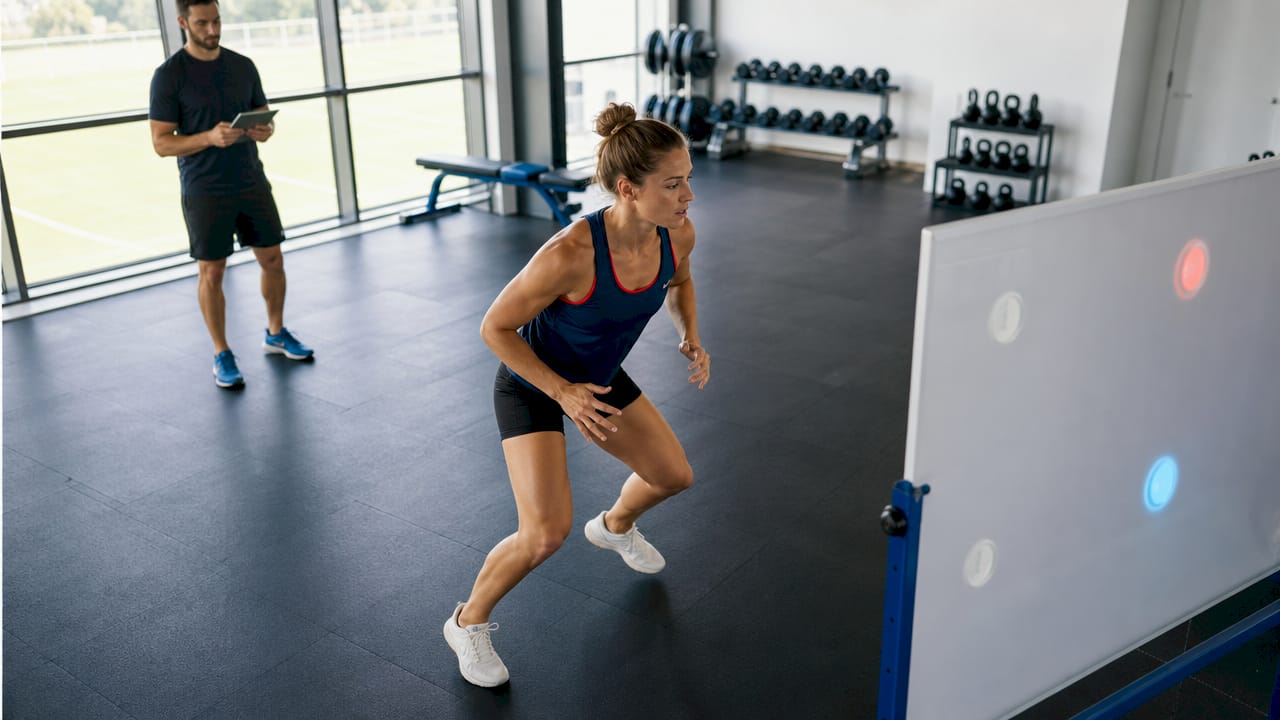
Agility training sharpens the brain’s ability to filter irrelevant information and act on the right cue. Reactive agility training for 3 weeks significantly enhances executive function, reducing Stroop task incongruent response times. That means athletes make faster, cleaner decisions under cognitive pressure. In basketball or football, where defenders and play patterns change every second, that mental speed is as valuable as physical speed.
- Reaction time: Agility training cuts the gap between stimulus and movement response.
- Balance and coordination: Rapid direction changes require synchronized joint control across the entire kinetic chain.
- Cognitive interference control: Athletes trained with reactive drills show stronger ability to suppress distracting stimuli.
- Neural efficiency: Agility training reduces neural resource consumption during cognitive tasks, meaning athletes think faster with less mental effort.
Pro Tip: Add a cognitive load to your agility drills. Call out a color, number, or direction cue mid-drill. This forces the brain to process and move simultaneously, which is exactly what happens in a game.
What are the most effective agility training methods?
Training method selection determines whether athletes develop real-game agility or just better footwork patterns. The research is clear: not all agility training transfers equally to competition.
SAQ training vs. reactive agility drills
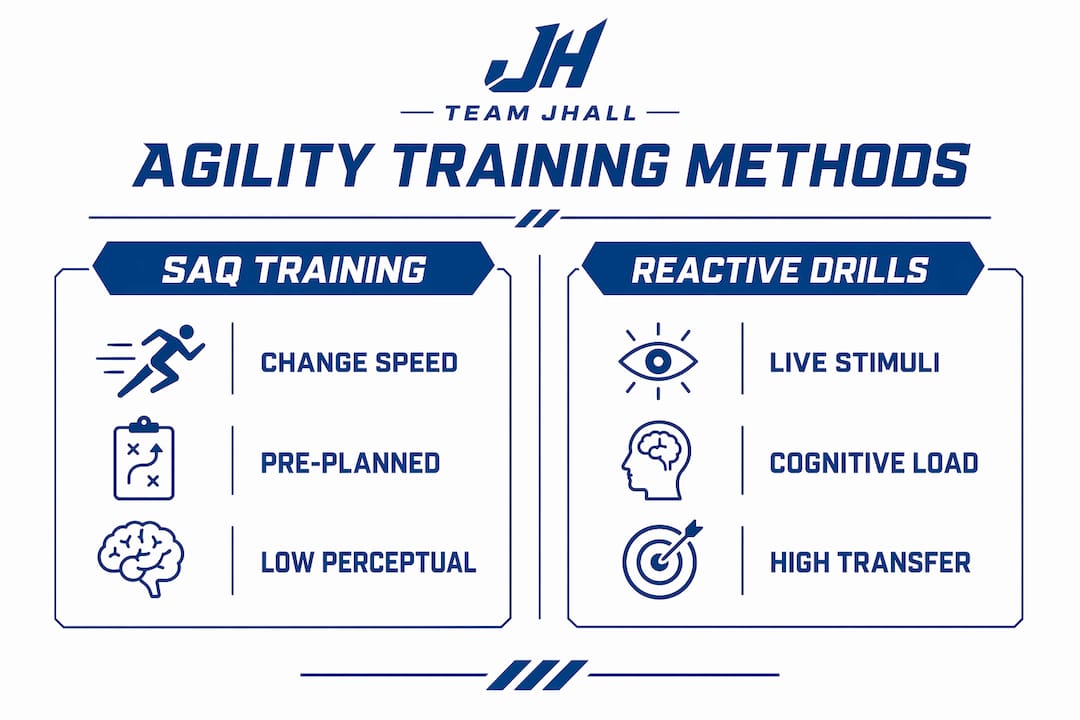
Speed-agility-quickness (SAQ) training is the most widely used protocol for developing change-of-direction speed. SAQ training for 6–12 weeks improves pre-planned change-of-direction speed and linear sprint performance significantly in adolescent and young adult athletes. SAQ includes short sprints, multidirectional drills, ladder footwork, and cutting tasks. The limitation is ecological validity. Traditional pre-planned drills lack real-time perceptual-cognitive elements required in games, which limits their effectiveness when used alone.
Reactive agility training closes that gap. Athletes respond to a live stimulus, such as a partner’s movement or a randomized light signal, rather than a memorized pattern. This forces perception-action coupling on every repetition.
Computerized agility training vs. ladder drills
| Method | Perceptual demand | Transfer to sport | Equipment needed |
|---|---|---|---|
| Ladder drills | Low (pre-planned) | Moderate | Agility ladder |
| Reactive partner drills | High (human cue) | High | Open space, partner |
| Computerized agility training (CAT) | High (randomized stimuli) | High | CAT platform |
| Cone drills (pre-planned) | Low | Moderate | Cones |
Computerized agility training with randomized visual stimuli yields greater basketball-specific performance gains than traditional rope ladder drills. CAT platforms continuously demand perceptual-motor integration and rapid reactive decision-making. That is the closest simulation to actual game conditions available in a training setting.
Recommended training parameters
- Frequency: Train agility more than 3 times weekly for maximum reactive gains.
- Session length: Keep sessions at 20–25 minutes of focused agility work.
- Program duration: Run programs for 7–8 weeks to see meaningful adaptation.
- Periodization: Use visual stimulus drills in the off-season and shift to human-based reactive drills in-season.
- Load monitoring: Pair GPS tracking with RPE scores to manage training load.
Programs using perception-action coupling showed larger effects than pre-planned drills alone. That is the single most important training design principle coaches can apply right now.
Pro Tip: Do not run agility sessions at the end of practice when athletes are fatigued. Agility requires full cognitive and neuromuscular engagement. Schedule it early, when the brain and body are fresh.
How does agility training improve game performance and reduce injury risk?
Agility training produces two categories of competitive benefit: performance gains on the field and structural protection against injury. Both outcomes compound over a career.
Game-day performance gains
Reactive agility directly improves real-game decision-making. Athletes trained with perception-action coupling adapt their movement patterns faster to changing defensive or offensive situations. A point guard who has trained reactive agility reads a defender’s hip rotation and changes direction before the defender commits. That is not instinct. That is trained neural efficiency.
“Superior neuromuscular and cognitive adaptations come from drills engaging executive inhibitory control, decision speed, and rapid movement modification.” — Frontiers in Sports and Active Living
The cognitive benefits extend beyond the drill itself. Athletes show lower activation in the prefrontal and premotor cortex during executive function tests after agility training. The brain works more efficiently. That efficiency shows up as faster tactical responses and better focus in high-pressure moments.
Injury prevention through better body control
- Deceleration control: Agility training teaches athletes to absorb force safely during rapid stops, protecting the knee and ankle.
- Body stabilization: Improved proprioception from reactive drills reduces the risk of ankle sprains and knee strains.
- Unexpected movement management: Athletes trained with randomized stimuli handle surprise direction changes without losing structural integrity.
Agility training improves injury prevention by enhancing knee deceleration control and body stabilization, reducing risks like ankle sprains and knee strains. That is not a minor side benefit. Injury prevention is career preservation. Athletes who stay healthy compound their development year over year.
The benefits of functional fitness for sports performance align directly with agility training outcomes. Functional strength and reactive movement work together to build athletes who are both durable and explosive.
What agility drills should athletes and coaches use?
Drill design determines training quality. The best agility drills force athletes to read, decide, and move in one continuous action.
- Partner mirror drill: Two athletes face each other. One leads, one mirrors. The follower cannot predict the movement. This builds reactive agility and perception-action coupling simultaneously.
- Light board reactive drill: Athletes respond to randomized light signals on a board or CAT platform. This removes pattern recognition and forces true reaction.
- Ball-drop reaction sprint: A coach drops a tennis ball from shoulder height. The athlete sprints to catch it before the second bounce. Simple, effective, and highly reactive.
- 5-10-5 shuttle with verbal cue: The athlete runs the standard 5-10-5 shuttle but changes direction only when the coach calls a cue. This adds cognitive interference to a physical drill.
- Cone weave with decision gate: Set up a cone weave with two exit gates. The coach signals which gate to exit through mid-drill. Athletes must process the cue while moving at speed.
Training approaches should progress from visual stimuli during the off-season to human-driven reactive drills during in-season for sport-specific anticipation skills. That progression builds the perceptual foundation first, then tests it against realistic competition demands.
Use GPS tracking alongside RPE to monitor training load and prevent overtraining. Agility sessions are neurologically demanding. Athletes can feel physically fresh but be cognitively depleted. Load monitoring catches that before it becomes an injury or performance problem.
Pro Tip: Film your athletes during reactive agility drills. Slow-motion review reveals whether they are reading cues early or reacting late. That visual feedback accelerates technical correction faster than verbal coaching alone.
Key takeaways
Agility is the integration of reactive movement, eccentric strength, and cognitive control, and training all three together produces the greatest competitive gains.
| Point | Details |
|---|---|
| Agility is cognitive, not just physical | Reactive agility depends on executive function and eccentric strength, not speed alone. |
| Reactive drills outperform pre-planned ones | Perception-action coupling drills transfer better to real game conditions than ladder patterns. |
| CAT platforms accelerate sport-specific gains | Computerized agility training with randomized stimuli outperforms traditional rope ladder drills. |
| Agility training protects athletes from injury | Improved deceleration control and body stabilization reduce ankle sprains and knee strains. |
| Monitor load to sustain progress | GPS and RPE tracking prevent overtraining during neurologically demanding agility sessions. |
Why most agility training misses the point
Most coaches I have worked with run agility drills the same way every week: cones in a fixed pattern, athletes running the same route, same timing. It looks productive. The stopwatch improves. But when game day arrives, those athletes still hesitate on cuts and react a half-second late to defenders.
The gap between research and practice on agility is wider than almost any other area of athletic development. The science has been clear for years. Perception-action coupling is the mechanism that makes agility transfer to competition. Pre-planned drills build fitness and footwork. They do not build the reactive brain.
The athletes I have seen make the biggest jumps in game performance are the ones whose coaches introduced human-based reactive drills and cognitive load into agility work. Not more volume. Not harder patterns. Just drills that forced the brain to read and respond in real time.
My advice to coaches is to audit your current agility program. Count how many of your drills require the athlete to read a live cue versus follow a memorized route. If the answer is fewer than half, your athletes are training a skill that does not fully exist in your sport. Customize the work to match the perceptual demands of your specific game. That is where the competitive edge lives.
— Jason
Gear built for athletes who train this hard
Athletes who commit to serious agility training need apparel that moves with them, not against them. Restrictive clothing breaks concentration and limits range of motion during reactive drills.

Teamjhall designs premium athletic apparel for competitors who train with purpose. The TJH Men’s Performance Tee and TJH Women SportTek Shorts are built for the demands of high-intensity agility work, offering full mobility and durability through every cut, sprint, and change of direction. Shop the full collection at the Teamjhall store and gear up with apparel that matches your commitment to performance.
FAQ
What is the role of agility in sport performance?
Agility is the ability to rapidly change whole-body movement in response to unpredictable stimuli. It improves reaction time, decision-making speed, balance, and injury resistance, making it a core component of competitive athletic performance.
How is agility different from speed or quickness?
Speed measures straight-line velocity, while agility integrates perception, decision-making, and directional change. Quickness refers to initial movement response time, but agility combines all three into one reactive, coordinated action.
How often should athletes train agility for best results?
Training more than 3 times weekly in sessions of 20–25 minutes over 7–8 weeks produces the greatest reactive agility gains, particularly when drills include perception-action coupling rather than pre-planned patterns.
Does agility training reduce injury risk?
Agility training improves knee deceleration control and body stabilization, which directly reduces the risk of ankle sprains and knee strains. Athletes who train reactive movement handle unexpected forces more safely than those who only train linear strength.
What is the best agility training method for team sport athletes?
Reactive agility drills using live human cues or computerized agility platforms with randomized stimuli produce the strongest transfer to team sport performance. Pre-planned drills like ladder work build a foundation but should not be the primary method.