

Examples of Faith-Driven Athletes: Inspiring Profiles
Some of the most compelling examples of faith-driven athletes in American sports right now include Aaron Judge (MLB), Allyson Felix (track), Clayton Kershaw (MLB), Trevor Lawrence (NFL), Tua Tagovailoa (NFL), Elana Meyers Taylor (bobsled), Ronnie Baker (sprinting), and Mark McKenzie (soccer). Each one has gone on record, not just in passing, but in interviews, podcasts, and social posts, crediting faith as the thing that holds their identity together when results go sideways.
Here is a quick-scan shortlist before the full profiles:
- Aaron Judge (MLB/Yankees): cites 2 Corinthians 5:7 as his anchor; frames faith as his identity foundation, not baseball.
- Clayton Kershaw (MLB/Dodgers): runs baseball camps in Zambia through his Kershaw’s Challenge charity; faith shapes his off-field platform as much as his pitching.
- Allyson Felix (track): six-time Olympic gold medalist who publicly credits her Christian faith for perspective through injury and motherhood.
- Trevor Lawrence (NFL/Jaguars): known for post-game prayers and consistent public witness; faith is a recurring theme in his media appearances.
- Tua Tagovailoa (NFL/Dolphins): points to faith as the reason he can stay grounded through the concussion controversies that threatened his career.
- Elana Meyers Taylor (bobsled): connected to Athletes in Action; faith carried her through Olympic setbacks and parenting children with disabilities.
- Ronnie Baker (sprinting): read the Bible cover to cover after a difficult Tokyo Olympics; credits the joy of the Lord for his competitive renewal.
- Mark McKenzie (soccer/USMNT): organized post-match prayer circles at the World Cup; became a faith leader for the entire squad.
Pro Tip: The Faith Driven Athlete podcast is the fastest way to hear these athletes in their own words. Search by name to find episodes featuring many of the athletes below.
Table of Contents
- Faith-driven athletes across every major sport
- Why faith often matters to elite athletes
- How athletes practice faith publicly and privately
- Where to hear these athletes in their own words
- Key Takeaways
- Faith, sport, and what actually holds up under pressure
- Wear your values the same way these athletes do
- Sources and further reading
Faith-driven athletes across every major sport
Baseball
Aaron Judge plays every game under the weight of enormous expectations, and he says faith is precisely what keeps that weight from crushing him. He publicly references 2 Corinthians 5:7 (“we walk by faith, not by sight”) as his operating principle, and Sports Spectrum has documented how that verse shapes his approach to slumps and pressure at-bats. For Judge, the scoreboard is not the final word on who he is.
Clayton Kershaw is one of the most decorated pitchers of his generation, and his faith has been visible since his early Dodgers years. He and his wife Ellen founded Kershaw’s Challenge, which has funded orphan care in Zambia, the Dominican Republic, and Los Angeles. Kershaw has spoken openly in interviews about using his platform as a pitcher to do something that outlasts any ERA title.
Cade Smith, Cleveland Guardians closer, carries Scripture on his glove and has spoken about why he can stay calm in ninth-inning situations that would rattle most pitchers. As Sports Spectrum reported, Smith says he knows “who I am in Jesus” and that clarity separates his performance from his identity. That separation is what keeps him steady.
Football
Trevor Lawrence has been public about his faith since his Clemson days, and it has not faded with the NFL spotlight. He prays on the field after games, speaks about faith in press conferences without hedging, and has described his relationship with God as the reason he does not define himself by wins and losses.
Tua Tagovailoa faced a genuine crisis when repeated concussions put his career in serious doubt. His response, in multiple interviews, was to lean on faith rather than panic. He has credited prayer and his Christian community for the mental stability that allowed him to return to the field.
TreVeyon Henderson of the NFL takes his public witness further than most. His social media bios declare “Jesus Saved My Life,” and he used the NFL’s My Cause My Cleats platform to promote Global Christian Relief. As the Christian Post documented, Henderson states plainly: “Apart from Jesus I can’t do anything.” That is not a postgame quote; it is his operating philosophy.
“The joy of the Lord is my strength. That’s what keeps me going out there and competing.” — Ronnie Baker, Sports Spectrum
Mason Plumlee (NBA) has been one of the more thoughtful voices on faith in professional basketball, discussing how his Christian faith shapes the way he treats teammates and approaches the grind of an 82-game season. He has participated in chapel services throughout his career and spoken about faith as a source of consistency when results fluctuate.
Monty Williams, longtime NBA coach, became one of the most widely shared faith voices in sports after his wife Ingrid was killed by a drunk driver in 2016. His press conference response, which went viral, was a direct expression of Christian forgiveness and grace. Williams has since spoken extensively about how faith rebuilt him as a leader and a father.
Soccer
Mark McKenzie stepped into a leadership role at the 2026 World Cup that went beyond his position as a defender. He organized post-match prayer circles that drew teammates regardless of their own religious backgrounds, and he led Bible studies that McKenzie described as the team’s unifying core. Sports Spectrum covered how his faith leadership created cohesion in a squad under enormous pressure.
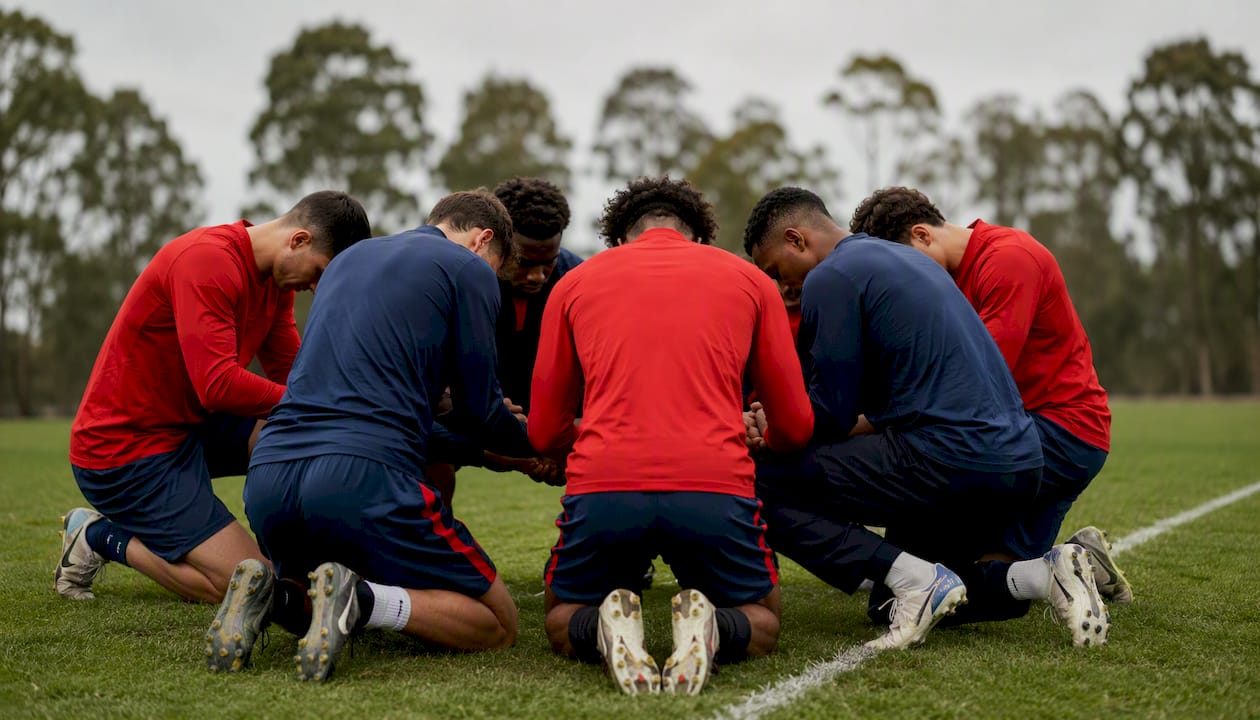
Matt Freese, goalkeeper for the USMNT, has publicly discussed going through the Bible in a Year plan and how shared chapel time built trust among teammates during the World Cup. He credits consistent Mass attendance and group Bible study for keeping him grounded when the stakes were highest. Freese has said he is grateful that “God’s given me so many opportunities.”
Jadin O’Brien incorporates Marian devotion and the Rosary into her pre-competition preparation, a practice she has described as centering her before high-pressure moments. Her Catholic faith is not background noise; it is a structured part of her athletic routine.
Track and field
Allyson Felix won six Olympic gold medals and is one of the most decorated American track athletes ever. She has spoken about her Christian faith as the source of perspective that allowed her to keep competing through a difficult pregnancy, a near-fatal delivery, and the advocacy work she took on afterward for maternal health. Faith gave her a reason to compete that was bigger than the medals.
Ronnie Baker hit a wall after the 2020 Tokyo Olympics, dealing with difficult finishes and what he described as depression. His recovery was not primarily physical. Baker read the Bible cover to cover, and that discipline reoriented his relationship with competition. He now describes the joy of competing as inseparable from what he calls the “joy of the Lord.”

Bobsled and sliding sports
Elana Meyers Taylor is one of the most decorated American bobsledders in history, and her faith story is one of the most layered in elite sport. She connected with Athletes in Action early in her career and has described Bible study and faith community as the support structure that carried her through Olympic setbacks and the experience of raising children with disabilities. Her path to Olympic gold, as the National Catholic Register documented, runs directly through her Christian faith.
Other sports and backgrounds
Not every faith-driven athlete in elite sport is Christian. Muslim athletes like Kareem Abdul-Jabbar and Hakeem Olajuwon built careers shaped by Islamic practice, including fasting during Ramadan while competing at the highest level. Olajuwon won an NBA championship in 1994 while observing Ramadan fasting, a fact that drew widespread attention to how Islamic discipline can coexist with elite performance. Jewish athletes have similarly navigated the tension between Sabbath observance and competition schedules. Sandy Koufax famously refused to pitch in Game 1 of the 1965 World Series because it fell on Yom Kippur, a decision that remains one of the most cited examples of faith over career in American sports history.
Why faith often matters to elite athletes
The short answer: faith gives athletes an identity that does not depend on the scoreboard. That stability turns out to be a genuine performance asset, not just a spiritual one.
Three patterns show up repeatedly across the athletes profiled here:
- Identity decoupling. Athletes who ground their self-worth in faith rather than results report steadier performance under pressure. Cade Smith’s ability to close games without visible anxiety is a documented example. The athletic identity research on this point is consistent: athletes who over-identify with their sport role are more vulnerable to anxiety and burnout when results dip.
- Disciplined spiritual routines. Prayer, Scripture reading, Mass, and the Rosary function as structured mental-reset practices. Montana Fouts credits prayer with reigniting her passion for softball after it had dimmed. Ronnie Baker’s cover-to-cover Bible reading after Tokyo was not casual; it was a deliberate mental-health intervention.
- Team cohesion through shared faith. Mark McKenzie’s prayer circles at the World Cup drew players who were not personally religious, because the ritual created a shared moment of purpose. Matt Freese’s Bible-study groups built trust that translated into on-field communication. Community in athletics research supports this: shared values, even when not universally held, generate cohesion.
Faith also functions as a platform reframe. TreVeyon Henderson’s My Cause My Cleats work and Clayton Kershaw’s Zambia orphan care both reflect the same logic: visibility in sport is an opportunity to serve, not an end in itself. That reframe tends to extend careers, because athletes with a purpose beyond the game have a reason to keep going when the game gets hard.
A note from Jason at Teamjhall: these stories matter to us because they reflect the same values the brand is built on. Confidence, faith, loyalty, and consistency are not just marketing words here. They are the reason we cover athletes like these.
How athletes practice faith publicly and privately
The practices vary by tradition, but the patterns are recognizable across sports:
- Scripture on gear. Christian Gonzalez writes Psalm 16:8 on his eye black before every game, turning his equipment into a moment-to-moment spiritual cue. Gonzalez has credited team chaplaincy for sustaining that practice through a long season.
- Social media as witness. Emeka Egbuka’s Instagram handle is literally “Christ Follower.” His Fox News interview explains how that choice reflects a deliberate decision to let faith lead his public identity, not his stats.
- Rosary and Marian devotion. Jadin O’Brien and Montana Fouts represent a Catholic devotional tradition that uses structured prayer as a pre-competition anchor. The Deseret News profile of Montana Fouts documents how that practice reignited her love for softball.
Pro Tip: If you want to follow an athlete’s faith journey authentically, look for consistency over time rather than one viral moment. An athlete who prays publicly once after a big win is different from one who maintains the same practice through losing streaks.
Challenges are real, too. Faith-driven athletes sometimes face criticism for expressing belief in public settings, particularly when their statements touch on social issues. Tim Tebow’s career became a lightning rod for debates about religion in sport that had little to do with his actual play. Some athletes navigate this by keeping their faith visible but their commentary measured; others, like Henderson, lean into the public witness fully and accept the scrutiny that comes with it.
Where to hear these athletes in their own words
- Faith Driven Athlete podcast — the single best primary source for extended athlete interviews. Episodes feature many of the athletes in this article speaking at length about how faith shapes their careers. Search by athlete name at faithdrivenathelete.com.
- Sports Spectrum — covers faith and sport with consistent depth. Their Aaron Judge profile, Ronnie Baker feature, Mark McKenzie World Cup piece, and Cade Smith interview are all worth reading in full.
- National Catholic Register — the Elana Meyers Taylor profile is one of the most detailed accounts of how faith sustained an Olympic career through genuine hardship.
- Christian Post — the TreVeyon Henderson interview is direct and unfiltered; Henderson speaks about faith, charity, and purpose without hedging.
- Deseret News — the Montana Fouts feature is a strong example of Catholic devotional practice in elite sport, useful for readers interested in traditions beyond evangelical Christianity.
- Fox News Sports — the Emeka Egbuka interview explains the social-media-as-witness approach in the athlete’s own words.
Key Takeaways
Faith-driven athletes consistently anchor their identity in belief rather than outcomes, and that separation is what makes them resilient when careers get hard.
| Point | Details |
|---|---|
| Identity over outcomes | Athletes like Cade Smith and Aaron Judge credit faith for separating self-worth from performance results. |
| Spiritual routines as mental tools | Prayer, Scripture reading, and Mass function as structured mental-reset practices, not just personal habits. |
| Shared faith builds team trust | Mark McKenzie’s prayer circles and Matt Freese’s Bible studies created cohesion that extended beyond religious belief. |
| Platform as service | TreVeyon Henderson and Clayton Kershaw both treat athletic visibility as an opportunity to serve communities, not just compete. |
| Teamjhall connection | Teamjhall is built on the same values these athletes model: confidence, faith, loyalty, and consistency in every area of life. |
Faith, sport, and what actually holds up under pressure
The conventional take on faith in sport is that it is a comfort mechanism, something athletes reach for when things go wrong. That framing undersells what is actually happening with the athletes in this article.
What Ronnie Baker, Elana Meyers Taylor, and Cade Smith describe is not comfort. It is a structural reorientation of what competition means. Baker did not pray his way through a bad Olympics; he read the entire Bible and came out the other side with a different relationship to winning and losing. That is a cognitive shift, not a coping strategy. The athletic mindset research on identity decoupling supports exactly this: athletes who separate their self-concept from their sport role perform more consistently under pressure, because failure does not threaten who they are.
The criticism that faith-driven athletes are naive or using religion as a crutch misses the discipline involved. Jadin O’Brien’s Rosary practice, Matt Freese’s Bible-in-a-Year plan, and Christian Gonzalez writing Psalm 16:8 on his eye black before every game are not passive. They are deliberate, repeated practices that require the same consistency as a training regimen. The athletes who sustain public faith through losing streaks, injuries, and career uncertainty are not the ones who found religion after a big win. They are the ones who built it into the daily structure of how they prepare.
What I find most interesting is the team-cohesion angle. McKenzie’s prayer circles at the World Cup drew players who were not personally religious. That tells you something important: the practice was creating a shared moment of stillness and purpose that had value independent of the theology. Faith, in that context, was functioning as a community-building tool that any team would want, whether or not every member shares the belief.
Wear your values the same way these athletes do
The athletes in this article do not keep their values private. They write them on their gear, put them in their social bios, and build charities around them. That kind of visible commitment to what you believe is exactly what Teamjhall is built for.

Teamjhall designs athletic and lifestyle apparel for competitors, creators, and everyday athletes who want their gear to say something real. The UA Ladies Athletic Tee and the full range at teamjhall.store are made for people who train hard and stand for something. If you want apparel that reflects confidence, faith, loyalty, and consistency, not just a logo, browse the full collection and find the piece that fits how you compete and who you are.
Sources and further reading
| Source | Description |
|---|---|
| Yankees’ Aaron Judge: faith foundation — Sports Spectrum | Primary interview documenting Judge’s use of 2 Corinthians 5:7 as his identity anchor. |
| Elana Meyers Taylor’s path to Olympic gold — National Catholic Register | Detailed profile of how faith and Athletes in Action sustained her Olympic career. |
| Ronnie Baker: joy of the Lord is my strength — Sports Spectrum | Feature on Baker’s post-Tokyo faith renewal and competitive reorientation. |
| Mark McKenzie: faith leader for USMNT — Sports Spectrum | Documents McKenzie’s prayer circles and Bible studies at the 2026 World Cup. |
| Cade Smith: ‘who I am in Jesus’ — Sports Spectrum | Interview on identity decoupling and Scripture on his glove. |
| TreVeyon Henderson: ‘Apart from Jesus I can’t do anything’ — Christian Post | Henderson on faith, dependence on Jesus, and charitable activism. |
| Christian Gonzalez: ‘eyes on the Lord’ — Sports Spectrum | Documents Psalm 16:8 eye black practice and team chaplaincy. |
| Montana Fouts: religion guides her career — Deseret News | Catholic devotional practice (Rosary, Mass) as athletic preparation. |
| Emeka Egbuka: faith drives career — Fox News Sports | Explains social-media-as-witness approach and identity separation. |