

Role of Discipline in Fitness: Build Consistency This Month
Discipline is the engine of fitness progress, not motivation, and you can build it with specific systems this week. Motivation gets you to the gym once; discipline gets you there on a Tuesday when you’re tired, behind on work, and the couch is right there. The difference between someone who transforms their body over six months and someone who quits by February usually isn’t talent or time. It’s whether they built a system that runs without emotional fuel.
Start here, today:
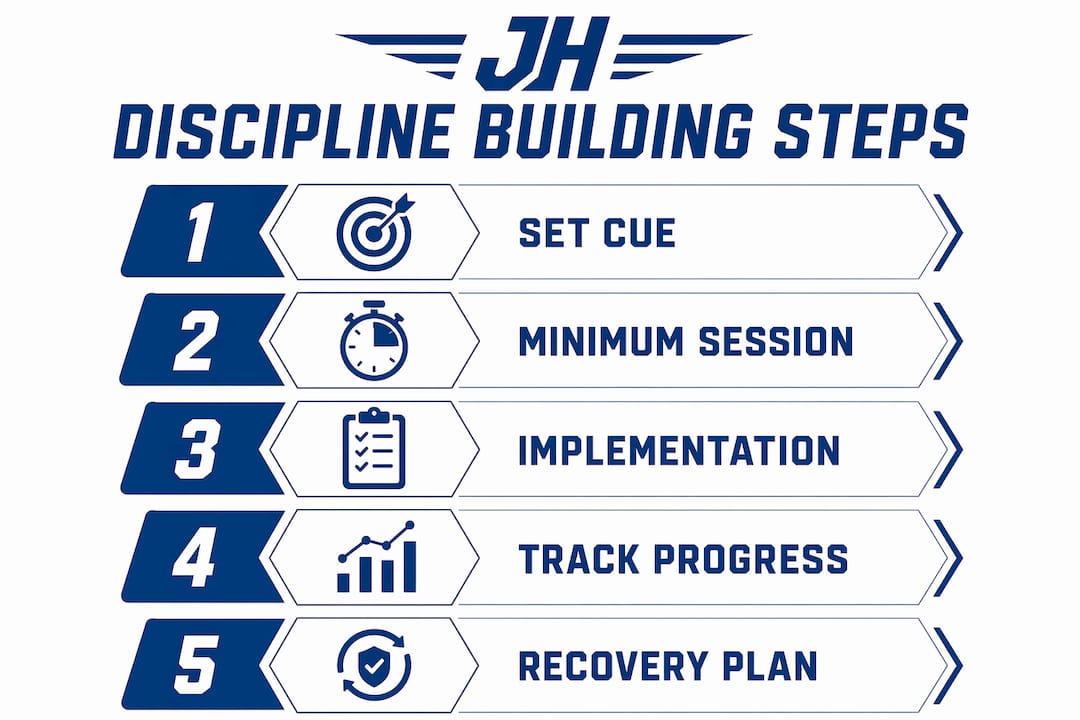
- Lock a fixed cue. Pick one time and place for your workout and treat it like a meeting you cannot cancel.
- Define your minimum viable session. A 10-minute warm-up counts. Showing up is the rule, not the performance.
- Log every session. A simple check mark in a notebook shifts your identity from “someone trying to work out” to “someone who works out.”
- Set one micro-goal for the week. Not a transformation goal. One session, protected.
Discipline is not about pushing harder. It’s about removing the decision entirely. When the cue fires, you move. That’s the whole system.
Apply these four steps consistently for two weeks and you’ll notice something: the negotiation in your head gets quieter.
Table of Contents
- Why does discipline matter more than motivation for fitness?
- Discipline vs. motivation: what’s the actual difference?
- What concrete tactics build discipline in your workout routine this week?
- A 4-week plan to build your discipline from scratch
- What gets in the way of discipline, and how do you recover fast?
- How long does it actually take to make exercise automatic?
- Key Takeaways
- Why Teamjhall takes discipline seriously
- Useful sources and further reading
Why does discipline matter more than motivation for fitness?
The research on this is blunt. A 2025 editorial published by the British Columbia Medical Journal reported an average of 66 days to solidify a new behavior, with the key finding being that consistency beats intensity for long-term health results. You don’t need longer workouts. You need more of them, reliably.
Adherence data makes the stakes concrete. One synthesis tracking adherence decay found that women’s adherence dropped significantly over the first three months. Men’s adherence declined more slowly in some cohorts, but the pattern held: motivation fades predictably, and when it does, only a system keeps you moving.
The neurological side supports this too. Habit loops built on a cue-routine-reward structure trigger neurochemical changes, including endorphin and dopamine release, that gradually make exercise feel less like a chore and more like a default. The brain starts to expect the routine, which lowers the activation energy needed to start.
| Metric | Finding | Source |
|---|---|---|
| Average habit formation | 66 days (range varies widely) | BCMJ editorial, 2025 |
| Adherence at month one | — | FitChef synthesis |
| Adherence at month three | — | FitChef synthesis |
| Self-monitoring predictor | Strongest predictor of long-term maintenance | FitChef synthesis |
A synthesis across numerous studies, self-monitoring was identified as the strongest predictor of long-term fitness maintenance. Flexible approaches also outperformed rigid rules once the initial intervention period ended. Research on the relationship between self-control and exercise points in the same direction: self-control supports consistency, and regular exercise in turn strengthens self-control mechanisms, creating a feedback loop that compounds over time.
Discipline vs. motivation: what’s the actual difference?
Most people treat these as the same thing. They’re not, and confusing them is why so many workout streaks die in week three.

Motivation is an emotional state. It spikes when you buy new shoes, watch a highlight reel, or feel disgusted after a bad week of eating. It’s real, but it’s unreliable. You cannot schedule it, and it has no obligation to show up when you need it.
Discipline is a system. It’s the decision you made yesterday that governs what you do today, regardless of how you feel. Fixed cues and reduced decision fatigue are what make workouts non-negotiable. When the alarm goes off at 6 AM and your shoes are already by the door, you’re not deciding whether to work out. The decision was already made.
| Quality | Motivation | Discipline |
|---|---|---|
| Nature | Emotional, variable | Behavioral, rule-based |
| Reliability | Unpredictable | Consistent when designed well |
| Fuel source | Feeling | Pre-committed cue |
| When it helps | Starting a new goal | Sustaining long-term habits |
| Risk | Fades under stress | Can become rigid if inflexible |
Here’s what that looks like on a bad day. You had a rough afternoon, dinner ran late, and you’re not feeling it. Motivation says skip it. A disciplined system says: your rule is 10 minutes minimum. You do the warm-up. Most of the time, you finish the full session anyway. On the days you don’t, you still showed up, which is the only thing that actually matters for building the habit.
Understanding how motivational goal framing interacts with your system helps too. Intrinsic goals (feeling stronger, moving better) tend to sustain discipline longer than purely external ones (looking a certain way for an event).
What concrete tactics build discipline in your workout routine this week?
Engineer your cue first
The single highest-leverage move is picking a fixed time and place. Consistent exercise timing was found in a PMC feasibility study to yield greater moderate-to-vigorous physical activity than a “choice” condition, even though most participants preferred having a choice. Early morning sessions showed the strongest habit formation and the greatest stability in routine. The reason is simple: morning workouts happen before the day’s competing demands can crowd them out.
Habit stacking amplifies this. Attach your workout to something you already do automatically. Coffee brews, you put on your training clothes. That’s it. The existing habit becomes the trigger for the new one.
Define your minimum viable session
This is the most underused tactic in fitness. A minimum viable session is the smallest version of a workout that still counts. It might be one compound lift, a 10-minute walk, or just completing your warm-up. The point isn’t the stimulus. It’s preserving your identity as someone who shows up. On low-energy days, the bar is “start the warm-up.” That’s the whole rule.

Practitioner guidance consistently recommends pre-defining this threshold and a backup option (mobility work, a short walk) before you ever need them. Decide when you’re fresh, not when you’re exhausted.
Use implementation intentions
An implementation intention is an if-then plan: “If I miss my morning session, then I do 15 minutes at lunch.” Research on behavior change shows these plans dramatically increase follow-through because they remove the in-the-moment decision. You’re not figuring out what to do when the plan breaks. You already know.
Pro Tip: Pair your minimum viable session with a simple tracking rule. Log a check mark for every session you complete, including the 10-minute ones. After two weeks, you’ll have a visual streak that becomes its own motivator, and more importantly, objective proof that you kept your word.
Home-based fitness guidance reinforces this: a dedicated space, a fixed schedule, and a minimum session rule are the three structural pillars that align with public health guidance on weekly activity targets. Program stability matters at every level, from beginners to competitive athletes.
A 4-week plan to build your discipline from scratch
This isn’t a fitness program. It’s a discipline program. The goal for each week is behavioral, not physical.
Week 1: Establish the foundation
- Choose one fixed workout time and location.
- Define your minimum viable session in writing (e.g., “10-minute warm-up counts”).
- Log every session with a simple check mark, no matter how short.
- Commit to three sessions this week, not five.
Week 2: Add structure and backup options
- Write your if-then backup plan: if you miss your primary session, your fallback is X.
- Add one habit stack (attach training to an existing daily anchor).
- Increase to four sessions if week one felt manageable.
- Note what disrupted you and adjust the cue, not the goal.
Week 3: Introduce progression and review
- Add modest load or duration using a micro-standard (e.g., add one set or five minutes).
- Run a five-minute weekly review: Did you hit your minimum? What broke the plan?
- Introduce one recovery or nutrition habit (consistent sleep time, protein at each meal).
- Check in with an accountability partner or log publicly.
Week 4: Consolidate and formalize
- Write a relapse rule: “If I miss two sessions in a row, I do a 10-minute session the next day, no exceptions.”
- Set a 30-day micro-goal for the next cycle (e.g., 16 sessions in 30 days).
- Formalize your accountability structure (training partner, app, or coach check-in).
- Review your tracking log and note the longest streak you hit.
Micro-goal checklist:
- Completed minimum viable session at least once per week
- Logged every session (including backups)
- Used the if-then plan at least once
- Ran a weekly review in weeks 3 and 4
- Identified and addressed one recurring barrier
What gets in the way of discipline, and how do you recover fast?
Every discipline system hits friction. The question isn’t whether it will break. It’s how quickly you recover.
Common barriers:
- Decision fatigue: Too many choices about when, what, or how long to train. Fix: pre-decide everything the night before.
- Schedule disruption: Travel, illness, work crunch. Fix: activate your backup session immediately, don’t wait for normal conditions to return.
- Low energy: Fix: lower the bar to your minimum viable session. Starting is the only rule.
- Boredom or plateau: Fix: change one variable (exercise, location, time) while keeping the cue intact.
- Injury: Fix: shift to what you can do. A 10-minute walk preserves the habit even when the full session is off the table.
Red flags that discipline is slipping:
- You’ve skipped your backup session twice in a row.
- The gap between sessions is growing without a planned reason.
- You’re negotiating with yourself about whether today “counts.”
Missing one session is a blip. Missing two in a row is the start of a new habit, and it’s the wrong one. The rule is simple: never miss twice.
Pro Tip: When you feel your discipline slipping, don’t try to rebuild the full system at once. Re-lock just the cue. Same time, same place, minimum session. One day. That’s the reset.
Consistent exercise timing research found that seasonal changes and schedule disruptions were among the most common real-world barriers. Planning for them in advance, not reacting to them in the moment, is what separates people who maintain habits from those who restart every January.
How long does it actually take to make exercise automatic?
The honest answer: longer than most fitness content admits. The BCMJ editorial reported an average of 66 days to solidify a new behavior, with a wide range depending on habit complexity, the individual, and cue consistency.
“Automatic” doesn’t mean effortless. It means the decision cost drops significantly. You stop negotiating and start moving. Here’s what that progression looks like in practice:
| Checkpoint | What to expect | What to track |
|---|---|---|
| 2 weeks | Cue is established; sessions feel deliberate | Did you hit your minimum every session? |
| 1 month | Backup plan has been tested; fewer negotiations | Streak length; backup plan used at least once |
| 66 days (avg.) | Sessions feel closer to default behavior | Consistency rate; how often you needed the backup |
| 3+ months | Habit is largely stable; focus shifts to progression | Weekly session count; recovery speed after a miss |
The Mayo Clinic notes that consistency is the key variable for gaining the benefits of exercise, and that even small amounts of activity accumulate meaningfully over time. That framing matters: the goal in the first 66 days isn’t peak performance. It’s showing up enough times that the behavior becomes part of who you are.
Professional athletes don’t rely on motivation to hit their sessions. They rely on systems built over years of exactly this kind of repetition.
Key Takeaways
Discipline converts sporadic effort into measurable fitness gains by replacing daily decisions with pre-committed rules, stable cues, and minimum viable sessions that keep the habit alive even on hard days.
| Point | Details |
|---|---|
| Discipline beats motivation | Adherence dropped significantly over the first three months when systems weren’t in place. |
| 66-day habit timeline | Research averages 66 days to solidify a new behavior; consistency matters more than intensity. |
| Minimum viable session | Define the smallest session that counts and use it on low-energy days to protect the habit. |
| Self-monitoring predicts success | Across 49 studies (n≈31,741), tracking was the strongest predictor of long-term maintenance. |
| Never miss twice | One missed session is normal; two in a row starts a new (wrong) habit. |
Why Teamjhall takes discipline seriously
Discipline isn’t a buzzword at Teamjhall. It’s the foundation the brand was built on. The performance lifestyle Teamjhall represents, confidence, family, faith, loyalty, and consistency, doesn’t happen by accident. It’s built session by session, decision by decision, on the days when showing up is the hardest thing on the list.
The research in this article confirms what athletes and coaches have known for a long time: the people who get results aren’t the ones with the most talent or the most motivation. They’re the ones who built a system and protected it. A fixed cue. A minimum standard. A log that holds them accountable to themselves.
That’s the same philosophy behind every piece of gear at Teamjhall. Premium athletic apparel designed for competitors, creators, and everyday athletes who are serious about showing up. If you’re building your discipline system and want gear that matches the commitment, that’s where to start.
For deeper reading on purpose-driven fitness and how to structure training around identity rather than emotion, Teamjhall’s blog covers the frameworks that make long-term consistency possible.

Useful sources and further reading
- British Columbia Medical Journal — Consistency Beats Intensity: 2025 editorial reporting the 66-day average habit-formation figure and the case for consistency over intensity.
- PMC — Consistent Exercise Timing Feasibility Study: Research on how fixed exercise timing increases moderate-to-vigorous physical activity and strengthens habit formation.
- FitChef — Discipline Matters for Fitness: Synthesis covering adherence decay models and the 49-study self-monitoring meta-analysis.
- GrabGains — Why Discipline Beats Motivation: Practitioner guide on the systems view of discipline, fixed cues, and minimum viable sessions.
- GymGazette — Science Behind Discipline and Fitness Consistency: Explains the habit loop framework and neurochemical feedback (endorphins, dopamine) that support repeated exercise.
- Fitness For Life Company — Discipline Techniques for Home Fitness: Practical home-based tactics: fixed schedule, dedicated space, and minimum session rules.
- Rock Solid Physical Therapy — Why Consistency Matters: Clinical perspective on training frequency and the cardiorespiratory and strength benefits of regular weekly sessions.
- Mayo Clinic — Exercise: 7 Benefits of Regular Physical Activity: Authoritative public health guidance on activity targets and the principle that consistency is the key variable.
- DepthChartIQ — Why Program Stability Matters for Athlete Development: Analysis of how program consistency drives athlete progression at every level.