

Build a Home Workout Routine for Athletes: 2026 Guide
A home workout routine for athletes is a structured, progressive training plan that targets strength, power, conditioning, and mobility using minimal equipment. You do not need a gym membership or expensive machines to train like a competitor. The right plan, built around proven sequencing and consistent progression, produces real athletic gains. This guide shows you exactly how to build a home workout routine for athletes, covering equipment, session structure, weekly splits, foundational movement patterns, and the most common mistakes that kill progress.
What equipment and space do you need to build an athlete-quality home workout plan?
Minimal equipment like bodyweight, resistance bands, a jump rope, and a pair of dumbbells is sufficient for elite-level mechanics and full circuits at home. That list covers every major energy system and movement pattern an athlete needs. You do not need a squat rack or a cable machine to build real strength.
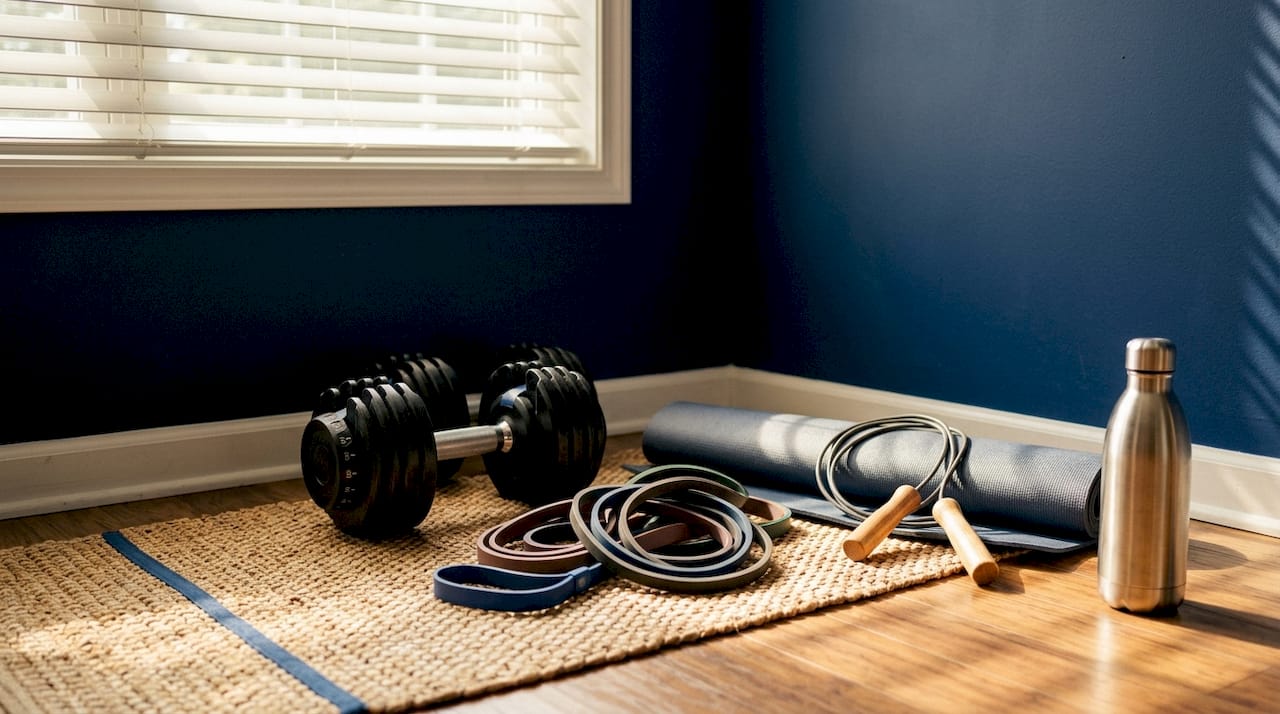
Space matters more than most athletes expect. A 6x8 foot area of clear floor gives you enough room for lunges, lateral shuffles, push-up variations, and most ground-based mobility work. A yoga mat protects your joints and defines your training zone. Keep your equipment within arm’s reach so transitions stay tight and your heart rate stays elevated.
The advantage of minimal equipment is scalability. Resistance bands come in multiple tension levels, so you can progress a pull-apart or banded squat the same way you would add weight to a barbell lift. Dumbbells let you load single-leg and single-arm movements that expose and fix strength imbalances. A jump rope builds conditioning faster than most treadmill programs.
| Equipment | Primary purpose | Alternative |
|---|---|---|
| Bodyweight | Foundational strength and control | No substitute needed |
| Resistance bands | Loaded mobility, activation, and pulling | Towel rows, isometric holds |
| Dumbbells | Unilateral strength and loaded hinges | Water jugs, backpack with books |
| Jump rope | Conditioning and coordination | Jumping jacks, shuttle runs |
| Yoga mat | Joint protection and defined space | Carpet, folded blanket |
How should athletes structure and sequence home workout sessions?
The Athletic Sequencing Method divides every session into three phases: Power, Tension, and Conditioning. Each phase targets a different energy system, and the order is not negotiable. Running them in sequence prevents energy system conflicts and keeps your output high across the full session.
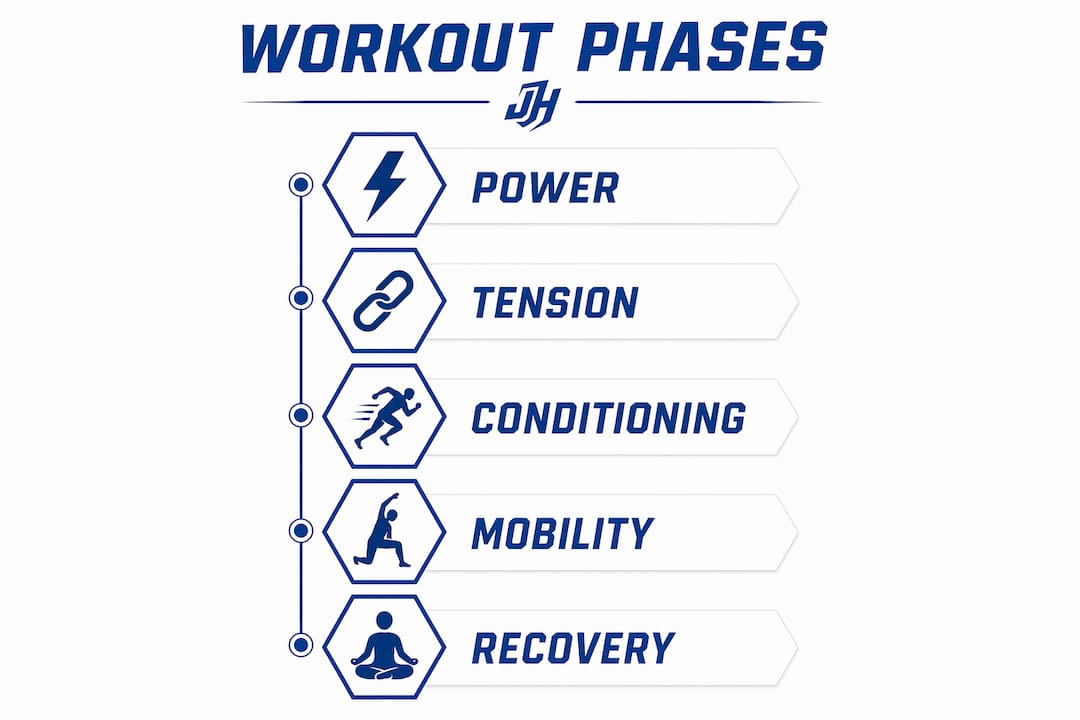
Phase 1: Power (explosive work)
This phase comes immediately after your warm-up. Explosive movements placed first maximize force output because your nervous system is fresh. Fatigued muscles cannot produce high-velocity force, so saving jumps or sprints for the end of a session is a structural mistake. Perform 3–5 reps per set with full recovery between sets.
- Broad jumps
- Vertical jumps
- Explosive push-ups
- Medicine ball slams (if available)
Phase 2: Tension (strength work)
Perform 3–4 sets of 8–12 reps with a 3–4 second lowering tempo. Slow tempos increase time under tension, which drives hypertrophy and joint stability. Rest 60–90 seconds between sets. Examples include single-leg Romanian deadlifts, dumbbell rows, Bulgarian split squats, and push-up variations.
Phase 3: Conditioning (interval work)
Finish with 5–10 minutes of interval work using a 30-second work, 30-second rest structure. Jump rope, squat jumps, lateral shuffles, and burpees all work here. This phase trains your aerobic and anaerobic systems without compromising the strength work that came before it.
Pro Tip: Schedule your Power phase within the first 10 minutes after your warm-up ends. Any delay lets neural fatigue creep in and reduces your peak force output by a measurable margin.
What does a weekly training split look like for home-based athletes?
Effective home athletic routines use 4–5 training days per week for performance goals and 3 days per week for maintenance. That split gives you enough frequency to drive adaptation while leaving room for recovery. Recovery is not optional. It is when your body actually gets stronger.
A balanced week includes 2–3 strength-focused sessions, 2 conditioning sessions, and 1 mobility or technique day. Stacking two heavy strength days back to back works only if you alternate muscle groups. Pairing a lower-body strength day with an upper-body strength day the following day is a practical way to manage fatigue.
Progression adds 2–5% load only after your form is stable across all sets. That rule prevents ego-driven jumps that break technique and cause injury. The Reps In Reserve (RIR) method is the cleanest way to manage intensity at home without a spotter. Finishing a set with 1–3 reps still available means you trained hard without crossing into technical failure.
| Day | Focus | Example movements |
|---|---|---|
| Monday | Lower body strength | Split squats, single-leg deadlifts, glute bridges |
| Tuesday | Conditioning | Jump rope intervals, shuttle runs, squat jumps |
| Wednesday | Upper body strength | Push-up variations, dumbbell rows, band pull-aparts |
| Thursday | Mobility and technique | Hip mobility drills, ankle dorsiflexion, core breathing |
| Friday | Full body strength | Deadlift pattern, push, pull, loaded carry |
| Saturday | Conditioning | Circuit training, jump rope, lateral drills |
| Sunday | Rest or active recovery | Walking, light stretching |
Pro Tip: Log every session in a notebook or notes app. Tracking sets, reps, and how the last rep felt gives you the data you need to apply the 2–5% progression rule with confidence.
Which foundational movement patterns should athletes prioritize at home?
Mastering five foundational patterns — squat, lunge, push, pull, and hinge — ensures your home training translates directly to sport performance. Random exercise selection feels productive but produces inconsistent results. Every session should include at least three of these five patterns. That structure is what separates sport-specific training from general fitness.
Here is what each pattern looks like in a home setting:
- Squat: Bodyweight squat, goblet squat with a dumbbell, jump squat for power
- Lunge: Reverse lunge, lateral lunge, walking lunge with dumbbells
- Push: Push-up, pike push-up, dumbbell floor press, explosive push-up
- Pull: Banded row, towel row under a table, dumbbell single-arm row
- Hinge: Romanian deadlift with dumbbells, single-leg hinge, glute bridge
Core and mobility work supports all five patterns. A weak core leaks force in every movement. Add plank variations, dead bugs, and pallof press holds to every session. These are not optional extras. They are the foundation that keeps your technique clean as load and fatigue increase.
Functional fitness built on these patterns also reduces injury risk. Athletes who train movement patterns rather than isolated muscles develop better joint stability and body control. That control shows up on the field, court, or track when it counts most.
What mistakes should athletes avoid when building a home workout routine?
Athletes who train without a structured progression plan typically plateau after the first 4–6 weeks of initial gains. The “more is better” trap is the most common reason. Adding sessions or volume without a plan does not accelerate progress. It accelerates fatigue and increases injury risk.
Watch for these warning signs of overtraining:
- Persistent soreness that does not resolve after 48 hours
- Declining performance on movements you have mastered
- Poor sleep quality despite physical fatigue
- Loss of motivation to train
When you notice a performance decline, reduce volume or load rather than pushing harder. That is the correct response. Pushing through a performance decline compounds the problem and extends recovery time.
Warm-up quality is another area where home athletes cut corners. Movement preparation with specific joint mobility drills, including ankle dorsiflexion, hip internal rotation, and diaphragmatic breathing, increases range of motion and injury resilience before you load any movement. A five-minute general warm-up does not prepare your joints for explosive work. A targeted 10-minute movement prep session does.
Finishing your sets with 1–3 reps in reserve is the single most underused tool in home training. It keeps your technique intact, protects your nervous system, and lets you train consistently five days a week without burning out.
Pro Tip: If you miss two or more sessions in a row, do not try to make up the volume. Return to your last completed week and repeat it before moving forward.
Key Takeaways
A structured, progressive home workout routine built around the Athletic Sequencing Method and five foundational movement patterns is the most direct path to sustained athletic performance gains.
| Point | Details |
|---|---|
| Use the Athletic Sequencing Method | Structure every session as Power, Tension, then Conditioning to match energy system demands. |
| Train 4–5 days per week | Mix 2–3 strength days, 2 conditioning days, and 1 mobility day for balanced athletic development. |
| Master five movement patterns | Squat, lunge, push, pull, and hinge cover every athletic demand without random exercise selection. |
| Apply the RIR method | Finish sets with 1–3 reps in reserve to protect technique and sustain training quality all week. |
| Progress load by 2–5% only | Add load only after form is stable across all sets to prevent injury and maintain long-term gains. |
Why consistency at home beats the perfect gym setup
I have coached athletes in full-facility gyms and watched them underperform athletes who trained in garages and living rooms. The difference was never the equipment. It was the structure. Athletes who show up with a plan, execute it with intention, and track their progress consistently outperform those who rely on access to machines and mirrors.
The hardest mental shift for home athletes is treating their space as seriously as a formal training facility. When you walk into your training area, that is your arena. The mindset you bring matters more than the square footage. I have seen athletes build genuine sport-specific strength using nothing but a pair of dumbbells, a resistance band, and a jump rope because they followed a progression plan and did not skip the boring parts.
The boring parts are the warm-up, the mobility work, and the recovery days. Those are the sessions that protect your ability to train the other four days. Skip them consistently and your progress stalls. Honor them and your performance compounds over months. That is the real secret to training like an everyday athlete at home.
— Jason
Gear built for athletes who train anywhere
Athletes who train at home deserve gear that keeps up with the work. Teamjhall designs performance apparel for competitors, creators, and everyday athletes who take their training seriously regardless of where it happens.

The TJH Men’s Performance Tee and the TJH Women’s Athletic Tank are built for full range of motion, breathability, and durability across every phase of your session. Whether you are hitting explosive jumps in Phase 1 or grinding through conditioning intervals, the right apparel keeps you focused on the work. Browse the full Teamjhall collection and gear up for your next session.
FAQ
How many days a week should athletes train at home?
Athletes training for performance should aim for 4–5 days per week, mixing strength, conditioning, and mobility sessions. Three days per week works for maintenance goals.
What is the Athletic Sequencing Method?
The Athletic Sequencing Method structures sessions into three phases: Power (explosive, 3–5 reps), Tension (strength, 8–12 reps with slow tempo), and Conditioning (intervals, 5–10 minutes). This order prevents energy system conflicts and maximizes output across the full session.
Can athletes build real strength at home without a gym?
Bodyweight, resistance bands, and dumbbells are sufficient for building sport-specific strength at home. The key is following a structured progression plan and mastering foundational movement patterns rather than selecting exercises randomly.
What is the RIR method and why does it matter for home training?
Reps In Reserve (RIR) means finishing a set with 1–3 reps still available rather than training to failure. Without a spotter at home, RIR protects your technique and nervous system so you can train consistently throughout the week.
How do athletes avoid plateaus in home training?
Structured weekly plans with defined session goals and a 2–5% load progression rule prevent the plateaus that hit unstructured home athletes after 4–6 weeks. Logging sessions and tracking performance trends is the most reliable way to stay ahead of stagnation.