

The Role of Clothing in Team Identity: A Coach's Guide
The role of clothing in team identity is to create a shared visual and psychological bond that transforms individual players into a cohesive, high-performing unit. Uniforms are not decorative. They are functional tools that shift a player’s mindset from “I” to “we,” and that shift has measurable consequences on focus, confidence, and group coordination. Research shows that 81% of consumers remember a brand’s or team’s color before its name. That single fact tells coaches everything they need to know about the power of consistent visual identity. Teamjhall builds its entire apparel philosophy around this principle: clothing is the first signal a team sends to itself and to the world.
What is the role of clothing in team identity?
Clothing signals belonging before a single word is spoken. When every player wears the same colors, the same cut, and the same logo, the group communicates unity without effort. That visual consistency is the foundation of what sports psychologists call shared social identity, the sense that individual goals are secondary to collective ones.
Design elements carry this message in three specific ways:
- Color: The 60-30-10 color ratio is the industry standard for professional uniform design. Sixty percent dominant color, 30% secondary, and 10% accent. Exceeding this ratio creates visual noise and makes a team appear disorganized.
- Logo and heritage: Logos anchor a team to its history. Heritage-inspired designs give players a sense of community and responsibility toward the team’s legacy. A player wearing a crest that has existed for decades carries that weight consciously.
- Fit and quality: A study of 252 participants found that ergonomic fit and color quality significantly improved motivation, mood, and confidence in physical activity settings. Poor fit signals low investment. Quality fit signals that the organization takes its athletes seriously.
Pro Tip: When selecting uniform colors, lock in your dominant color first and treat it as non-negotiable. Every other design decision should serve that anchor color, not compete with it.
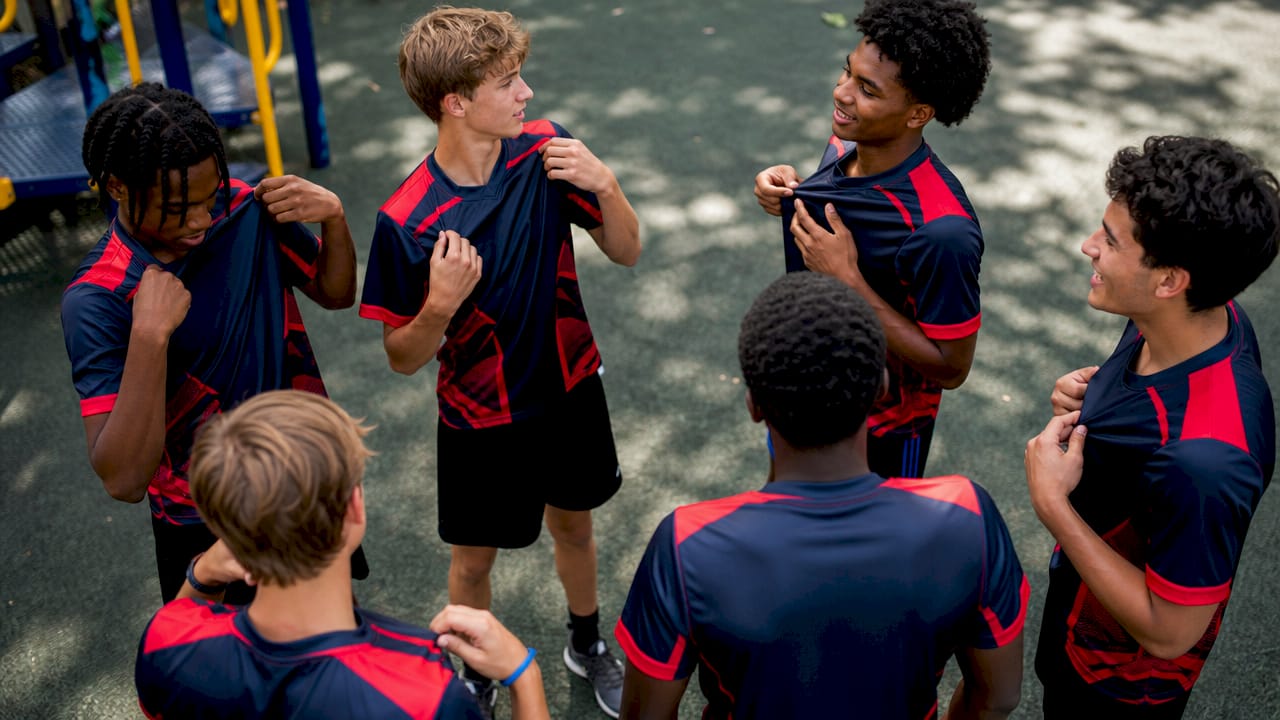
The clothing impact on team spirit starts at the design stage, long before anyone steps on the field. Coaches who treat uniform selection as a purely logistical task miss a major opportunity to shape how their team sees itself.
How does uniform psychology affect team performance?
The science behind this is called enclothed cognition, the idea that what you wear changes how your brain operates. It is not a metaphor. It is a documented neurological process.
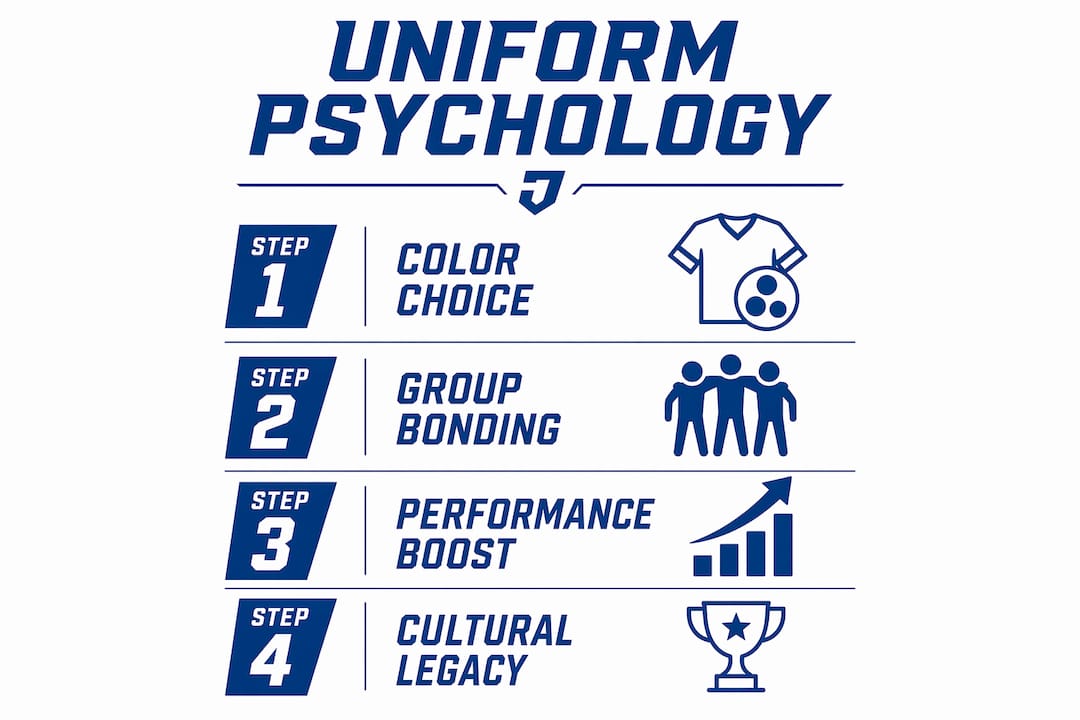
Researchers found that participants in professional attire made 50% fewer errors on attention-demanding tasks compared to those in casual wear. That reduction links directly to activation of the temporoparietal junction, a brain region tied to social cognition and perspective-taking. When players wear matching uniforms, they activate the same brain areas responsible for empathy and coordinated group action.
Three psychological mechanisms explain this effect:
- Mindset shift: Uniforms act as a psychological trigger. Putting on the jersey signals the brain that individual mode is over and team mode has begun. This is why pre-game uniform rituals accelerate the mental transition into match mode.
- Equality and trust: Uniforms remove visual hierarchy. When everyone looks the same, status markers disappear. Well-designed uniforms reduce conflict, build trust, and improve communication across the team.
- Collective confidence: Matching appearance raises group confidence independent of individual skill levels. A less talented team that looks unified often outperforms a more talented team that looks fragmented.
“Uniforms function as a ‘double agent,’ serving both practical coordination and psychological anchoring. They turn the individual ‘I’ mindset into a collective ‘we’ that is greater than the sum of its parts.”
The clothing’s role in group cohesion is not passive. It actively reshapes how players think, how they relate to each other, and how quickly they enter a competitive state.
Why does team clothing carry cultural weight?
A uniform is never just fabric. It carries the weight of every player who wore it before and every fan who cheered for it. This cultural dimension is what separates a jersey from a shirt.
Teams that understand this use their uniforms as symbols of legacy. Throwback designs, regional color palettes, and locally inspired logos connect players to a place and a history larger than any single season. That connection builds pride, and pride builds commitment.
The emotional attachment extends beyond the locker room. Fans who wear team apparel in the stands are not just showing support. They are joining the same shared identity that the players carry on the field. This is why uniform design bridges past and future, linking players to team heritage and continuity in ways that boost long-term commitment.
| Cultural element | Effect on team identity |
|---|---|
| Heritage logos | Connects players to legacy and responsibility |
| Regional color palettes | Builds local pride and community recognition |
| Throwback designs | Reinforces continuity and tradition |
| Fan apparel alignment | Extends team identity beyond the playing field |
Key cultural signals in team clothing include:
- Consistent use of founding colors across all apparel lines
- Incorporating local symbols or regional history into logo design
- Releasing heritage editions to honor milestone seasons
- Aligning fan merchandise with player uniforms for visual unity
The importance of attire in teamwork reaches its peak when clothing connects players to something bigger than the current game. That sense of responsibility to a legacy changes how athletes carry themselves.
How can coaches use clothing to build a stronger team?
Coaches who treat uniform strategy as a performance tool get results that go beyond aesthetics. The practical application of clothing’s psychological power comes down to three areas: ritual, personalization, and visual consistency.
Ritual use of the uniform is the most underused tool in coaching. Teams with specific pre-game uniform routines shift into match mode faster than those without. A structured moment where players put on their gear together, in the same order, in the same space, creates a repeatable psychological trigger. Over time, the act of putting on the jersey becomes the signal that competition has begun.
Personalization within uniformity is where many teams get the balance wrong. Uniforms that eliminate all individual markers, no names, no numbers, no personal touches, can disengage players by reducing their sense of individual contribution. Successful uniform design balances team unity with individual identity markers. A player who sees their name on the back of a jersey feels seen. That feeling drives effort.
Visual consistency across all apparel matters for both players and fans. Consistent visual design reduces mental friction during competition and makes coordinated group action faster. When warm-up gear, game jerseys, and sideline apparel all share the same color system and logo placement, the team presents a unified front that reinforces identity at every moment.
Pro Tip: Build a uniform ritual into your pre-game routine. Designate a specific time and place where the team dresses together. That shared act is a psychological contract. It tells every player that the individual is now part of something collective.
Practical steps for coaches to apply these principles:
- Lock in a color system using the 60-30-10 ratio and apply it across all team apparel
- Include player names or numbers on all game uniforms to preserve individual identity
- Create a team-wide pre-game dressing ritual and protect it as part of game preparation
- Align practice gear, game uniforms, and fan merchandise under one visual identity
- Review uniform quality annually. Worn, ill-fitting gear sends the wrong signal to players
How clothing influences team values shows up most clearly in these small, deliberate choices. The teams that get this right do not leave it to chance.
Key Takeaways
Clothing is a psychological and cultural tool that directly shapes team identity, cohesion, and competitive performance when used with intention.
| Point | Details |
|---|---|
| Color consistency drives recall | Use the 60-30-10 ratio to build a professional, memorable visual identity. |
| Uniforms trigger a collective mindset | Pre-game dressing rituals accelerate the mental shift from individual to team mode. |
| Fit and quality affect confidence | Ergonomic, well-made uniforms improve motivation and mood among athletes. |
| Heritage design builds commitment | Logos and throwback elements connect players to legacy and raise long-term investment. |
| Personalization prevents disengagement | Including names and numbers keeps individual players emotionally connected to the team. |
What coaches get wrong about uniform strategy
I have watched coaches spend hours on playbooks and minutes on uniforms. That ratio is backwards. The uniform is the first piece of team culture a player puts on their body. It is the most repeated ritual in a season. Getting it wrong is not a small oversight.
The biggest mistake I see is treating the uniform as purely aesthetic. A team picks colors they like, slaps on a logo, and calls it done. They miss the psychological layer entirely. Uniforms should function as psychological interventions, not just visual statements. When you skip that layer, you skip a real chance to build resilience and collective optimism into your team’s daily routine.
The second mistake is ignoring the ritual. I have seen teams with great uniforms that never leverage them. Players dress in different rooms, at different times, in different orders. The psychological trigger never fires consistently. The jersey becomes just a jersey. That is a waste of a powerful tool.
The third mistake is going too far toward uniformity. I understand the instinct. You want everyone to look the same. But a player who cannot find themselves in the uniform, literally or symbolically, will eventually check out. The role of clothing in self-expression matters even within a team context. Names, numbers, and small personal touches are not vanity. They are retention tools.
Get the design right, build the ritual, and leave room for the individual within the collective. That is the formula.
— Jason
Teamjhall apparel built for team identity
Building team identity through clothing requires more than picking a color. It requires quality materials that hold up under competition, color systems that stay consistent across every piece, and fit that makes every athlete feel confident from the first whistle.

Teamjhall designs performance apparel for competitors, coaches, and teams who understand that what you wear is part of how you compete. Every piece in the Teamjhall line is built around the principles covered here: color consistency, quality fit, and the confidence that comes from wearing gear that reflects your values. From the TJH Men’s Performance Tee to the UA Ladies Athletic Tee, every option is designed to reinforce team unity without sacrificing individual pride. Your team’s identity starts with what they put on. Make it count.
FAQ
What is the role of clothing in team identity?
Clothing creates a shared visual identity that psychologically shifts players from individual to collective thinking. Uniforms signal belonging, build trust, and reinforce the values a team stands for.
How do uniform colors affect team cohesion?
The 60-30-10 color ratio is the standard for professional team uniforms. Consistent color use improves brand recall and makes a team appear organized and authoritative to opponents and fans alike.
Does wearing a uniform actually improve performance?
Research shows that athletes in professional attire made 50% fewer errors on attention-demanding tasks than those in casual wear. Uniforms activate brain regions linked to social cognition, which directly supports coordinated team action.
Why does personalization matter in team uniforms?
Uniforms without individual markers like names or numbers can reduce a player’s sense of contribution and lead to disengagement. Balancing team uniformity with personal identity elements keeps athletes emotionally invested.
How can coaches use uniforms to build team culture?
Coaches can establish pre-game dressing rituals, maintain consistent visual identity across all apparel, and incorporate heritage design elements. These practices turn the uniform into a repeatable psychological trigger for competitive focus.