

What Is Sport-Specific Conditioning for Athletes?
Sport-specific conditioning is the process of designing training that exactly matches the metabolic, biomechanical, and neurological demands of a particular sport. It is not general fitness training. Every variable, including intensity, volume, movement selection, and work-to-rest ratio, gets aligned to what your sport actually requires. The National Strength and Conditioning Association (NSCA) recognizes specificity as a foundational training principle, and sports science consistently confirms that training transfer improves when conditioning mirrors competition demands. If you want to perform better on the field, court, or track, generic workouts will only take you so far.
What is sport-specific conditioning and why does it matter?
Sport-specific conditioning designs training variables such as intensity, volume, and movement to align with the metabolic, biomechanical, and neurological demands of a sport. That alignment is what separates training that transfers to competition from training that simply makes you tired. A marathon runner and a basketball player both need conditioning. The type, structure, and energy system targeted must be completely different for each.
General fitness training builds a broad physical base. Sport-specific conditioning builds the exact capacities your sport demands. A soccer player who only lifts heavy weights will develop strength but may still gas out in the 80th minute. The missing piece is conditioning that matches the actual energy demands of a 90-minute match with repeated sprints and short recovery windows.
The NSCA defines the specificity principle as the idea that adaptations are specific to the type of training performed. This means your nervous system, muscles, and energy systems adapt to the precise stimuli you give them. Give them the wrong stimuli and you get adaptations that do not transfer to your sport.
What are the core components that make conditioning sport-specific?
Three pillars define sport-specific conditioning: energy system demands, biomechanical specificity, and neurological adaptation. Each one must be addressed for training to transfer effectively.
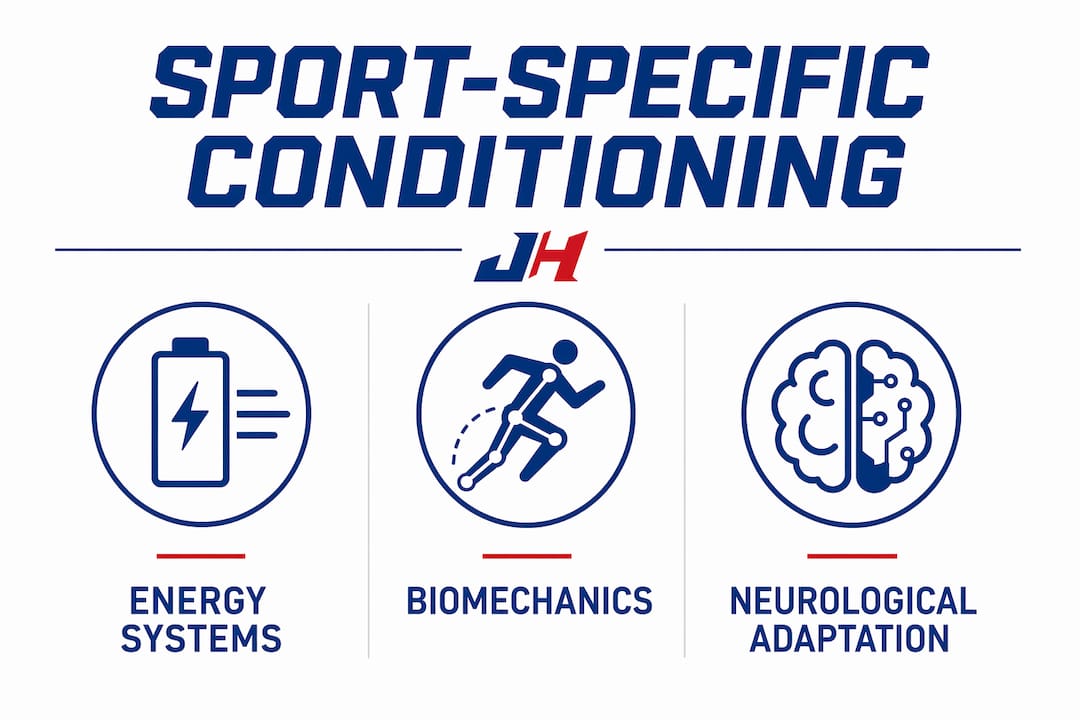
Energy system demands
Every sport relies on a mix of aerobic and anaerobic energy systems, but the proportions vary dramatically. Basketball requires repeated short bursts of anaerobic effort with brief recovery periods. Long-distance running demands sustained aerobic output over extended time. Work-to-rest ratios should replicate real game demands, because a mismatch leads to performance ceilings and suboptimal energy system development. Training your energy systems in the wrong ratio is one of the most common and costly mistakes athletes make.
Biomechanical specificity
Movement patterns, joint angles, speed of contraction, and stabilization requirements must match your sport. A slow leg press does not develop explosive jumping power for a volleyball player. Slow or mechanically dissimilar exercises do not effectively improve sport performance because the nervous system adapts only to precise stimuli. The exercise must match the speed, direction, and stabilization pattern of the target movement.
Neurological adaptation
Conditioning also trains your nervous system to fire muscles in the right sequence, at the right speed, under fatigue. Integrative neuromuscular training improves lower-limb strength, power, sprint speed, agility, and balance in football players. That finding reflects a broader truth: the nervous system needs sport-relevant stimuli to build the motor patterns that hold up under competition pressure.
- Energy system match: Map your sport’s work-to-rest ratio and train the dominant energy system accordingly.
- Movement specificity: Select exercises that replicate the speed, joint angle, and stabilization demands of your sport.
- Neuromuscular training: Include plyometrics, agility drills, and high-intensity intervals that mirror game scenarios.
- Skill under fatigue: Practice technical skills while fatigued to build the motor patterns that survive competition.
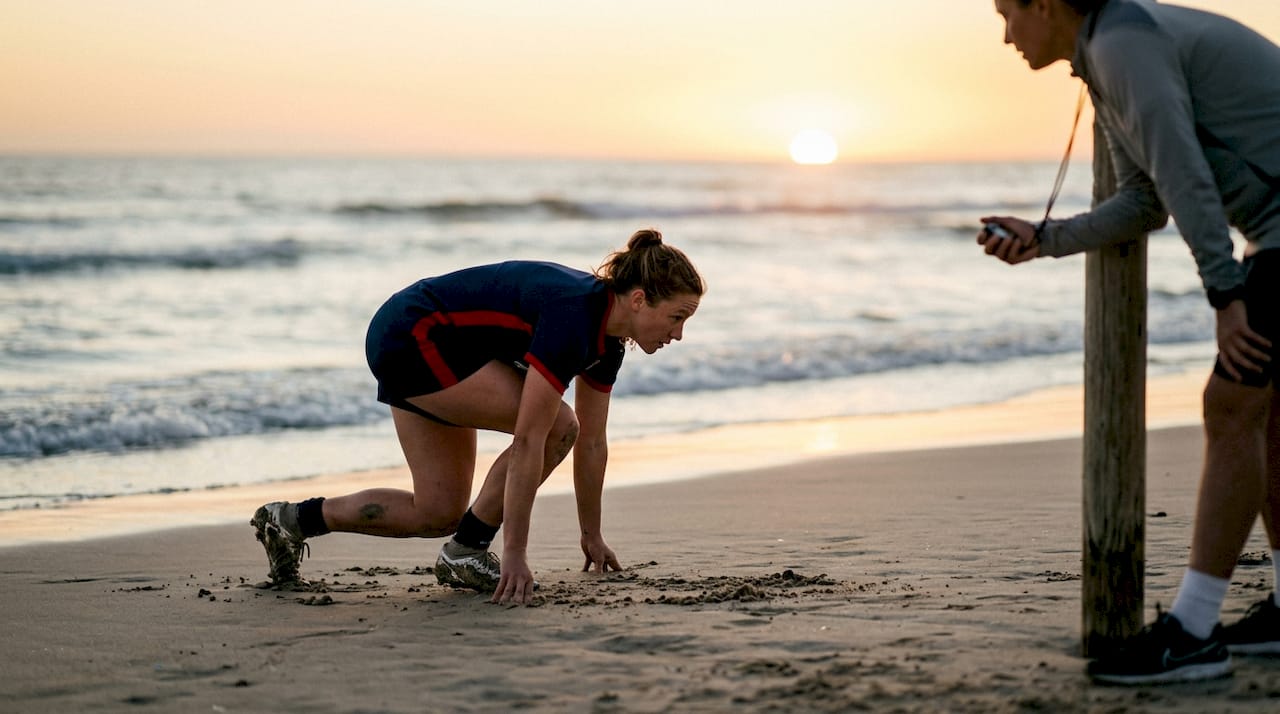
Pro Tip: Record your sport’s actual work-to-rest ratio during a game or match using a stopwatch. Use that ratio as the template for your interval training sessions.
How does periodization influence sport-specific conditioning programs?
Periodization is the structured sequencing of training qualities over time. Without it, athletes often train everything at high intensity simultaneously, which limits adaptation and raises injury risk. Annual periodization that respects off-season base building and pre-season intensification produces better long-term performance than year-round high-intensity work.
A well-designed pre-season block follows a clear progression:
- Weeks 1–4 (Tendon adaptation): Low-load, high-volume work to prepare connective tissue for the demands ahead. Skipping this phase is a leading cause of early-season injuries.
- Weeks 5–8 (Hypertrophy): Increased volume and moderate intensity to build the muscular base that supports power development.
- Weeks 9–11 (Strength-power): Heavy compound lifts combined with explosive work to convert muscular size into usable force.
- Week 12 (Peak potentiation): Reduced volume with maintained intensity to prime the nervous system for competition.
Pre-season periodization follows this 12-week block model, with intensity managed by mean velocity tracking. Sets end when velocity drops 20–25% from the first rep to avoid excessive fatigue. That threshold matters because training past it produces diminishing returns and increases recovery debt.
The off-season serves a different purpose. It builds the structural and aerobic base that pre-season work will intensify. Programming requires sequenced progression of physical qualities, avoiding concurrent high-intensity training of all components. Trying to build strength, power, and sport-specific conditioning at maximum intensity simultaneously is a recipe for stalled progress.
Pro Tip: Use a simple velocity-based tracking app or a linear position transducer to monitor bar speed during strength sessions. A consistent drop in velocity across a week signals accumulated fatigue, not just a bad day.
| Phase | Duration | Primary focus |
|---|---|---|
| Tendon adaptation | 4 weeks | Connective tissue prep, low load |
| Hypertrophy | 4 weeks | Muscular base, moderate intensity |
| Strength-power | 3 weeks | Force production, explosive work |
| Peak potentiation | 1 week | Nervous system priming, low volume |
What mistakes undermine sport-specific conditioning?
The biggest misconception in sport-specific training is that mimicking sport movements in the gym is enough. It is not. Specificity requires matching speed, power, stabilization, and energy demands, not just the shape of a movement.
Doing a slow squat to improve your vertical jump is like practicing free throws in slow motion and expecting it to transfer to game speed. The nervous system does not generalize across speeds. You must train at the velocity and intensity the sport demands.
- Movement mimicry without speed match: A slow leg press does not build explosive power. The exercise must replicate the contraction speed of the target movement.
- Strength without metabolic conditioning: Raw strength gains hit a ceiling when the athlete cannot sustain force output due to poor energy system development. Ignoring metabolic conditioning limits performance gains even when raw strength is high.
- Neglecting recovery monitoring: Training hard without tracking fatigue readiness leads to overreaching. Overreaching without adequate recovery produces regression, not adaptation.
- Training all qualities simultaneously: Running max-intensity strength, power, and conditioning blocks at the same time prevents any single quality from peaking. Sequencing is not optional. It is the mechanism of adaptation.
Conditioning also teaches skills, not just builds engines. Conditioning targets both engine development and the skillful deployment of physical qualities. Pacing, breathing under pressure, and maintaining technique while fatigued are all conditioned abilities. Ignoring them in training guarantees they will fail in competition.
How can athletes develop effective sport-specific conditioning?
Building sport-specific conditioning starts with a clear assessment of your sport’s physical demands. You need to know the dominant energy system, the key movement patterns, and the typical work-to-rest ratio before you design a single session.
Assess your sport’s demands
Measure the actual work-to-rest ratio in your sport. A basketball possession lasts roughly 15–24 seconds of intense effort, followed by a brief reset. A soccer midfielder covers 7–9 miles per match with repeated sprint efforts. Those numbers define your conditioning targets. Without them, you are guessing.
Match training variables to sport demands
Select exercises, intervals, and recovery periods that replicate your sport’s profile. Plyometrics, sprint intervals, and agility circuits work for sports with repeated explosive efforts. Tempo runs and threshold intervals work for endurance-dominant sports. Functional fitness principles applied to sport-specific demands produce training that transfers directly to competition.
Monitor recovery with objective metrics
Countermovement jump height is one of the most reliable indicators of neuromuscular readiness. A CMJ result more than 5% below your 7-day average signals that a 30% volume reduction is appropriate to reduce soft tissue injury risk. That single metric can prevent weeks of lost training time.
| Sport | Dominant energy system | Conditioning focus |
|---|---|---|
| Basketball | Anaerobic with aerobic recovery | Short sprint intervals, repeated effort capacity |
| Soccer | Mixed aerobic/anaerobic | Tempo runs, repeated sprint endurance |
| Marathon running | Aerobic | Long slow distance, threshold intervals |
Pro Tip: Test your countermovement jump height every Monday morning before training. Track the number weekly. Use it as your green or red light for training intensity that week.
Key Takeaways
Sport-specific conditioning produces superior performance transfer because it matches training stimuli precisely to the metabolic, biomechanical, and neurological demands of competition.
| Point | Details |
|---|---|
| Definition matters | Sport-specific conditioning aligns intensity, volume, and movement to exact sport demands, not general fitness. |
| Energy system match | Train the aerobic or anaerobic system in the ratio your sport actually uses during competition. |
| Periodization is non-negotiable | Follow a sequenced block model: tendon adaptation, hypertrophy, strength-power, then peak potentiation. |
| Specificity is not mimicry | Exercises must match the speed, power, and stabilization demands of your sport, not just the movement shape. |
| Monitor recovery objectively | Use countermovement jump testing to adjust training volume and prevent overreaching injuries. |
What I’ve learned about conditioning that most programs get wrong
Most athletes I have worked with or observed come into sport-specific programming with the same blind spot: they confuse looking sport-specific with being sport-specific. They do lateral band walks because soccer players move laterally. They do medicine ball throws because their sport involves rotation. The movements look right. The adaptations do not follow.
The specificity principle is ruthless. Your nervous system does not care that an exercise resembles your sport. It cares about the speed of contraction, the stabilization demand, and the metabolic context. A slow, controlled movement trains slow, controlled motor patterns. If your sport requires explosive, reactive output, that training does not transfer.
The second thing I have seen consistently undermine athletes is the refusal to sequence training qualities. Coaches and athletes want everything at once: max strength, peak conditioning, and sport-specific power, all in the same training block. The body cannot adapt to competing stimuli at high intensity simultaneously. You get a little of everything and a lot of nothing. Block periodization exists for a reason. Trust the sequence.
Recovery monitoring changed how I think about programming entirely. Objective metrics like countermovement jump testing remove the guesswork from training load decisions. When an athlete’s jump height drops, the answer is not to push harder. The answer is to pull back, let the adaptation consolidate, and come back stronger. That discipline, more than any single exercise selection, separates athletes who peak at the right time from those who arrive at competition already depleted.
If you want to build a sport-specific training program that actually works, start with your sport’s demands, sequence your qualities, and monitor your recovery. Everything else is detail.
— Jason
Gear built for the way athletes actually train
Athletes who take sport-specific conditioning seriously need gear that keeps up with the intensity of their sessions. Teamjhall designs athletic apparel for competitors who train with purpose, not just for the look of it.

The Teamjhall store carries performance pieces built for high-movement conditioning work, from breathable athletic tees to flexible shorts that hold up through sprint intervals, plyometric circuits, and agility drills. Every piece is designed for athletes who show up consistently and train with intent. When your gear fits the work, nothing gets in the way of the session. Browse the full collection at Teamjhall and find what fits your training.
FAQ
What does sport-specific conditioning mean?
Sport-specific conditioning means designing training variables such as intensity, volume, and movement patterns to match the exact metabolic, biomechanical, and neurological demands of a particular sport. It differs from general fitness training by targeting the precise adaptations that transfer to competition performance.
How is sport-specific training different from general fitness training?
General fitness training builds broad physical capacity, while sport-specific training targets the exact energy systems, movement speeds, and stabilization demands your sport requires. Mismatched training produces adaptations that do not transfer to competition, creating a performance ceiling regardless of overall fitness level.
What is the best way to develop sport-specific strength training?
Start by mapping your sport’s work-to-rest ratio, dominant energy system, and key movement patterns. Then select exercises that match the speed and stabilization demands of those movements, and sequence training qualities using a periodized block model rather than training everything at maximum intensity simultaneously.
How do you monitor fatigue in sport-specific conditioning?
Countermovement jump testing is one of the most reliable methods. A jump height more than 5% below your 7-day average signals accumulated neuromuscular fatigue and indicates a training volume reduction of around 30% to prevent injury and allow adaptation to consolidate.
What are the main benefits of sport-specific conditioning?
Sport-specific conditioning improves the physical qualities that directly affect competition performance, including sprint speed, repeated effort capacity, agility, and power output. It also builds the ability to maintain technique and decision-making under fatigue, which generic training programs rarely address.