

Functional Fitness Explained: Move Better Every Day
Functional fitness is exercise that trains the movement patterns you use in daily life, like squatting, bending, lifting, and carrying, so those tasks get easier and safer. Instead of isolating one muscle at a time, it trains your body to work as a coordinated unit.
Three things happen when you commit to it:
- Daily tasks get easier. Carrying groceries, hauling a suitcase, or hoisting a toddler onto your hip stops feeling like a workout in itself.
- Balance improves. You catch yourself before a stumble becomes a fall.
- Injury risk drops. Stronger, better coordinated movement patterns mean fewer strains from the ordinary stuff, like twisting to grab something off the back seat.
This approach works for almost anyone, from a 25-year-old desk worker to a 70-year-old grandparent who wants to keep gardening without back pain. If that’s you, keep reading. The rest of this guide breaks down exactly how it works and gives you exercises to start today.
Key Takeaways
Functional fitness works because it trains movement patterns, not isolated muscles, which directly improves balance, coordination, and everyday physical independence.
| Point | Details |
|---|---|
| Six core patterns | Build every routine around squat, hinge, push, pull, carry, and rotate. |
| Frequency over intensity | Three sessions a week for eight weeks produced measurable balance and movement gains. |
| Start with bodyweight | Progress from bodyweight to bands, then dumbbells, then kettlebells as form improves. |
| Complements traditional lifting | Use functional patterns for daily carryover and traditional lifts for muscle-specific goals. |
| Minimal equipment required | A backpack, gallon jugs, or resistance bands cover most exercises at home. |
Table of Contents
- What Is Functional Fitness Explained in Plain Terms?
- How Does Functional Fitness Actually Work?
- What Are the Real Benefits of Functional Fitness?
- Who Should Try Functional Fitness and How Do You Modify It?
- Functional Fitness vs Traditional Weight Training: What’s the Difference?
- What Are the Best Functional Fitness Exercises to Start With?
- How Do You Start a Functional Fitness Routine?
- What Equipment Do You Actually Need?
- What Does the Research Actually Say?
- Why Functional Fitness Fits Real Life Better Than a Gym Routine
- Frequently Asked Questions
- Sources
What Is Functional Fitness Explained in Plain Terms?
Functional fitness trains your body to handle the physical demands of real life, not just to look good in a mirror or lift a heavier number on a machine. Harvard Health describes it as training that builds real-world strength, mobility, and resilience by treating the body as one connected system rather than a collection of separate muscles.
Think about what your body actually does in a normal day. You squat down to load the dishwasher. You hinge at the hips to pick up a laundry basket. You push a heavy door open, pull a stubborn drawer shut, carry bags up a flight of stairs, and twist to check your blind spot while driving. Functional fitness trains exactly those motions, under load, so they get stronger and more controlled over time.
A few terms will come up again and again in this guide, so here’s a quick glossary:
- Movement pattern: A category of motion your body performs repeatedly, like squatting or pulling, rather than a single exercise.
- Kinetic chain: The connected system of joints, muscles, and nerves that work together during movement. A weak link anywhere in the chain, say a stiff ankle, can force your knee or lower back to compensate, according to Harvard Health’s explanation of the kinetic chain.
- Core stability: The ability of your trunk muscles to keep your spine steady while your arms and legs move.
- Compound (multi-joint) movement: An exercise that works several joints and muscle groups at once, such as a squat or a deadlift, as opposed to an isolation move like a bicep curl.
Picture three people: a warehouse worker who needs to lift boxes safely all shift, a new parent bending over a crib dozens of times a day, and a retiree who wants to garden without throwing out their back. None of them need bigger biceps as much as they need a body that moves well under real-world stress. That’s the entire premise of functional fitness.
How Does Functional Fitness Actually Work?
The mechanics come down to three core principles: training multiple joints and muscles together, building stability and coordination through the kinetic chain, and choosing exercises that closely mimic what you actually do outside the gym.
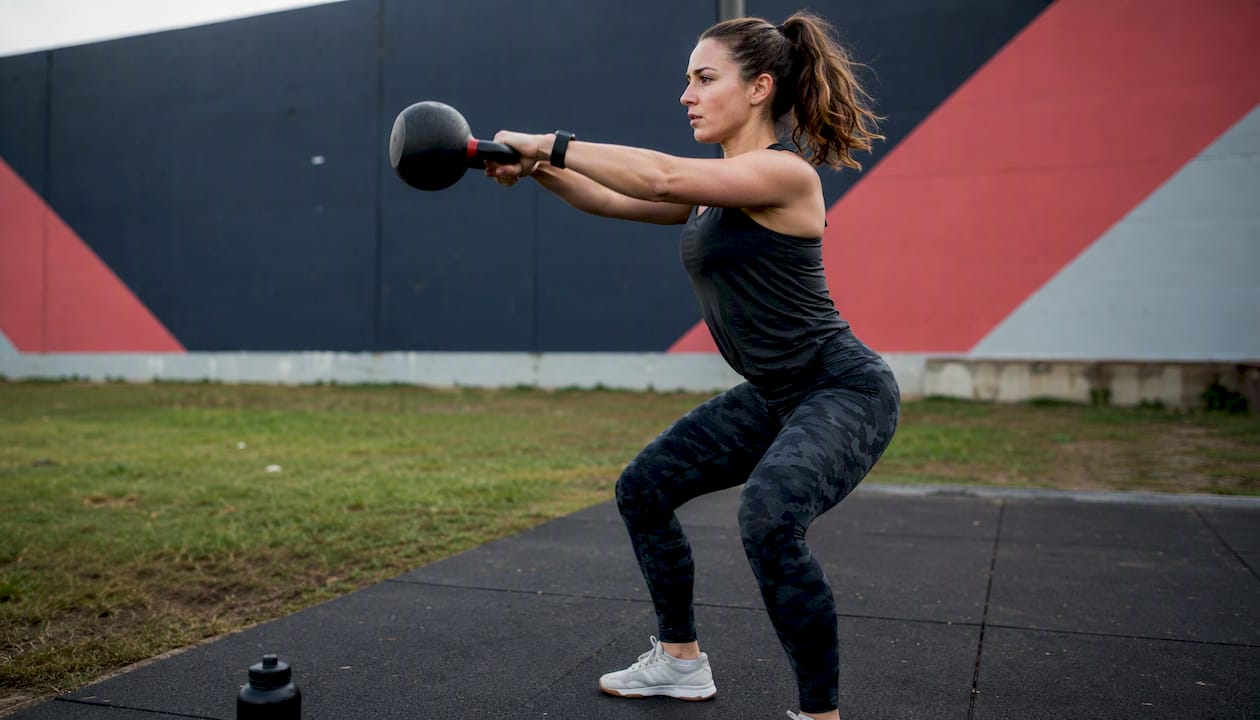
Mayo Clinic notes that functional exercises are typically multijoint, multimuscle movements that emphasize core stability, things like deadlifts, lunges with an overhead press, or resisted squats. Rather than sitting in a machine that isolates your quads, you stand up and squat, which forces your core, hips, ankles, and stabilizer muscles to fire together, just like they do when you get out of a low chair.
Experts commonly organize all of this around six primary movement patterns, and research on movement patterns confirms these categories cover the vast majority of human motion:
- Squat: Bending at the hips and knees to lower your body, the pattern behind sitting down and standing up.
- Hinge: Bending primarily at the hips while keeping the spine neutral, the pattern behind picking something up off the floor.
- Push: Moving weight away from your body, like pushing open a heavy door or shoving a stroller uphill.
- Pull: Drawing weight toward your body, the pattern behind opening a drawer or hauling a rope.
- Carry: Holding load while walking, which builds grip strength and postural endurance.
- Rotate: Twisting through the torso, the pattern behind swinging a golf club or reaching across the back seat.
Mechanically, training these patterns repeatedly does two things. It strengthens the muscles along the kinetic chain so force transfers efficiently instead of leaking out at a weak joint, and it primes your nervous system to react faster and more precisely. Physical therapists at Dartmouth Health note that this kind of training improves balance and coordination by helping muscles respond more efficiently during real-life movement, not just in a controlled gym setting.
Pro Tip: When you’re choosing a progression, start with your bodyweight and master the pattern before adding load. A wobbly squat with a kettlebell is a worse choice than a clean, controlled bodyweight squat done for reps.
What Are the Real Benefits of Functional Fitness?
The most consistent, well-supported benefits are better balance, improved coordination, and greater functional independence, meaning you can keep doing the physical tasks of daily life without help as you age.
One of the clearest data points comes from a controlled study where middle-aged adults completed three functional strength training sessions per week, about 60 minutes each, for eight weeks. That program produced significant improvements in balance and functional movement scores, along with better body composition. Eight weeks is not a long commitment, and a moderate frequency of sessions weekly is realistic for most schedules.
Beyond balance and coordination, functional training delivers a few secondary benefits worth knowing about:
- Better conditioning. Full-body compound movements raise your work capacity, which is why functional training often overlaps with sport-specific endurance work.
- Body composition changes. The MDPI study linked functional training to measurable improvements in body composition alongside the balance gains.
- Lower injury risk over time. Strengthening the entire kinetic chain reduces the compensations that lead to overuse injuries in a single joint.
- Long-term independence. This matters more than people realize. Muscle mass naturally declines starting around age 25 in people who don’t do resistance training, and functional patterns are one of the most direct ways to fight that decline while keeping your movements practical, not just your muscles bigger.
Who Should Try Functional Fitness and How Do You Modify It?
Functional fitness suits almost anyone whose goal is to move better in daily life, not just to hit a number on a barbell. That covers more people than you might think.
You’re a strong candidate if you fall into one of these groups:
- Everyday movers who want groceries, stairs, and yard work to feel easier.
- Aging adults looking to preserve balance and independence as muscle mass naturally declines.
- Anyone returning from a break in training who needs to rebuild coordination, not just strength.
- People who want practical strength over aesthetic-only training.
Safety comes down to a few basic rules. Start with movements you can control with good form before adding external load. If you have a joint replacement, cardiovascular condition, or are recovering from an injury, check with your doctor or physical therapist before starting, since a physical therapist can also tailor patterns around a specific limitation. Dartmouth Health frames functional fitness as a flexible philosophy rather than a rigid rule book, which means the same squat pattern can look like a chair stand for a beginner or a loaded kettlebell squat for someone more advanced.
A safe progression usually looks like this: bodyweight first, then resistance bands, then dumbbells, then kettlebells once your form is consistent under load. If you’re new to structured training altogether, our guide on what makes someone an everyday athlete is a good place to see how this fits into a broader mindset.
Functional Fitness vs Traditional Weight Training: What’s the Difference?
The core difference is focus: functional fitness trains movement patterns for real-world transfer, while traditional weight training often isolates individual muscles to build size or maximal strength. Neither approach is wrong. They solve different problems, and the strongest programs usually blend both.
Traditional lifting, think bicep curls, leg extensions, or a chest press machine, is excellent for building muscle in a specific area with minimal technical complexity. Functional fitness asks more of your coordination and core, but pays off in how you move outside the gym. Insight on combining approaches suggests that training only for aesthetics can leave gaps in coordination and stability unless movement patterns get addressed directly.
| Factor | Functional fitness | Traditional weight training |
|---|---|---|
| Primary goal | Movement pattern transfer, daily function | Muscle size, isolated strength |
| Typical exercises | Squats, deadlifts, carries, rotational work | Machine curls, leg press, isolation lifts |
| Best used for | Everyday tasks, balance, injury resilience | Building muscle mass in a specific area |
The two work well together. Add functional patterns to build carryover into daily life, then use traditional lifting blocks to target specific muscle growth. If you’re building out a sports performance program, our piece on functional fitness for sports performance covers how the two approaches stack for athletes.
What Are the Best Functional Fitness Exercises to Start With?
Here are ten exercises that cover all six primary movement patterns. Pick three to five to start, master the form, then add the rest as you get comfortable.
- Bodyweight squat (squat pattern). Purpose: builds the strength behind sitting and standing. Cues: chest up, weight in heels, knees track over toes. Progressions: goblet squat with a dumbbell, then a loaded barbell squat. At home: use a chair as a depth target.
- Romanian deadlift (hinge pattern). Purpose: trains safe bending and lifting from the floor. Cues: soft knees, hinge at the hips, keep the bar or weight close to your legs. Progressions: dumbbell version first, then a barbell or kettlebell. At home: use a loaded backpack.
- Push-up (push pattern). Purpose: builds pressing strength for pushing doors, carts, or furniture. Cues: hands under shoulders, brace your core, lower with control. Progressions: incline push-up on a counter, then a full push-up on the floor.
- Standing overhead press (push pattern). Purpose: mimics lifting objects onto a shelf. Cues: brace your core, press straight up, avoid arching your back. Progressions: light dumbbells, then kettlebells.
- Bent-over row (pull pattern). Purpose: builds the strength to pull open heavy doors or drawers. Cues: flat back, pull elbows past your ribs, squeeze your shoulder blades. Progressions: resistance band row, then dumbbell row.
- Suitcase carry (carry pattern). Purpose: trains grip strength and posture under load, exactly like carrying groceries. Cues: stand tall, shoulders level, walk with control. Progressions: one dumbbell, then two for a balanced load.
- Farmer’s carry (carry pattern). Purpose: builds full-body stability while walking under load. Cues: same as the suitcase carry but with weight in both hands. Progressions: light dumbbells, then heavier kettlebells for distance.
- Walking lunge (squat/hinge blend). Purpose: trains single-leg stability for stairs and uneven ground. Cues: step forward, drop the back knee toward the floor, keep your torso upright. Progressions: bodyweight, then holding light dumbbells.
- Standing rotational chop (rotate pattern). Purpose: trains the twisting motion behind reaching or swinging. Cues: pivot your back foot, rotate through the torso, keep your arms extended. Progressions: light band, then a medicine ball.
- Dead bug (core stability). Purpose: trains your core to stay stable while your limbs move, the foundation under every other pattern. Cues: press your lower back into the floor, move opposite arm and leg slowly, breathe steadily. Progressions: bodyweight, then adding ankle weights.
If you don’t have equipment, a loaded backpack, a couple of gallon jugs, or resistance bands cover almost every progression above. Cleveland Clinic points out that functional strength training scales easily between home and gym settings using minimal tools like kettlebells and bands.
How Do You Start a Functional Fitness Routine?
A simple three-day-a-week plan is enough to see real change, based on the same frequency used in the research behind functional training’s balance and movement gains.
Here’s a sample week:
- Day one, full body (35 to 40 minutes): squat, push-up, farmer’s carry, dead bug.
- Day two, rest or light walking.
- Day three, full body (35 to 40 minutes): Romanian deadlift, bent-over row, walking lunge, rotational chop.
- Day four, rest.
- Day five, full body (35 to 40 minutes): overhead press, suitcase carry, squat variation, dead bug.
- Days six and seven, rest or active recovery like a walk or stretching.
Progress by adjusting one variable at a time. Add reps first, then add load, then increase frequency once your body adapts. Tracking is simple: write down weight and reps for each move so you can see steady, small increases over a few weeks.
Before each session, run through a short warmup:
- Five minutes of light cardio, like walking or a bike.
- Bodyweight versions of that day’s main movements, done for a few slow reps.
- A couple of dynamic stretches for your hips and shoulders.
If your schedule is tight, two sessions a week with slightly longer workouts still produce results, just more slowly. Our guide on building a home workout routine for athletes has more detail on structuring sessions around a busy calendar, and if you want a deeper look at building training in cycles, athletic periodization explains how to plan progress over months instead of weeks.
What Equipment Do You Actually Need?
You need less than most people assume. A few pieces of gear cover almost every exercise in this guide.
- Kettlebells: versatile for carries, squats, and hinges, and they build grip strength as a side effect.
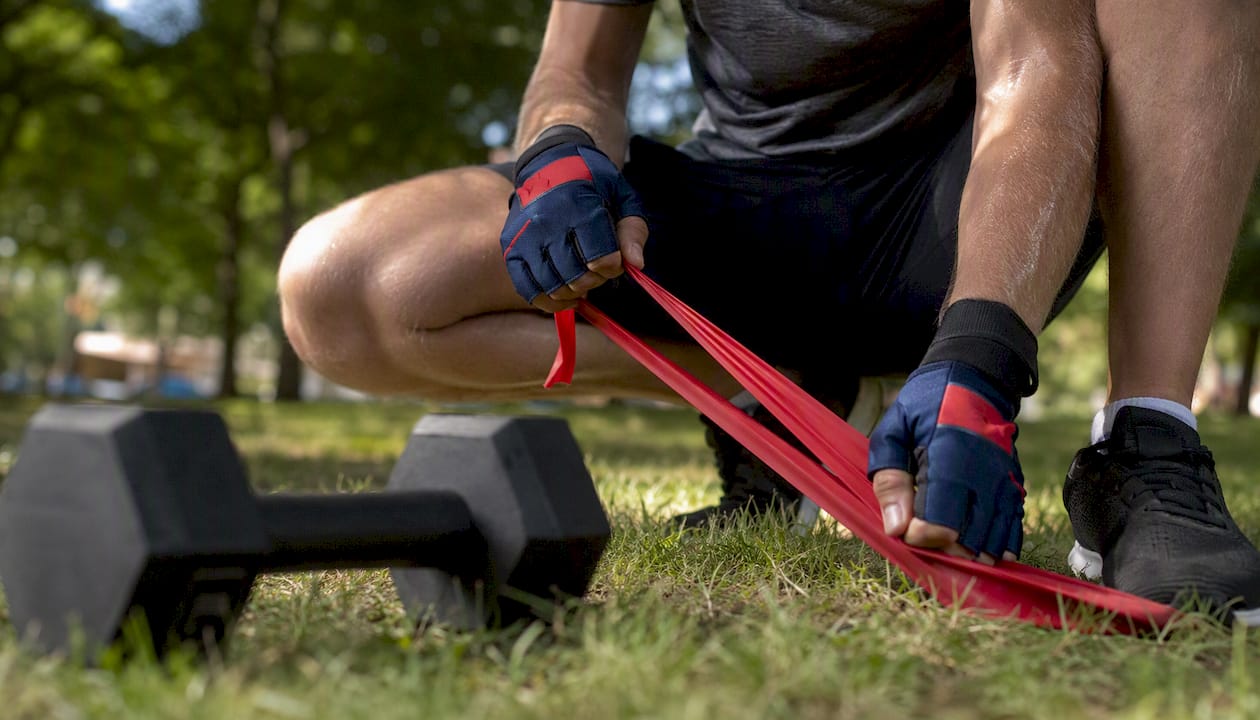
- Resistance bands: cheap, portable, and ideal for rows and rotational work.
- A medicine ball: useful for the rotational chop and other explosive movements.
- Dumbbells: the most flexible tool for presses, rows, and carries.
- A sandbag: an unstable load that challenges your core more than a fixed weight.
No budget for gear? A loaded backpack replaces a weighted vest, gallon jugs work as makeshift dumbbells, and a sturdy towel can substitute for a resistance band in some pulling exercises. If you’re building a starter kit, prioritize one pair of adjustable dumbbells and a resistance band set first. That combination covers all six movement patterns without taking up much space. Training in gear that moves with you matters here too, and a performance shirt built for this kind of range of motion is worth having in the mix.
What Does the Research Actually Say?
The strongest evidence behind functional fitness comes from a controlled eight-week program of three sessions per week, roughly 60 minutes each, which produced measurable gains in balance and functional movement scores among middle-aged adults, along with improved body composition.
Outpatient physical therapists describe functional fitness as training that primes the nervous system to help muscles respond more efficiently in real-life situations, not just in a controlled gym environment.
That framing from Dartmouth Health’s physical therapy team matters because it shifts the goal away from chasing a bigger lift and toward a body that reacts well under unpredictable, real-world conditions. Clinician guidance from Harvard Health and the Mayo Clinic Diet blog echoes this, both describing functional exercises as multi-joint movements that build core stability and mirror daily tasks rather than isolating single muscles. The practical takeaway: pick a frequency you can sustain, three sessions a week is well-supported, and let the movement patterns do the work over consistent weeks rather than chasing quick fixes.
Why Functional Fitness Fits Real Life Better Than a Gym Routine
Most people don’t fail at fitness because they lack motivation. They fail because the training they chose doesn’t match what their body actually needs to do all day. Functional fitness closes that gap. It’s the difference between having strong arms for photos and having a body that can carry a couch up a flight of stairs without pulling something.
What gets overlooked is how much this approach depends on consistency over intensity. The eight-week research behind these gains used three sessions a week, not daily grinding. That’s a sustainable rhythm, and sustainability is what actually changes how your body performs a decade from now.
At Teamjhall, we build apparel for people who train this way, competitors, everyday athletes, and everyone chasing something real in how they move. Functional fitness reflects that same philosophy: consistency over flash, function over show.
Frequently Asked Questions
What is functional fitness explained in one sentence? Functional fitness is training built around real-life movement patterns, like squatting, hinging, pushing, pulling, carrying, and rotating, so daily tasks get easier and safer.
Is functional fitness better than traditional weight training? Neither is strictly better. Functional fitness improves movement transfer and balance, while traditional lifting builds muscle size more directly. Most well-rounded programs use both.
How often should I do functional fitness training? Three sessions a week is well-supported by research and realistic for most schedules, producing measurable improvements in balance and functional movement within eight weeks.
Can beginners do functional fitness safely? Yes. Start with bodyweight versions of the six movement patterns, focus on form, and progress to bands, dumbbells, or kettlebells once movements feel controlled.
Do I need a gym to practice functional fitness? No. A backpack, resistance bands, or household items like gallon jugs can substitute for most gym equipment, since the emphasis is on movement pattern, not the tool.
Sources
- Sustainability (MDPI) — study cited by Medical News Today
- PMC article on movement patterns
- Harvard Health — Functional fitness
- Mayo Clinic Diet blog — Functional fitness: Is it right for you?
- Dartmouth Health — Why you need functional fitness for strength and balance
- Cleveland Clinic — Getting started with functional strength training