

Why Playing Multiple Sports Matters for Young Athletes
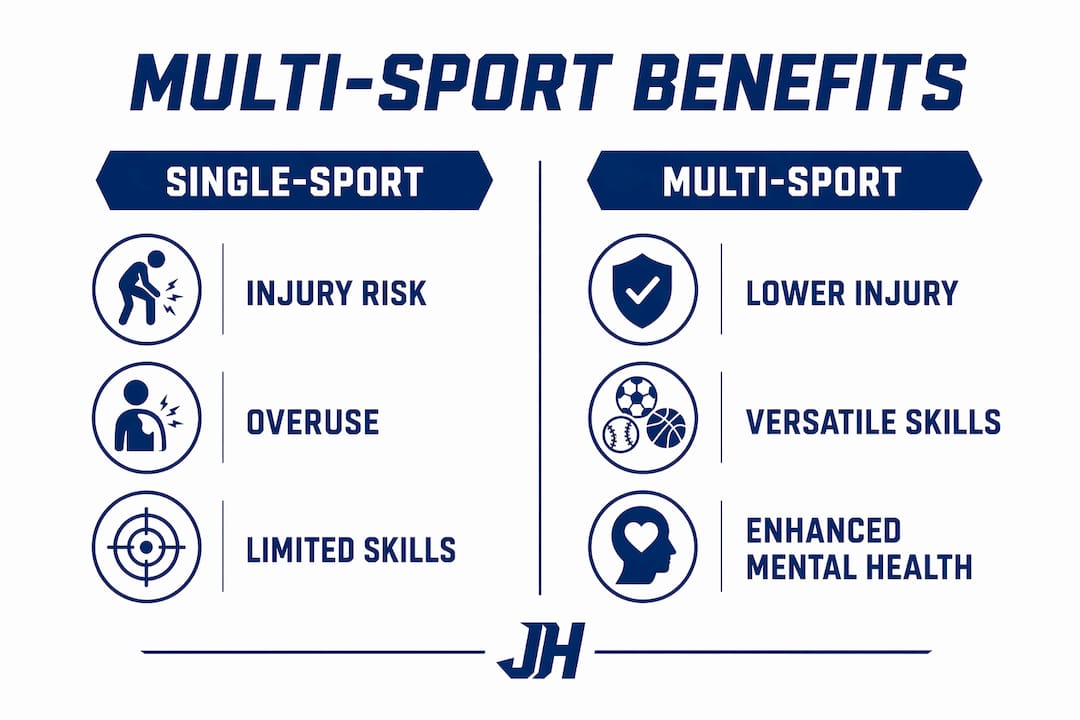
Multi-sport participation builds more durable, versatile athletes and cuts overuse injury risk — and the evidence behind that claim is strong enough that UHealth and Dartmouth Health Children’s both recommend delaying single-sport specialization until at least age 12–15. Studies cited by UHealth report that early specialization nearly doubles mental-health risk compared with kids who play multiple sports. The short version: keep seasons varied, aim for 3–4 different sports across the year, and resist the pressure to lock a child into one sport before mid-adolescence.
- Multi-sport athletes show lower burnout rates and higher long-term physical activity levels than early specializers.
- Overuse injuries — stress fractures, tendinitis, growth-plate problems — spike when kids train in one sport year-round.
- Elite-level outcomes favor early diversification: 29 of 32 first-round picks in the 2018 NFL Draft had multi-sport backgrounds.
Table of Contents
- Why playing multiple sports matters for your body
- How multi-sport participation shapes mental health and social skills
- When should a young athlete specialize?
- How to plan a multi-sport year that actually works
- What to look for in apparel when your athlete plays multiple sports
- Key Takeaways
- The case for multi-sport development, from where I stand
- Teamjhall gear built for multi-sport athletes
- Sources and further reading
Why playing multiple sports matters for your body
Varied sport exposure protects the body in a way that single-sport training simply cannot replicate. When a child runs, throws, swims, and kicks across different seasons, no single muscle group absorbs the same repetitive load week after week. That rotation is what prevents the stress fractures, tendinitis, and growth-plate damage that accumulate with year-round specialization. Pitching more than eight months a year, for example, carries a significantly increased risk of elbow surgeries — a pattern that shows up across adolescent baseball at alarming rates.
The neuromuscular case is just as compelling. Each sport demands a different movement vocabulary: the lateral shuffle of basketball, the rotational power of tennis, the proprioceptive demands of gymnastics. A Scientific Reports study found that kids engaged in diverse sports participation showed better strength, endurance, speed, and flexibility — and stuck with their programs longer. That motor-skill foundation transfers directly to agility and sport IQ in ways that single-sport drilling cannot produce.
One nuance worth naming: a PMC study on ACL reconstruction outcomes found no clear advantage for multi-sport athletes in post-surgical recovery timelines. Multi-sport participation is powerful for prevention and development — it is not a guaranteed fast-track through injury rehab.
| Risk Factor | Single-Sport Specialization | Multi-Sport Participation |
|---|---|---|
| Overuse injury risk | High (repetitive loading, no seasonal rest) | Lower (varied loading patterns) |
| Burnout likelihood | Higher, especially pre-adolescence | Lower; renewed focus each season |
| Weekly hour cap (safe guideline) | Often exceeded without structure | Target: no more hours/week than athlete’s age, max ~16 hrs |
| Elite-athlete background | Minority | 29 of 32 2018 NFL first-round picks had multi-sport histories |
Practical load rules from pediatric guidance: build in 1–2 rest days per week, and never let weekly training hours exceed the athlete’s age. A 10-year-old should train no more than 10 hours per week across all sports combined.
How multi-sport participation shapes mental health and social skills
Early specialization nearly doubles mental-health risk in youth athletes — that figure alone should reframe how families think about the youth sports calendar. When a child’s entire athletic identity is tied to one sport, a bad season, an injury, or a coach conflict can feel catastrophic. Spreading across sports distributes that emotional risk and keeps the experience of competition feeling fresh.
The social gains are real and often underappreciated. Rotating through different teams means a child builds relationships with different peer groups, adapts to different coaching styles, and learns to communicate in new contexts every season. That kind of social flexibility — reading a room, earning trust quickly, following a new leader — is exactly what athletic identity research identifies as a marker of long-term resilience.
- Multi-sport kids are more likely to stay physically active into adulthood than early specializers.
- Changing team contexts builds leadership and communication skills that carry beyond sport.
- Exposure to multiple sports helps children discover where their genuine passion and talent align — rather than defaulting to the sport a parent or coach chose for them at age seven.
Pro Tip: Alternate a high-intensity competitive season with a lower-stakes or recreational season. That rhythm preserves enjoyment and gives the nervous system — and the kid — a real break.
When should a young athlete specialize?
The research consensus is clear: for most sports, delay specialization until at least age 12–15. UHealth guidance and the PMC sports-specialization review both point to middle or late adolescence as the appropriate window, with narrow exceptions for early-entry artistic disciplines like gymnastics or figure skating. A meta-analysis in Perspectives on Psychological Science found that world-class adult athletes had more multidisciplinary early practice — not less — and started their primary sport later than their peers.
Signs specialization is happening too soon:
- Persistent pain that does not resolve with a few days of rest
- Training in one sport more than eight months per year
- Declining enjoyment, reluctance to attend practice, or mood changes around game days
- Sleep disruption tied to performance anxiety
- Refusal to take at least one full season off per year
When the timing is right, transition gradually:
- Let the athlete lead the conversation — genuine motivation matters more than a parent’s timeline.
- Reduce secondary sports one at a time rather than cutting everything at once.
- Work with a coach to set a phased practice plan that preserves cross-training elements.
- Build a competitive sports portfolio that documents progress across sports before narrowing focus.
- Keep at least one full off-season per year, even after specialization begins.
Pro Tip: Before any specialization conversation with a coach, ask directly: “What does your off-season program look like, and how do you handle athletes who cross-train?” A coach who dismisses cross-training is a red flag.
How to plan a multi-sport year that actually works
Aim for 3–4 different sports across the calendar year and protect at least one low- or no-competition season. That framework comes from Dartmouth Health Children’s guidance and aligns with what sustainable fitness scheduling research shows about periodization for young athletes.
| Season | Sport Focus | Weekly Hours (example, age 12) | Rest Days |
|---|---|---|---|
| Fall | Soccer or football | — | 2 days minimum |
| Winter | Basketball or swimming | — | 2 days minimum |
| Spring | Baseball, track, or tennis | — | 2 days minimum |
| Summer | Low-competition / recreational | — | 3+ days; prioritize recovery |
Managing time conflicts is the hardest part for most families. When schedules collide, let the athlete choose — that autonomy builds ownership and prevents resentment. Set a firm travel-time limit per week so sports logistics do not consume family life. For recovery and load management between seasons, structured rest is not optional; it is where adaptation happens.
- Resolve practice overlaps by talking to coaches early in the season, not mid-season.
- Cap total organized sports commitments at two simultaneous sports maximum.
- Treat the summer low-competition window as a genuine recovery block, not a third competitive season.
What to look for in apparel when your athlete plays multiple sports
Versatility is the non-negotiable starting point. Gear that works only for one sport creates friction — and expense — every time the season changes. For apparel, prioritize these features:
- Moisture-wicking fabric that pulls sweat away during high-output sessions
- Four-way stretch that accommodates the lateral cuts of basketball and the forward drive of track
- Reinforced seams that hold up through repeated washing and high-movement use
- Quick-dry construction for athletes moving between practices with little turnaround time
- Inclusive sizing so every athlete in the family finds a fit that supports full range of motion
Footwear is sport-specific — do not cut corners on cleats or court shoes. But apparel above the ankle can and should work across contexts. A performance tee worn for a morning track workout should be just as functional at an afternoon basketball practice. When evaluating a garment in-store or at home, do a squat, a lateral shuffle, and a reach overhead. If the fabric pulls, bunches, or restricts, it will fail mid-game.
Pro Tip: Check the fabric weight. Lighter is not always better for multi-sport use — a mid-weight moisture-wicking fabric handles both cool morning warm-ups and peak-exertion afternoon sessions without feeling soaked or stiff.
Protective gear — shin guards, helmets, pads — stays sport-specific. Do not try to cross-use protective equipment across sports. The savings are not worth the safety trade-off.
Key Takeaways
Multi-sport participation builds more durable, versatile athletes by reducing overuse injury risk, supporting neuromuscular development, and protecting long-term mental health — delay specialization until at least age 12–15 and aim for 3–4 sports across the year.
| Point | Details |
|---|---|
| Delay specialization | Research and medical guidance support waiting until age 12–15 for most sports before narrowing focus. |
| Follow the hour rule | Never train more hours per week than the athlete’s age; cap at approximately 16 hours for competitive youth. |
| Target 3–4 sports per year | Dartmouth Health Children’s recommends 3–4 different sports across the year with at least one low-competition season. |
| Watch for red flags | Persistent pain, declining enjoyment, and training more than 8 months in one sport signal premature specialization. |
| Gear for versatility | Choose moisture-wicking, four-way-stretch apparel with reinforced seams; Teamjhall designs performance pieces built for exactly this kind of multi-sport, multi-season use. |
The case for multi-sport development, from where I stand
The conventional wisdom in youth sports has long been that earlier focus equals faster progress. Coaches push it, travel-team culture reinforces it, and well-meaning parents buy in because the logic sounds reasonable. But the evidence keeps pointing the other direction: early diversification produces more sustainable athletes, not slower ones.
What gets underestimated is the identity piece. A child who has only ever been “a soccer player” is one bad season away from losing their entire athletic self-concept. A child who has been a soccer player, a swimmer, and a point guard has a much wider foundation to stand on. That resilience does not show up in a tryout drill — it shows up three years later when the pressure gets real.
At Teamjhall, the belief is that athletes are built across contexts, not just inside one sport. The apparel we design reflects that: pieces that move with you from the weight room to the court to the field, because the best athletes rarely live in just one of those places.
Teamjhall gear built for multi-sport athletes
Athletes who rotate across sports need apparel that keeps up — not pieces that wear out after one season or restrict movement on a different court. Teamjhall’s performance line is built for exactly that kind of use: moisture-wicking fabrics, four-way stretch, and durable construction that holds up through fall soccer, winter basketball, and spring track without missing a rep.

The UA Ladies Athletic Tee is a strong starting point for female athletes and active moms who train alongside their kids — breathable, form-supporting, and versatile enough for any season. For the full range of performance pieces designed for competitors who never stop moving, visit Teamjhall and find the gear that fits your whole athletic year, not just one sport.
Sources and further reading
- Choosing Variety: The Case for Multi-Sport Participation in Youth Athletics — UHealth Collective
- Importance of Variety in Activities — Dartmouth Health Children’s
- Sports Specialization, Part II: Alternative Solutions to Early Sport Specialization in Youth Athletes — PMC
- What Makes a Champion? Early Multidisciplinary Practice, Not Early Specialization — Perspectives on Psychological Science
- Multi-Sport Participation and ACL Recovery Outcomes — PMC
- Sports Program Diversity and Physical Fitness — Scientific Reports
- Benefits of Playing Multiple Sports — Geisinger