

Champion Daily Routines: 8 Examples You Can Use Today
Here are concrete, ready-to-use examples of champion daily routines you can copy and adapt right now. Each one below maps to a different lifestyle, schedule, or performance goal.
Quick-scan list:
- Morning Athlete Routine — mobility, cold exposure, visualization before 7 AM
- Entrepreneur Deep-Work Day — 90-minute focus blocks, zero meetings before noon
- Artist/Creator Ritual — protected creative window, analog warm-up, output review
- Scientist/Researcher Focus Day — literature review, deep-work sprint, peer check-in
- Recovery-First Schedule — sleep anchor, active recovery, nutrition timing
- Travel/Compressed Routine — 20-minute minimum viable version for busy days
- Mental-Performance Routine — visualization, breathwork, pre-performance cue
- Evening/Night-Priority Routine — wind-down protocol, reflection, next-day prep
Elite athletes like Connor Fields and high-output entrepreneurs share one thing: they don’t rely on motivation. They build systems. Forbes notes that highly successful people run significant parts of their day on autopilot, preserving mental energy for decisions that actually matter. These eight routines are built on that same principle.
Key Takeaways
Champion routines work because they automate high-value behavior, reduce daily decision fatigue, and compound into elite performance over weeks and months.
| Point | Details |
|---|---|
| Start with three priorities | Pick only three outcomes your routine serves; everything else fills around them. |
| Protect one anchor hour | A single daily block, same time every day, is the most reliable consistency strategy. |
| Use the compressed version | A 20-minute minimum viable routine prevents the all-or-nothing trap on busy days. |
| Run a two-week trial | Two weeks is enough to feel the difference; track one metric and don’t optimize mid-trial. |
| Teamjhall performance gear | Teamjhall apparel is built for athletes and competitors who show up for their routines daily. |
Table of Contents
- Eight champion daily-routine examples with sample schedules
- Why champion routines produce outsized results
- How to build a champion routine that actually fits your life
- Quick templates and checklists you can use today
- What routines actually mean when you live by them
- Gear that helps you show up every day
- Sources
Eight champion daily-routine examples with sample schedules
Each routine below includes a purpose line, a sample time-block schedule, and one adaptation tip. Use them as starting points, not rigid scripts.
1. Morning athlete routine
Who it fits: Competitive athletes, fitness-focused individuals, anyone who performs best early.
| Time | Block |
|---|---|
| — | Wake, hydrate with water, 5-minute breathwork |
| — | Movement: strength or conditioning session |
| — | Cold exposure or contrast shower if possible |
| — | Visualization + journaling (3 wins from yesterday, 1 focus for today) |
| — | Breakfast, no screens |

Adaptation tip: Can’t hit 5:30 AM? Compress the movement block to 25 minutes and skip cold exposure on weekdays. The visualization and journaling stay — they take 10 minutes and set the mental frame for the day.
For a deeper look at how professional athletes structure their full training days, the Teamjhall training habits guide breaks it down in practical terms.
2. Entrepreneur deep-work day
Who it fits: Founders, freelancers, remote workers who need sustained cognitive output.
| Time | Block |
|---|---|
| — | Wake, coffee, 10-minute review of top 3 priorities |
| — | Deep-work sprint #1 (avoid email and message distractions) |
| — | Walk or light movement |
| — | Deep-work sprint #2 |
| — | Meetings, calls, collaboration |
| — | Lunch + mental reset |
| — | Administrative tasks, email batch |
| — | Optional third focus block or learning |
Adaptation tip: If mornings are unavailable, shift both deep-work sprints to late afternoon and protect that window just as fiercely. The 90-minute block structure matters more than the clock time.
Kevin O’Leary’s documented routine follows a similar logic: early wake, sustained physical activity, and strict limits on email access until his most productive hours are spent.
3. Artist/creator ritual
Who it fits: Writers, designers, musicians, content creators who need a protected creative window.
| Time | Block |
|---|---|
| — | Wake, analog warm-up (sketch, freewrite, or instrument) |
| — | Primary creative work — no feedback, no publishing |
| — | Break, walk outside |
| — | Revision, editing, or secondary creative tasks |
| — | Lunch, rest |
| — | Output review: what shipped, what needs work |
Adaptation tip: The analog warm-up is the most skippable-looking piece and the most important. Even five minutes of freewriting before opening a laptop shifts the brain from reactive to generative mode.
4. Scientist/researcher focus day
Who it fits: Graduate students, researchers, analysts, anyone doing knowledge-intensive work.
| Time | Block |
|---|---|
| — | Wake, light movement, review yesterday’s notes |
| 7:30–9:30 AM | Literature review or data analysis sprint |
| — | Break |
| — | Writing or experimental work |
| — | Lunch, walk |
| — | Peer check-in, collaboration, or secondary reading |
| — | Daily log: what was learned, what’s next |
Adaptation tip: Batch all email and Slack into a single 30-minute window after lunch. Researchers who check messages continuously lose the deep-focus state that produces original thinking.
5. Recovery-first schedule
Who it fits: Athletes in heavy training blocks, anyone returning from injury, or high-stress periods.
| Time | Block |
|---|---|
| — | Wake, mobility work, hydration protocol |
| — | Breakfast with protein and carbohydrate timing |
| — | Low-intensity active recovery (walk, swim, or yoga) |
| — | Lunch, rest |
| — | Nap or meditation (20–30 min) |
| — | Wind-down: no screens, light stretching, sleep prep |
| 9:30 PM | Lights out |
Adaptation tip: Recovery routines fail when athletes treat them as optional. Schedule the nap and the wind-down the same way you’d schedule a workout. For nutrition timing guidance that supports this template, the Teamjhall athletic performance nutrition guide is worth bookmarking.
6. Travel/compressed routine for busy days
Who it fits: Anyone whose schedule gets disrupted by travel, family obligations, or packed workdays.
| Time | Block |
|---|---|
| 6:00–6:20 AM | 20-minute minimum viable workout (bodyweight or hotel gym) |
| 6:20–6:30 AM | 5-minute visualization, 5-minute journaling |
| Evening | 10-minute wind-down reflection before sleep |
This is the non-negotiable floor. On a compressed day, three things stay: movement, mental prep, and a brief reflection. Everything else is optional. BetterUp’s daily routine research confirms that even short, consistent habit blocks outperform elaborate routines that get abandoned under pressure.
Adaptation tip: Build this version first, before you build the full version. Knowing your floor prevents the all-or-nothing trap that kills most routines.
7. Mental-performance routine
Who it fits: Athletes before competition, executives before high-stakes presentations, performers before a show.
| Time | Block |
|---|---|
| 60 min pre-event | Arrive at location, change into gear, reduce external stimulation |
| 45 min pre-event | 10-minute breathwork (box breathing or 4-7-8 pattern) |
| 35 min pre-event | Visualization: run the performance in full detail, including obstacles |
| 20 min pre-event | Physical activation (dynamic warm-up or light movement) |
| 10 min pre-event | Anchor cue: a phrase, gesture, or song that signals “go mode” |
Connor Fields, an Olympic BMX champion, documents daily visualization as a core training tool, not a pre-competition add-on. The neural pathways built through regular mental rehearsal function the same way physical repetition does. The more you rehearse the performance mentally, the more automatic it becomes under pressure.
Pro Tip: Pick one anchor cue and use it every single time — before practice, before competition, before any high-stakes moment. The cue only works because of its consistency. Change it and you reset the conditioning.
8. Evening/night-priority routine
Who it fits: Night owls, shift workers, parents of young children, or anyone whose best hours are after 6 PM.
| Time | Block |
|---|---|
| 6:00–7:00 PM | Primary deep work or training session |
| 7:00–8:00 PM | Dinner, family time, social connection |
| — | Creative or learning block |
| 9:00–9:30 PM | Reflection: journal, gratitude, next-day priorities |
| 9:30–10:00 PM | Wind-down: no screens, reading or light stretching |
| 10:00 PM | Sleep |
Adaptation tip: The biggest risk in an evening-priority routine is letting social media or streaming eat the wind-down window. Set a hard stop on devices at 9:30 PM and treat it like a meeting you can’t reschedule.
Why champion routines produce outsized results
Routines work because they convert intention into automated, energy-efficient behavior that compounds over time. That’s not motivational language; it’s how the brain actually operates.
Forbes describes how highly successful people condition routines to run on autopilot, reducing the number of decisions they face before noon. Every decision you make draws from the same finite pool of cognitive energy. When your morning is scripted, that energy stays available for the work that actually moves the needle.
Three mechanisms explain most of the performance gain:
Habit automation and context cues. When a behavior is tied to a consistent time, place, or preceding action, the brain stops deliberating and starts executing. The cue triggers the routine without willpower.
Decision fatigue reduction. Discipline is a system, not a feeling. Champions don’t rely on motivation because motivation is inconsistent. A pre-built schedule removes the daily negotiation with yourself about whether to train, when to start, or what to prioritize.
Recovery as performance infrastructure. Sleep and active recovery aren’t passive. They’re when the body consolidates skill, repairs tissue, and resets the nervous system. Routines that protect sleep duration and quality directly protect performance output.
Measurement closes the loop. Tracking one metric per routine (sleep score, output volume, training load) gives you feedback that motivation alone never provides. The discipline-fitness connection is exactly this: small daily decisions, tracked and repeated, compound into results that look extraordinary from the outside.
How to build a champion routine that actually fits your life
The framework is simple. The execution is where most people stall.
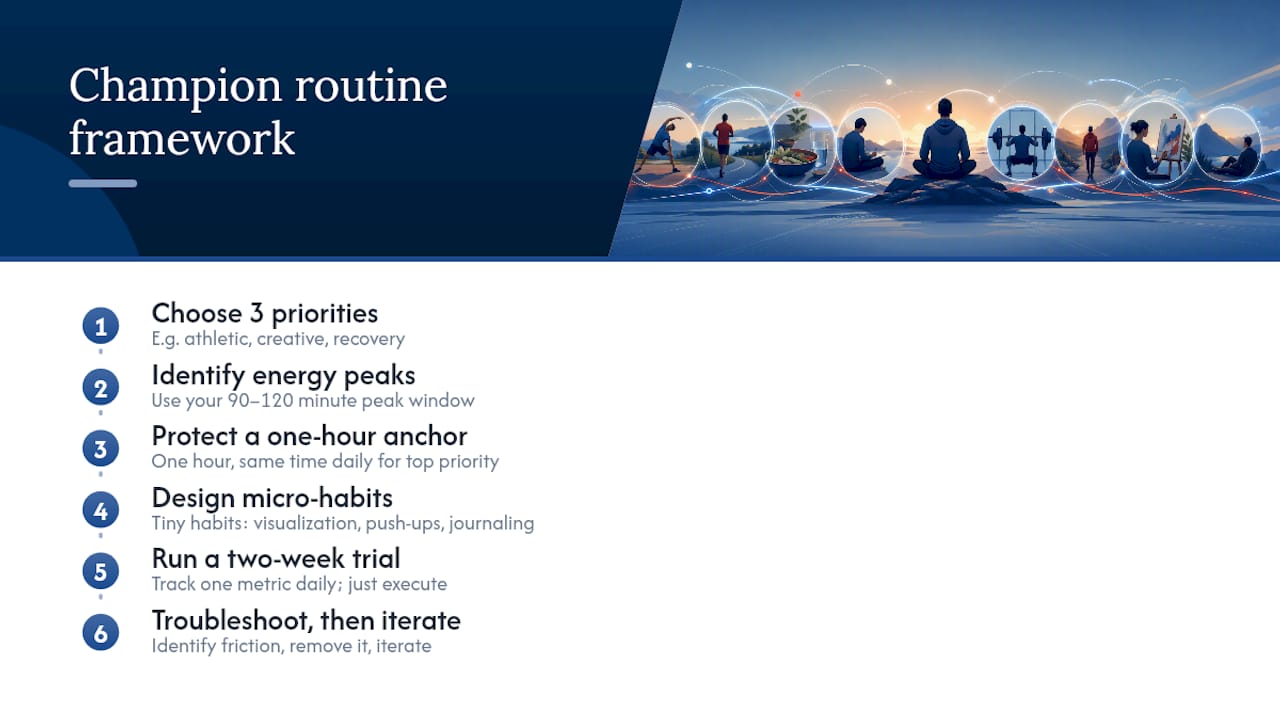
Step 1: Choose 3 priorities. Not ten. Pick the three outcomes that matter most right now: athletic performance, creative output, recovery, mental clarity, family presence. Your routine exists to serve those three things.
Step 2: Identify your energy peaks. Most people have a 90–120 minute window of peak cognitive or physical energy. Schedule your highest-priority work or training there. Everything else fills around it.
Step 3: Protect a one-hour anchor. One hour, same time every day, dedicated to your top priority. Protecting this anchor period is the single most reliable consistency strategy across every routine archetype.
Step 4: Design micro-habits for each priority. A micro-habit is a behavior small enough that skipping it feels worse than doing it. Five minutes of visualization. Ten push-ups. One page of journaling. These are the seeds of the full routine.
Step 5: Run a two-week trial. Two weeks is long enough to feel the difference and short enough to commit without dread. Track one metric daily (sleep hours, training sessions completed, pages written). Don’t optimize during the trial — just execute and observe.
Step 6: Troubleshoot, then iterate. Missed a day? Identify the friction point (alarm, prep time, energy level) and remove it. Traveling? Drop to the compressed version from Routine 6. The goal is never perfection; it’s a floor you can always return to.
Experts consistently recommend personalizing routines to match your values rather than copying someone else’s schedule hour for hour. The principles transfer. The exact times don’t.
For mental preparation specifically, the athletic mindset guide covers visualization and pre-performance cues in detail.
Quick templates and checklists you can use today
| Template | Key Priority | Anchor Time | Min. Duration | Busy-Day Swap | Metric to Track |
|---|---|---|---|---|---|
| Athlete | Training + recovery | 6:00 AM | 30 min | 20-min bodyweight session | Sessions completed per week |
| Founder | Deep work | 6:30 AM | 45 min | One 90-min focus block | Output tasks completed |
| Creative | Uninterrupted creation | 7:00 AM | 45 min | 20-min freewrite or sketch | Creative output shipped |
| Recovery | Sleep + active recovery | 9:30 PM (sleep) | 20 min | 15-min mobility + 8-hr sleep | Sleep hours logged |
Daily review checklist (takes 5 minutes):
- Sleep: Did you hit your target hours?
- Movement: Did you complete your minimum viable session?
- Focused work: Did you protect your anchor block?
- Recovery: Did you eat, hydrate, and decompress?
- Connection: Did you check in with family, faith, or community?
Copy this checklist into Notion, Apple Notes, or a printed habit tracker. The format doesn’t matter. The daily review does.
What routines actually mean when you live by them
Most articles about champion routines treat them as productivity hacks. That framing misses the point. A routine isn’t about squeezing more output from your day. It’s about deciding, in advance, who you’re going to be when you wake up.
The values that drive Teamjhall — confidence, consistency, family, faith, loyalty — aren’t abstract. They show up in the choices you make before 8 AM. Whether you train when you don’t feel like it. Whether you protect time for the people who matter. Whether you show up the same way on a hard day as you do on an easy one.
The templates in this article are starting points. Adapt them. Cut what doesn’t fit your life. Add what reflects what you actually care about. The goal isn’t to copy a champion’s schedule; it’s to build a schedule that makes you one.
Gear that helps you show up every day
Consistency starts before you walk out the door. When your training gear fits right and feels built for performance, the friction of getting started drops. That’s not a small thing.

Teamjhall designs performance apparel for athletes, creators, and competitors who take their routines seriously. The TJH Performance Shirt is built for training sessions, morning workouts, and the days when showing up is the whole battle. For women training on their own schedule, the UA Ladies Athletic Tee delivers the same performance-first fit. Browse the full collection at Teamjhall and gear up for the routine you’re building.
Sources
- This Is How Highly Successful People Plan Their Daily Routines
- 14 Daily Routine Examples For a Productive and Powerful Day
- Elite Performance Habits That Drive Elite Results
- Kevin O’Leary’s daily routine (Business Insider)
- The morning routines of successful people (WeWork Ideas)