

10 Fitness Habits of Successful Parents That Actually Stick
The fitness habits of successful parents come down to four non-negotiables: protected short sessions, habit-stacked movement throughout the day, family-integrated activities, and consistent recovery. You don’t need an hour. You need a system that survives your worst week.
The 8 habits to start today:
- Protect two short anchor sessions per week, no matter what
- Use exercise snacking: 3–5 minute movement bursts between parenting tasks
- Stack workouts onto existing habits (coffee brewing, school drop-off, nap time)
- Make family play count toward your weekly activity goals
- Train functional strength: squats, hinges, carries, and core work
- Eat protein at every meal and keep high-protein snacks ready
- Prioritize sleep over late-night screen time
- Rest on purpose: short breathing and mobility work between demands
Do this today: Block two workout slots in your calendar this week and treat them like a pediatrician appointment. Non-negotiable.
Table of Contents
- How do successful parents find time to work out?
- What workout formats actually fit a parent’s schedule?
- How to make fitness a family habit, not a competition with parenting
- Which strength moves do parents actually need?
- What should busy parents actually eat and how do they protect sleep?
- How do you recover when you’re already running on empty?
- A plug-and-play weekly schedule you can copy right now
- How do you make these habits stick long-term?
- What does the research say about short workouts for parents?
- Key Takeaways
- Why family-first fitness is the only kind worth building
- Useful sources and further reading
How do successful parents find time to work out?
The answer isn’t time management. It’s expectation management. Parents who stay consistent don’t plan for their best week. They plan for their worst week and build a minimum that holds up when everything goes sideways.
That shift matters more than any workout program. When your baseline is two 20-minute sessions and a few movement snacks, a sick kid or a late work call doesn’t derail you. You just hit the minimum and move on.
The practical tool is simple: pick two anchor slots per week, ideally the same days and times. Early morning before the house wakes up, during a school pickup window, or right after bedtime routines are the three most common choices for parents. Write them down. Block them in your phone. Then build a short list of exercise-snack rules for the days those slots get blown up: three sets of push-ups while the coffee brews, a 5-minute walk after lunch, bodyweight squats during a conference call.
Protecting anchor sessions and unpredictable schedules is a skill, not a personality trait. You build it by designing the system around failure, not success.
Pro Tip: Don’t ask yourself “do I have time to work out today?” Ask “which version of my workout fits today?” A 5-minute version still counts.
What workout formats actually fit a parent’s schedule?
Short formats deliver real results when done consistently. Exercise snacking, 10–15 minute circuits, and 20–30 minute anchor sessions each have a place in a parent’s week, and you don’t need all three every day.
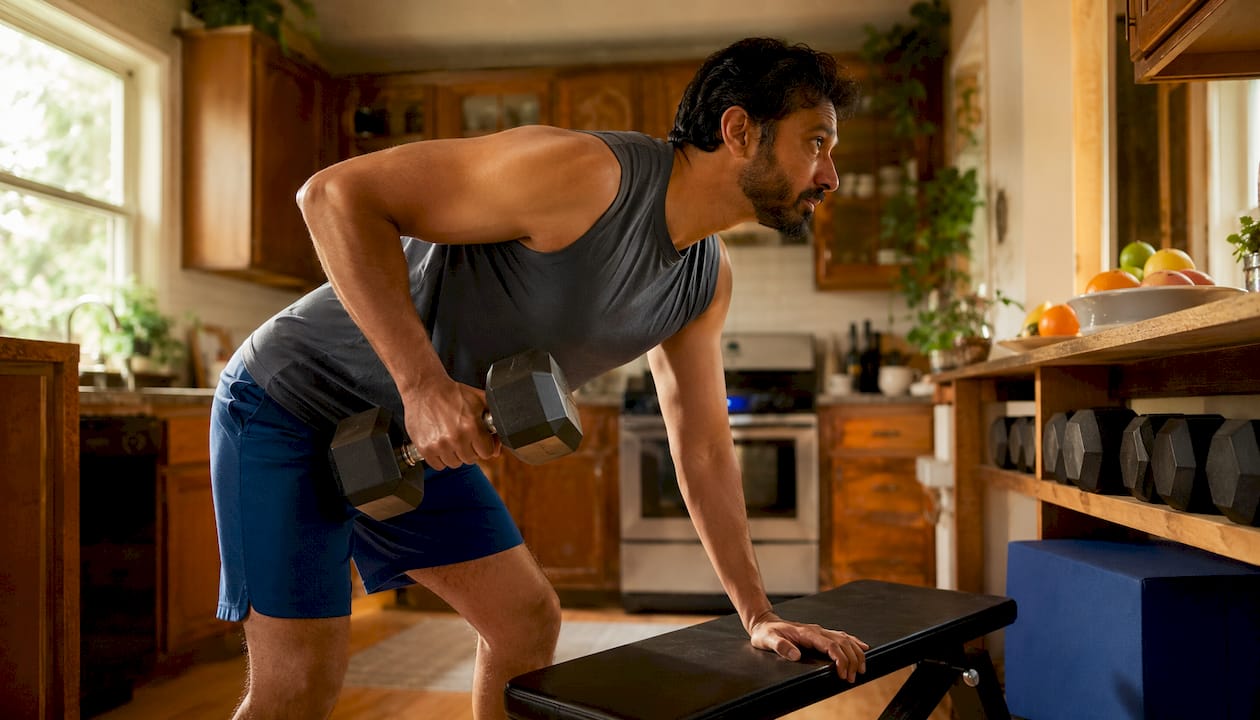
Exercise snacking means slicing movement into segments as short as 90 seconds and as long as 15 minutes, distributed across the day. The barrier to starting drops dramatically when the commitment is “one set of squats” instead of “a full workout.” Keep a resistance band or a pair of dumbbells visible in the kitchen or living room. Visible equipment triggers action; equipment in a closet doesn’t.
Here are three templates you can use today:
-
10-minute full-body circuit (anchor or snack): 40 seconds on, 20 seconds rest. Goblet squat, push-up, reverse lunge, plank hold, hip hinge. Two rounds. No equipment needed beyond bodyweight or one dumbbell.
-
12-minute stroller walk circuit: Walk briskly for 3 minutes, stop for 10 bodyweight squats and 10 push-ups against a bench or curb, repeat four times. Covers cardio and strength in one block.
-
15-minute strength micro-session: Three compound moves, three sets each, minimal rest. Deadlift (or Romanian deadlift with dumbbells), push-up variation, farmer carry. This is your anchor session on a compressed day.
For setup, the home workout routine guide at Teamjhall covers how to organize a small training space and scale sessions when time or energy is limited. The key cue to start: put on your shoes. That single physical action is the most reliable trigger parents report for following through.
Pro Tip: Accumulate reps across the day when you can’t string a full session together. Ten push-ups five times beats zero push-ups once.
How to make fitness a family habit, not a competition with parenting
Treating exercise as family play increases your consistency and teaches your kids something no classroom can. When movement is woven into the day rather than carved out against it, you stop fighting the schedule.
The WHO Physical Activity Guidelines recommend adults accumulate 75 minutes of vigorous activity or 150 minutes of moderate activity per week. Active family play counts toward that total. A 30-minute bike ride, a playground session where you’re actually moving, a game of tag in the backyard — these are not consolation prizes. They’re legitimate training.
Activity ideas that count toward your weekly minutes:
- Family walks at a brisk pace (20–30 minutes)
- Playground circuits: pull-ups on monkey bars, step-ups on benches, lunges between equipment
- Bike rides with kids in a trailer or on their own bikes
- Tag, relay races, or obstacle courses in the yard
- Swimming laps while kids play in the same pool
For ages 2–10, the goal is unstructured movement with you present and participating. Chase them. Carry them. Roll on the floor. That’s functional training with a better soundtrack. For ages 11 and up, you can introduce simple shared workouts: a 10-minute bodyweight circuit before school, a weekend hike with a weighted pack, or a friendly push-up challenge.
Research on athletic career longevity consistently points to parental modeling as one of the strongest predictors of a child’s long-term physical activity. You’re not just staying fit. You’re building a family culture.

Which strength moves do parents actually need?
Functional strength beats aesthetic-only training for parents, full stop. The goal isn’t a six-pack. It’s being able to lift a 40-pound kid off the floor without tweaking your back, carry two bags of groceries plus a diaper bag, and get up and down from the ground dozens of times a day without fatigue.
The functional fitness principles that apply to athletes apply directly here: compound movements, hip hinge patterns, loaded carries, and core stability under load. These movements match what parenting actually demands.
The 7 moves every parent should own:
- Goblet squat: Hold a dumbbell or kettlebell at your chest, squat deep. Builds leg and core strength for floor-to-standing transitions.
- Hip hinge / Romanian deadlift: The single most important move for parents. Teaches safe lifting mechanics for picking up kids and gear.
- Farmer carry: Pick up two heavy objects and walk. Builds grip, core, and shoulder stability simultaneously.
- Push-up progression: Start on knees if needed, progress to full, then add a pause at the bottom. Covers chest, shoulders, and triceps.
- Plank and side plank: Core stability that protects your lower back during all the asymmetrical carrying parents do.
- Reverse lunge: More stable than a forward lunge, easier on the knees, and directly mimics stair climbing with a load.
- Glute bridge: Floor-based, zero equipment, and directly counteracts the hip flexor tightening that comes from sitting and stroller pushing.
Two short strength sessions per week is enough to build and maintain functional capacity. Start with two sets of 8–10 reps per move. When that feels manageable for three consecutive sessions, add a third set or increase the load slightly.
Pro Tip: Keep one dumbbell or kettlebell next to your couch. If it’s visible during TV time, you’ll use it. If it’s in a bag in the garage, you won’t.
What should busy parents actually eat and how do they protect sleep?
Small, consistent protein-focused choices plus a few sleep-protecting rules do more for a parent’s fitness than any supplement or advanced program. Recovery is where the gains happen, and parents are chronically under-recovering.
On nutrition, the simplest framework is protein at every meal and a high-protein snack ready to grab. Greek yogurt, hard-boiled eggs, cottage cheese, rotisserie chicken, and protein shakes require almost no prep and cover the gap between meals. Batch-cooking one protein source on Sunday (a sheet pan of chicken thighs, a pot of ground turkey) cuts daily decision-making to nearly zero.
Practical rules that hold up on chaotic days:
- Eat protein first at every meal before anything else on the plate
- Keep three grab-and-go snacks stocked at all times (Greek yogurt, string cheese, mixed nuts)
- Prep one large protein batch per week and portion it into containers
- Drink water before coffee in the morning — dehydration compounds fatigue
- On low-sleep nights, swap high-intensity sessions for a 20-minute walk; don’t skip entirely
Sleep is the one variable parents underestimate most. Cutting sleep to squeeze in a 5 AM workout sounds disciplined. Getting less than six hours consistently raises cortisol, blunts recovery, and makes the workout less effective than a full night’s rest would have been. The rule: protect sleep first, then fit the workout around it. On nights when sleep is under six hours, lower the workout intensity and prioritize walking over lifting.
How do you recover when you’re already running on empty?
Short recovery practices reduce stress and make workouts sustainable over months and years, not just weeks. Parents don’t burn out from working out too hard. They burn out from never recovering between demands.
High-ROI recovery habits that take under 10 minutes:
- 3–5 minute breathing routine: Box breathing (4 counts in, 4 hold, 4 out, 4 hold) done before bed or after a stressful parenting moment lowers heart rate and cortisol measurably.
- 5–10 minute mobility flow: Hip flexor stretch, thoracic rotation, and a child’s pose sequence. Do it on the floor while kids watch a show.
- 10–20 minute nap: If your schedule allows, a short nap between 1–3 PM restores alertness without disrupting nighttime sleep.
- Low-effort walking: A 15-minute walk after dinner is active recovery, not a skipped workout. It improves digestion, reduces evening cortisol, and counts toward weekly minutes.
Scale back workout intensity when you’re running on less than six hours of sleep, dealing with illness, or carrying a heavy emotional load. This isn’t weakness. It’s the reason parents who prioritize functional strength and recovery over pre-parenting workout intensities stay consistent for years while others cycle through burnout.
Pro Tip: Put a foam roller or yoga mat in your living room, not a back room. Proximity drives use. A 5-minute floor stretch during a cartoon is still recovery.
A plug-and-play weekly schedule you can copy right now
A realistic parent week includes two protected anchor strength sessions, daily movement through walking or play, and exercise snacks on the days when the anchor sessions don’t happen. That’s the whole framework.
Sample weekly schedule
| Day | Primary session | Optional family activity |
|---|---|---|
| Monday | 20-min strength anchor (Template A) | Evening walk, 15 min |
| Tuesday | Exercise snacks only (3 × 5 min) | Playground after school |
| Wednesday | 20-min strength anchor (Template B) | Bike ride or yard play |
| Thursday | 15-min conditioning (Template C) | None required |
| Friday | Exercise snacks only (3 × 5 min) | Family active game |
| Saturday | 30-min family workout or hike | Counts as anchor |
| Sunday | Rest or 20-min walk | Light yard activity |
Three micro-workout templates
Template A — Bodyweight strength (20 min): Goblet squat 3×10, push-up 3×10, reverse lunge 3×8 each side, plank 3×30 sec. Rest 45 seconds between sets. Swap to knee push-ups or reduce sets on harder days.
Template B — Dumbbell strength (20 min): Romanian deadlift 3×10, farmer carry 3×30 sec, glute bridge 3×12, side plank 2×20 sec each side. Use lighter weights on low-sleep days; never skip the hip hinge.
Template C — Quick conditioning (15 min): Jump rope or jumping jacks 2 min, bodyweight squat 20 reps, push-up 15 reps, mountain climber 30 sec. Repeat three rounds with 60 seconds rest. Stroller-friendly version: replace jump rope with a brisk 3-minute walk pushing the stroller.
For longer program templates and scaling advice, Teamjhall’s home workout guide for athletes covers how to progress these sessions over 8–12 weeks.
How do you make these habits stick long-term?
Consistency beats perfect programming every time. A mediocre plan you follow for six months outperforms an optimal plan you abandon after three weeks. The accumulation approach — building reps and sessions across a week rather than chasing single perfect workouts — is what separates parents who stay fit from those who restart every January.
Habit stacks that work for parents:
- Morning coffee brews → 2 sets of push-ups and squats
- School drop-off → 10-minute walk before returning home
- Kids’ bath time → 5-minute mobility flow in the hallway
- Nap time starts → immediate workout start, no scrolling first
- After dinner → 15-minute family walk
For tracking, keep it to three metrics: sessions completed per week, average sleep hours, and energy level on a 1–5 scale. That’s it. A simple notes app or a paper habit tracker works fine. The goal is pattern recognition, not data collection.
Accountability options that don’t require a gym:
- Text a friend your two anchor session times each Monday
- Post a weekly check-in to a private group or a fitness community
- Set a recurring phone alarm labeled with your workout name, not just “workout”
- Use a goal-setting framework to set one specific monthly target tied to a parenting task (e.g., “carry my kid up the stairs without losing breath”)
The accountability doesn’t need to be public or elaborate. It needs to be consistent and slightly uncomfortable to skip.
What does the research say about short workouts for parents?
Parents can meet WHO weekly cardiovascular targets through a mix of short high-effort bouts and active family time. The WHO recommends 75 minutes of vigorous activity or 150 minutes of moderate activity per week for adults. Active family play counts toward those minutes, which means a parent who does two 20-minute strength sessions, three 15-minute walks, and one 30-minute family bike ride has covered the week.
Short sessions work because frequency and consistency drive adaptation, not session length alone. The five-pillar approach backed by practical fitness research — strength training, daily walking, adequate protein, sleep and stress management, and consistency over perfection — maps directly onto the plan in this article. None of those pillars require a gym membership or more than 30 minutes at a time.
Trust signals and resources behind this plan:
- WHO physical activity guidelines: official weekly targets for adults
- ACE Fitness at-home workout research: compound and EMOM formats for parents
- Teamjhall’s active family lifestyle guide: practical templates for integrating kids into movement
- Harvard Health and Mayo Clinic: functional fitness evidence base
- Jason (author): Teamjhall performance lifestyle content focused on family, consistency, and functional training
Key Takeaways
The most effective parenting fitness routines protect two short anchor sessions per week, stack movement onto existing daily habits, and count active family time toward WHO weekly targets.
| Point | Details |
|---|---|
| Protect anchor sessions | Block two 20–30 minute sessions weekly and treat them as non-negotiable appointments. |
| Use exercise snacking | Several brief movement bursts daily maintain consistency on chaotic days. |
| Family activity counts | Active play, walks, and bike rides count toward the WHO’s weekly recommended 75 minutes of vigorous or 150 minutes of moderate activity for adults. |
| Prioritize functional strength | Goblet squats, hip hinges, carries, and planks directly reduce injury risk from daily parenting tasks. |
| Recovery drives results | Short breathing routines, mobility work, and sleep-first rules sustain long-term adherence better than intensity alone. |
Your one-week checklist:
- [ ] Block two anchor workout slots in your calendar (treat them like appointments)
- [ ] Add 2–3 exercise snacks daily using the habit stacks above
- [ ] Take two active family sessions (walk, playground, bike ride) to count toward your 75 minutes of vigorous or 150 minutes of moderate activity goal this week
- [ ] Prep one high-protein food batch for the week
- [ ] Do one 5-minute breathing or mobility session before bed
Why family-first fitness is the only kind worth building
Most fitness content treats parenting as an obstacle to training. The parents who stay fit long-term treat it as the reason to train. That reframe changes everything about how you structure a week.
The plan in this article isn’t a compromise. Two anchor sessions, daily movement, functional strength, and family activity aren’t a watered-down version of real fitness. They’re what real fitness looks like when you have actual responsibilities. The parents who chase pre-kid training volumes usually burn out or resent the process. The ones who build around their life tend to still be moving well a decade later.
Gear matters less than mindset, but it helps to train in something that moves with you. Teamjhall builds performance apparel for exactly this kind of athlete: the parent who shows up for a 20-minute session at 5:45 AM, the one who does push-ups while the coffee brews, the one who runs a playground circuit with their kid on a Tuesday afternoon. That’s the athlete we’re designing for.
If you want longer programs and templates beyond what’s in this article, the Teamjhall blog has guides on purpose-driven fitness and training habits that scale with your season of life.
Useful sources and further reading
- WHO Physical Activity Guidelines — Official weekly targets (75 min vigorous / 150 min moderate) and definitions of what counts as moderate activity.
- ACE Fitness: At-Home Exercise Routines for Busy Parents — Two sample compound and EMOM workouts designed for parents at home.
- Harvard Health: Functional Fitness Moves — Evidence base for the functional movements prioritized in this plan.
- Mayo Clinic: Is Functional Fitness Right for You? — Plain-language explanation of functional training principles and benefits.
- CDC: Benefits of Physical Activity — U.S. government summary of physical activity benefits and guidelines.
- Teamjhall: Active Family Lifestyle Guide — Practical templates for building movement into family routines.
- Teamjhall: Home Workout Routine for Athletes — Scaling advice and session templates for constrained home environments.
- DepthChartIQ: Athletic Career Longevity Factors — Partner analysis on how parental modeling shapes long-term athletic development in kids.