

Footwork in Competitive Sports: Why It Wins Games
Footwork is the movement foundation that creates faster reactions, cleaner force transfer, and safer landings in competition. Every decisive action in sport — a defender cutting off a drive, a tennis player reaching an optimal contact point, a boxer slipping a punch — starts with where the feet are and how fast they get there. Here is what that means for your training right now:
- Reaction time: Proper foot positioning before a stimulus cuts the time between reading a cue and moving.
- Change-of-direction: Efficient deceleration and redirection mechanics determine whether you beat an opponent to a space or arrive a half-step late.
- Power transfer: Force moves through the kinetic chain from the ground up; poor foot placement bleeds power before it reaches the hands or hips.
- Injury risk: Controlled landings and stable single-leg positions reduce ankle sprains and ACL loading.
- Tactical positioning: Getting to the right spot early gives you options; arriving late forces errors.
Start today by running a 5-0-5 change-of-direction test to establish your baseline, or schedule two short SAQ micro-sessions this week.
Table of Contents
- Why does footwork affect performance in competitive sports?
- What components make footwork effective?
- How do different sports use footwork patterns?
- What does research say about footwork training timelines?
- How should you design a footwork training program?
- Practical drills and two sample sessions
- How do you test and measure footwork progress?
- What injuries and mistakes should you watch for?
- Key Takeaways
- The thing most athletes get backwards about footwork
- Useful sources and further reading
Why does footwork affect performance in competitive sports?
Footwork determines whether an athlete arrives at the ball, the space, or the contact point in a position to execute. That single fact connects to almost every match-winning action a coach cares about.
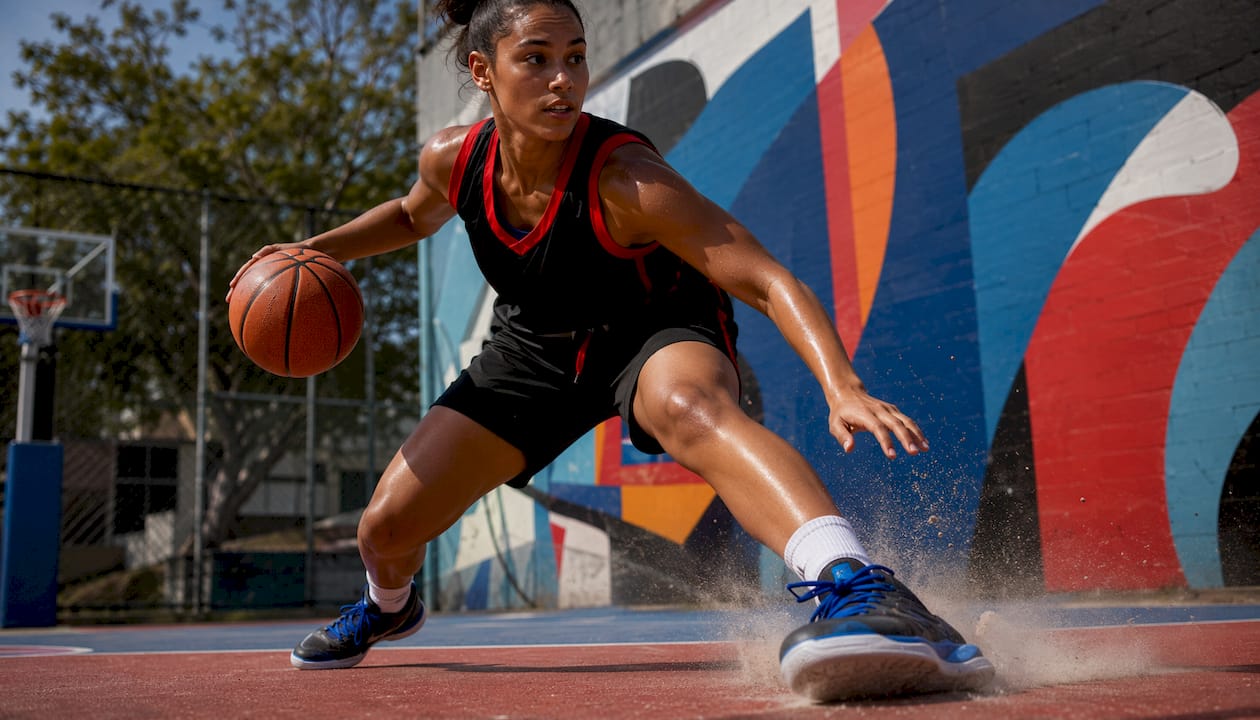
In soccer, a defender who plants the penultimate step wide and drops the center of mass can redirect at full speed; one who arrives flat-footed either fouls or gets beaten. In tennis, reaching the optimal hitting point depends entirely on the split-step and the subsequent crossover or shuffle — former Top 10 player Maria Kirilenko put it plainly: “everything comes from your feet.” In basketball, the jab step and one-two footwork create the separation that makes a shot or drive possible; without it, even a skilled shooter is easy to guard.
Inefficient footwork also raises energy cost. Extra steps, mistimed weight shifts, and reactive scrambling all burn energy that should go toward executing skills. Structured SAQ training addresses this directly by building the motor patterns that eliminate wasted movement. The practical implication is straightforward: improving footwork changes what you can do in a game, not just what your drill scores look like.
What components make footwork effective?
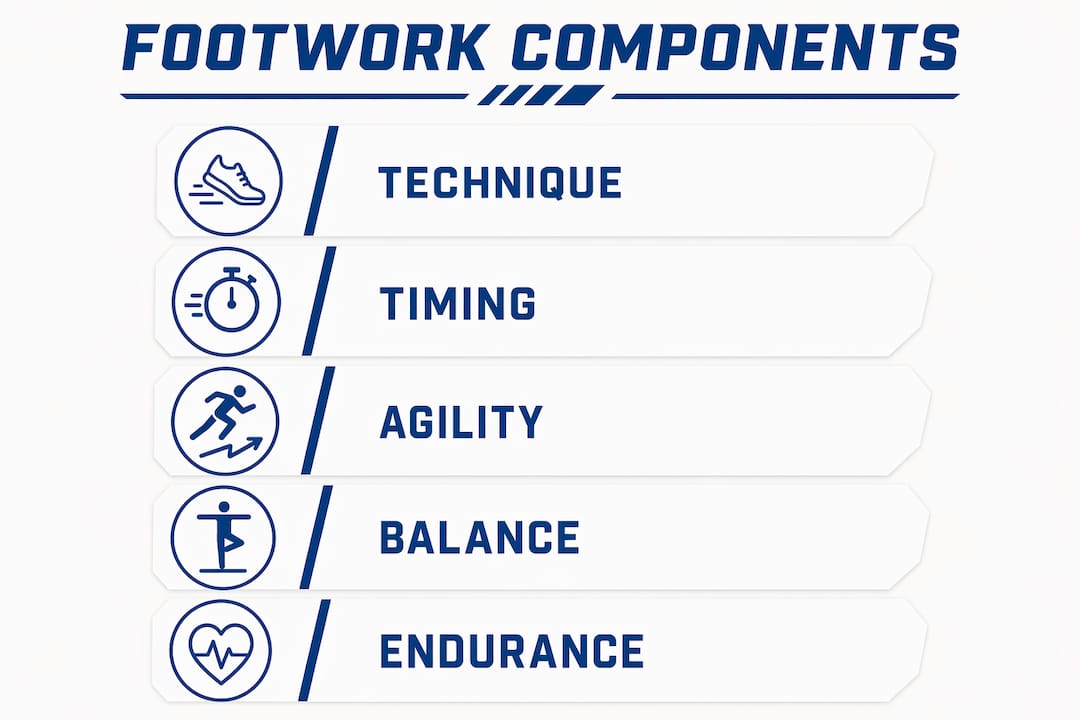
Four components drive clean, fast footwork. Coaches who can identify and address each one separately will see faster athlete development than those who simply run more drills.
- Technique and timing: The sequence of steps, the angle of foot strike, and the moment of weight transfer. Poor technique looks like overstriding, late weight shifts, or crossing the feet when shuffling.
- Balance and positioning: Center-of-mass control and the penultimate step. Planting the second-to-last step wider and lower before a cut dramatically improves braking and redirection mechanics.
- Neuromuscular control and reactivity: The nervous system’s ability to fire the right muscles in the right order, fast. Deficits show up as hesitation, stumbling on reactive drills, or inconsistent landing mechanics.
- Physical conditioning: Ankle stiffness for push-off, eccentric strength for deceleration, and hip stability for single-leg control. Athletes who lack this base fatigue quickly and compensate with unsafe mechanics.
Pro Tip: Start every footwork block with technique and timing work at 60–70% speed. Motor control learned at low speed transfers to high speed; motor errors learned at high speed are much harder to unlearn.
| Component | Typical drills | Measurable outcome | Common deficit |
|---|---|---|---|
| Technique/timing | Ladder patterns, split-step practice | Step count, contact time | Overstriding, crossed feet |
| Balance/positioning | Single-leg holds, penultimate step cues | Landing stability score | Narrow penultimate step |
| Neuromuscular reactivity | Reactive cone drills, partner-cue SAQ | Reaction time, 5-0-5 time | Hesitation, inconsistent landings |
| Physical conditioning | Nordic curls, single-leg hops, plyometrics | Change-of-direction time | Fatigue-driven form breakdown |
How do different sports use footwork patterns?
Every sport demands a specific mix of footwork types. Knowing which patterns matter for your sport lets you pick drills that actually transfer to competition.
The five primary categories are: linear acceleration and deceleration, lateral shuffles, split-step and reactive hops, pivot and rotational footwork, and micro-adjustment steps. Here is how they map to sport tasks:
- Soccer: Cutting and run-throughs (linear deceleration into lateral redirect); defensive recovery shuffles; pivot turns for shielding.
- Basketball: Jab step and one-two footwork for creating separation; drop-step for post play; defensive slide and closeout shuffle. Elite NBA players spend years refining these patterns precisely because they create scoring opportunities that raw athleticism alone cannot.
- Tennis/badminton: Split-step on opponent contact; crossover step to wide balls; small adjustment steps at the last moment before contact. The Mouratoglou Academy identifies the waiting position and split-step as the two highest-leverage tennis footwork cues.
- Table tennis: Short lateral steps and in-place repositioning dominate. Elite table tennis players at provincial and national levels perform a high volume of directional changes per match, covering significant lateral distance across a best-of-seven contest.
- Boxing/martial arts: Pivot footwork for angle creation; lateral movement for range management; explosive push-off for combination setups.
The coaching rule for transfer: pick drills that replicate your sport’s typical ground-contact time, direction-change frequency, and reaction demands. A ladder drill that trains slow, deliberate steps does not transfer to a sport where contacts last milliseconds.
What does research say about footwork training timelines?
Structured SAQ programs produce measurable change-of-direction gains in adolescent and young adult team-sport athletes within weeks, and the physiological mechanisms behind that are well understood.
A systematic review published in Nature Scientific Reports found that ladder and cone-based cutting drills significantly improve change-of-direction test performance when training is structured and progressive. Separately, markerless motion analysis of world-class badminton players showed that top athletes maintain higher mean footwork speed, lower speed variability, and better spatial efficiency across rallies compared with high-school-level players. The gap between elite and developing athletes is not just physical; it is a motor-patterning gap.
Three physiological mechanisms explain why footwork training works:
- Motor patterning: Repeated, quality reps build automatic movement sequences that free up cognitive load during competition.
- Eccentric strength: Deceleration demands high eccentric loading through the hamstrings, quads, and calves. Eccentric overload training such as Nordic hamstring curls can reduce change-of-direction time in soccer players by an amount comparable to several weeks of standard sprint training.
- Ankle and tendon stiffness: Stiffer tendons return energy faster during push-off, reducing ground-contact time and improving reactive ability.
| Study/source | Core outcome | Practical takeaway |
|---|---|---|
| Nature SAQ systematic review | Structured SAQ improves change-of-direction in team-sport athletes | Program ladder and cone drills progressively, not randomly |
| Frontiers badminton motion analysis | Elite athletes show higher speed and lower variability than high-school players | Use video/markerless analysis to identify variability, not just speed |
| Eccentric training research | Nordic-style eccentric work reduces change-of-direction time | Add 1–2 eccentric sessions per week alongside SAQ |
| WTA tennis coaching data | Footwork errors directly increase unforced error rates | Prioritize footwork in early-season technical blocks |
Expect several weeks for measurable field-test improvements with consistent training. Complex skill transfer to live competition typically takes longer, especially for sport-specific reactive patterns.
How should you design a footwork training program?
The executive summary: prioritize movement quality first, then specificity, then progressive overload. Speed and unpredictability come last, not first.
Session structure for most athletes follows three blocks. Open with a warm-up and activation phase (5–8 minutes of dynamic movement, ankle mobility, and low-intensity ladder patterns). Move into a technical skill block (10–15 minutes of isolated footwork at 70–80% intensity, focused on one or two components). Close with a high-intensity reactive block (8–12 minutes of SAQ or sport-transfer drills at full effort with full recovery between reps). Sports performance training frameworks consistently recommend this sequencing because it prevents fatigue from corrupting technique during the learning phase.
Progression steps follow a clear path:
- Unweighted technical practice with coaching cues and slow-motion feedback.
- Reactive SAQ with a delayed decision cue (partner points, light signal).
- Sport-specific load and context: small-sided games, technical drills under mild fatigue.
Frequency: 2–4 short, high-quality footwork sessions per week suits most competitive athletes. Micro-sessions of 15–20 minutes integrated into warm-ups are often more effective than one long weekly block, because frequency drives motor learning. Pair heavier eccentric and plyometric work with strength days, and keep reactive SAQ sessions lower in volume on days before competition.
Footwear and surface matter more than most coaches acknowledge. Grip, sole stiffness, and contact time must match the training surface. Footwear and athletic performance interact directly with how well drill mechanics transfer to game conditions.
Practical drills and two sample sessions
The highest-value drills to prioritize: ladder quick-feet patterns, cone cutting, 5-0-5 rehearsal runs, reactive split-step, and short-burst plyometrics. These cover the full range of footwork demands and require minimal equipment.
Equipment: agility ladder, 6–8 cones, quick-feet markers, resistance bands, light hurdles (optional).
Categorized drill list
- Warm-up/activation: Ankle circles, lateral band walks, low-intensity two-feet-in ladder runs.
- Technical isolated drills: Ickey shuffle (ladder), T-drill at 70% speed, penultimate step cut practice with a cone marker.
- Reactive SAQ: Partner-cue lateral shuffle (partner points left/right), light-signal cone sprint, mirror drill.
- Plyometrics/decels: Broad jump to stick landing, lateral bound to single-leg hold, box drop to deceleration.
- Sport-transfer drills: Small-sided 3v3 with restricted touch (soccer), closeout-and-contest (basketball), split-step to forehand/backhand shadow (tennis).
Beginner session (40 minutes)
- Dynamic warm-up: leg swings, hip circles, ankle mobility — 5 minutes.
- Ladder two-feet-in pattern, focusing on arm drive and upright posture — 3 sets × 20 meters, full rest.
- Split-step timing drill: stand at net/baseline, coach tosses ball, athlete split-steps on toss — 3 sets × 8 reps.
- Single-leg balance hold: 3 × 20 seconds each leg, eyes closed on final set.
- Cone shuffle: 4 cones in a line, 1-meter spacing, lateral shuffle touch — 4 × 10 seconds, 45-second rest.
- Cool-down: static calf and hip flexor stretch.
Advanced session (50 minutes)
- Dynamic warm-up with resistance band lateral walks and reactive hops — 8 minutes.
- Reactive partner-cue SAQ: partner calls direction, athlete cuts to cone — 5 × 6 reps, full rest between sets.
- Loaded deceleration: sprint 10 meters, decelerate to single-leg stick in 2 steps — 4 × 4 reps each leg.
- 5-0-5 rehearsal runs at 95% effort — 6 reps, 90-second rest.
- Sport-specific sequence: 3 sport-transfer drill reps at full game speed.
- Nordic hamstring curl eccentric holds — 3 × 5 reps.
- Cool-down and movement quality review.
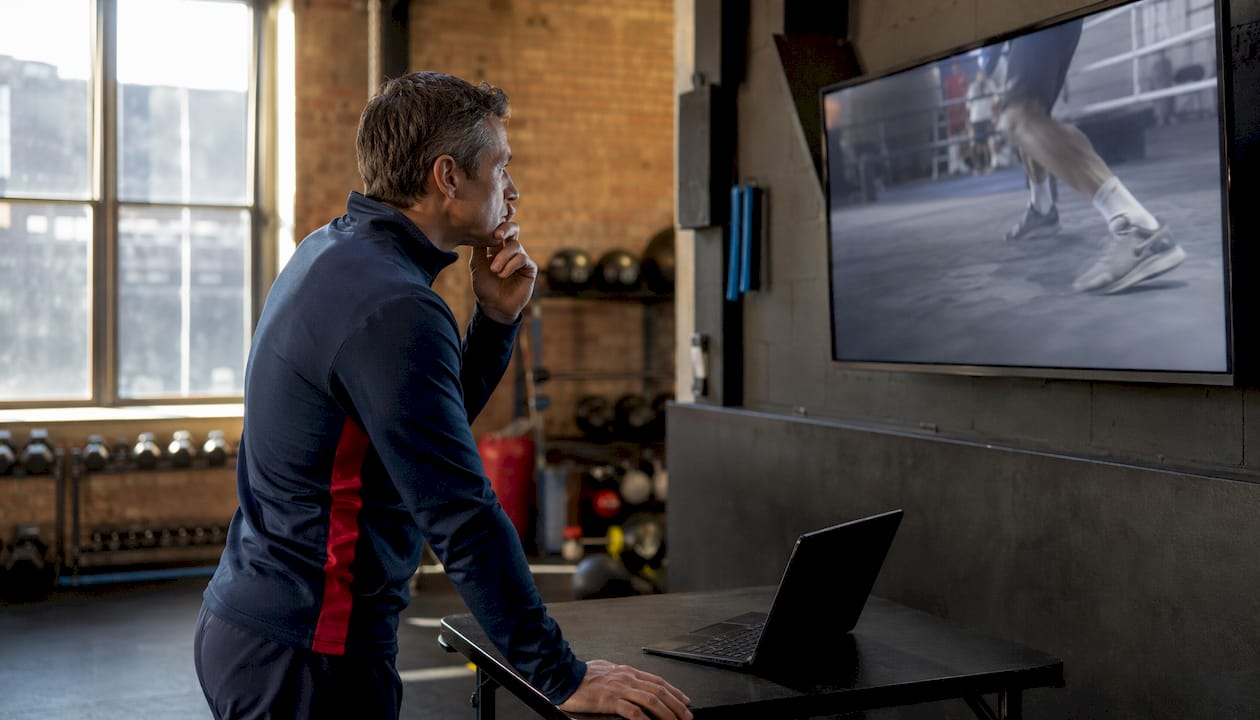
Pro Tip: For the advanced session, record one set of the 5-0-5 rehearsal runs on video. Reviewing foot placement on the pivot step takes 90 seconds and catches errors that feel invisible at full speed.
How do you test and measure footwork progress?
Three field tests give you reliable, repeatable data: the 5-0-5 change-of-direction test, the T-test, and the pro-agility shuttle (also called the 5-10-5). Add a reactive test for athletes in decision-heavy sports.
- 5-0-5 test: Sprint 15 meters, pivot at a cone, sprint 5 meters back. Measures deceleration and 180-degree change-of-direction. Record both legs separately; asymmetry above 10% is a flag.
- T-test: Sprint forward 10 yards, shuffle left 5 yards, shuffle right 10 yards, shuffle left 5 yards, backpedal to start. Measures multidirectional speed. Excellent for team-sport athletes.
- Pro-agility (5-10-5): Start at center cone, sprint 5 yards right, sprint 10 yards left, sprint 5 yards back through center. Widely used in combine settings; good for comparing athletes across positions.
- Reactive test option: Add a simple partner-cue reaction test (athlete responds to a visual or audio signal before the sprint) to capture decision-making speed alongside pure movement speed. For youth athletes, sprint speed and agility testing protocols offer sport-specific benchmarks worth referencing.
Retest every 4–8 weeks. A meaningful improvement is typically a consistent reduction in time across multiple trials, not a single fast rep. Pair objective test times with a short video review or movement quality checklist. Markerless analysis tools can quantify variability across reps, which raw time alone misses.
What injuries and mistakes should you watch for?
Poor footwork mechanics and reckless volume increases are two of the most direct contributors to ankle sprains and ACL loading. The physiology is simple: when the foot lands in a poor position, the knee and ankle absorb force at angles they are not built to handle repeatedly.
Common training mistakes:
- Rushing to full speed before athletes have clean mechanics at moderate intensity.
- Ignoring single-leg control work; most sport actions involve one-leg loading, not two.
- Mismatching footwear to training surface, which changes grip and contact time in ways that corrupt drill mechanics.
- Running excessive high-rep random drills under fatigue, which trains bad patterns as efficiently as good ones.
Prevention actions:
- Use assessment-driven progressions: test single-leg squat quality and landing mechanics before adding reactive load.
- Integrate eccentric strength work such as Nordic hamstring curls to build the deceleration capacity that protects the knee.
- Include single-leg control drills in every session, not just as a warm-up afterthought.
- Plan recovery: athletic longevity depends on managing cumulative load, not just session intensity.
If an athlete shows persistent ankle instability, asymmetric landing mechanics, or pain during deceleration, refer to a physical therapist or movement specialist before continuing high-intensity footwork work.
Key Takeaways
Footwork is the single most transferable physical skill in competitive sports: train it with quality, specificity, and measurable progressions, and nearly every other performance metric improves with it.
| Point | Details |
|---|---|
| Footwork is the foundation | Every sport action — cutting, shooting, defending — depends on foot position and timing before the skill executes. |
| Quality before speed | Train technique and motor control at 60–80% intensity before adding reactive speed or unpredictability. |
| SAQ and eccentric training work | Structured SAQ programs and eccentric loading both produce measurable change-of-direction gains within 4–8 weeks. |
| Test and retest consistently | Use the 5-0-5, T-test, or pro-agility every 4–8 weeks; combine with video review to catch variability raw times miss. |
| Integrate sport context | Transfer drills to small-sided games and sport-specific sequences so gains show up in competition, not just test scores. |
The thing most athletes get backwards about footwork
Most athletes treat footwork as a warm-up activity. They run through a ladder, check the box, and move on to the “real” training. That is exactly backwards.
Footwork is where the performance ceiling gets set. You can have elite strength, elite conditioning, and a technically sound shot, but if your feet are late or misplaced, none of that fires at the right moment. The athletes who separate themselves at the highest levels are not always the fastest movers; they are the ones who are already in position before the play develops. That is anticipation built through footwork repetition, not raw speed.
The other mistake is treating footwork training as sport-agnostic. A ladder drill is a tool, not a program. The question is always: does this drill replicate the contact time, direction-change angle, and decision demand of my sport? If it does not, it is general conditioning, not footwork training. Coaches who understand that distinction build athletes who move better in games, not just in the gym.
At Teamjhall, the belief is that preparation and consistency separate competitors from everyone else. If you are building a training program around these principles, the Teamjhall performance gear is designed for athletes who take that work seriously.
Useful sources and further reading
The sources below were selected for recent evidence, sport-specific analysis, and practical coaching application. Each one offers something a coach or athlete can act on directly.
- WTA Tennis — Importance of footwork: Player and coach quotes on how footwork reduces unforced errors and creates power; useful for tennis-specific coaching cues.
- Nature Scientific Reports — SAQ systematic review: Evidence base for structured SAQ programming; cite when justifying ladder and cone-drill inclusion in a training plan.
- Frontiers in Sports — Badminton footwork motion analysis: Markerless motion data on elite vs. developing athletes; useful for coaches who want objective metrics beyond raw speed.
- Mouratoglou Academy — Tennis footwork techniques: Practical split-step and ladder drill breakdowns; directly applicable to court-sport footwork sessions.
- The Ringer — NBA footwork analysis: Long-form breakdown of elite basketball footwork patterns; good for illustrating mastery and long-term skill acquisition to athletes.
- TopSpin11 — Table tennis footwork: Sport-specific movement volume data and footwork technique breakdowns for table tennis.
- Eccentric training and change-of-direction: Practical guide on Nordic curl progressions and their effect on deceleration capacity.
- Ausported — Fundamentals of footwork: Broad sport overview of footwork principles; useful as a starting reference for multi-sport coaches.
- Core Newport PT — Evidence-based footwork drills: Physical therapy perspective on single-leg control, deceleration mechanics, and progressive loading; essential for injury-prevention programming.
- NSB Scouting — Sprint speed for youth athletes: Practical sprint and agility guidance with measurable benchmarks for youth development programs.
Combine these sources with on-court video review and a simple movement quality checklist. Evidence tells you what to train; observation tells you what your athlete actually does. For training gear built for athletes who train this way, visit the Teamjhall store.