

Role of Speed Training in Sports: Accelerate and Win
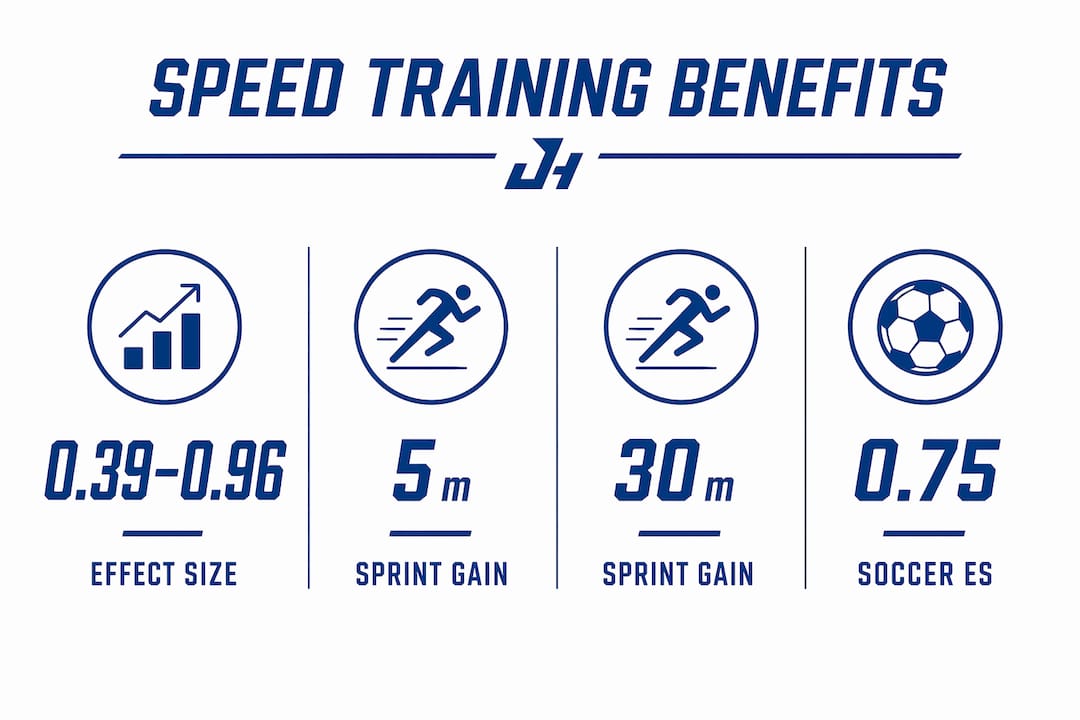
Speed training directly improves acceleration, top-end velocity, change of direction, lower-limb power, and reaction time, making it one of the highest-return investments in any athlete’s program. The evidence backs this up: a 2026 systematic review across 11 RCTs found SAQ training produced effect sizes ranging from 0.39 to 0.96 across sprint, power, and reaction-time tests.
The immediate, measurable benefits include:
- Sprint gains at short distances: Moderate beneficial effects on 5 m and 30 m sprints from SAQ interventions lasting a few weeks.
- Change-of-direction improvement: A 2026 Scientific Reports meta-analysis reported a standardized mean difference of −0.71 for pre-planned COD speed in team-sport athletes.
- Lower-limb power: The same systematic review found a large positive effect on lower-limb power, the largest among outcomes measured.
Team-sport athletes, sprinters, and endurance runners chasing top-end speed all benefit. The gains are not sport-specific accidents; they reflect real neuromuscular adaptations that transfer directly to competition.
Table of Contents
- Why does speed training matter for athletic performance?
- What are the core components of a speed-training program?
- What does the research actually say about speed training?
- How should you structure a single speed-training session?
- Sample weekly templates and progression by sport and level
- How do you manage injury risk and recovery?
- How do you test and track speed progress?
- What equipment and space do you actually need?
- Common myths and mistakes to avoid
- Practical advice for consistency and long-term gains
- Key Takeaways
- Speed training, confidence, and the Teamjhall approach
- Useful sources and further reading
Why does speed training matter for athletic performance?
Speed underpins the decisive moments in almost every sport. A half-second advantage off the line creates a scoring chance in soccer. A faster first step wins a defensive position in basketball. A sharper acceleration out of a corner separates podium finishers from the pack.
The physiology behind this is straightforward. High-velocity sprinting recruits fast-twitch muscle fibers that lower-intensity work simply cannot reach. World Athletics guidance specifically highlights this for endurance athletes: adding speed sessions forces fast-twitch recruitment and improves running economy in ways that easy mileage alone never will. The neuromuscular coordination gains, better inter-muscular timing, quicker ground contact, and improved stretch-shortening cycle efficiency, transfer across sport contexts.
The transfer is not uniform, though. In soccer, high-speed actions represent a small fraction of total match distance, yet those moments directly determine goals and defensive outcomes. Getting faster at those specific actions matters far more than improving average running speed.
What are the core components of a speed-training program?
A complete speed program draws from six distinct training types. Each targets a different physical quality, and mixing them is what produces well-rounded athletic speed.
- Acceleration work: Flying starts, 10–20 m build-ups, and block starts (3–5 reps). Develops first-step power and horizontal force application, the foundation of every sport-specific burst.
- Max-velocity sprints: 30–60 m sprints at near-maximal effort after a rolling start (3–4 reps, full recovery). High-intensity sprint sessions that reach near-maximal velocities are critical for neuromuscular adaptation; sport-specific starts are useful but traditional sprint methods often deliver higher peak intensities.
- SAQ drills: Ladder patterns, cone sequences, and reactive agility setups (2–3 sets of 5–8 reps). Target COD ability and reactive decision-making under movement pressure.
- Plyometrics: Broad jumps, hurdle hops, and bounding (3–4 sets of 6–8 contacts). Builds elastic leg stiffness and reactive power, directly supporting max-velocity mechanics.
- Resisted and assisted sprints: Sled pushes (10–20 m) and bungee-assisted runs. Resisted work overloads acceleration mechanics; assisted work trains the nervous system to tolerate higher velocities.
- Speed endurance: Intervals of 10–40 s at above-VO₂max intensity. Speed endurance training improves performance across 20-second to 10-minute efforts and remains effective even when total training volume is reduced, making it a time-efficient tool for athletes with busy schedules.
What does the research actually say about speed training?
The 2026 SAQ systematic review is a comprehensive evidence base for programming decisions.
| Outcome | Interpretation |
|---|---|
| 5 m sprint | Moderate meaningful acceleration gains |
| 30 m sprint | Moderate top-speed transfer |
| Lower-limb power | Large positive response |
| Reaction time | Moderate neural adaptation |
| COD (subgroup ≤60 min sessions) | Larger effect observed; session length important |
The PLOS One SAQ meta-analysis adds soccer-specific precision: sprint performance effect size of 0.75 across 5 m, 10 m, and 20 m distances, with a particularly strong effect at 10 m (ES = 1.41). COD ability showed a separate effect size of 0.35, and lower-limb power (vertical and horizontal jumps) came in at 0.67. Flexibility showed no significant improvement, which is worth noting for coaches who expect SAQ to replace dedicated mobility work.
World Athletics reinforces the recovery side: fast-twitch recruitment at high intensity elevates injury risk, so progression must be controlled and recovery sessions must be genuine rest, not disguised easy workouts.
How should you structure a single speed-training session?
A well-designed speed session runs 45–60 minutes. Longer than that and intensity drops, which defeats the purpose entirely.
- Dynamic warm-up (10–12 min): Leg swings, hip circles, A-skips, B-skips, and 2–3 build-up strides at 70–80% effort. The nervous system needs priming before maximal work.
- Activation drills (5 min): Wall drives, ankle pops, or resisted marches. These reinforce the mechanics you want during the main set.
- Main set (25–30 min): Choose one primary focus per session. For acceleration: 6–8 × 20 m from a standing start, 2–3 min full recovery between reps. For max velocity: 4–5 × 40 m flying sprints, 3–4 min recovery. For SAQ: 3 sets of a cone sequence or ladder pattern, 90 s between sets.
- Cooldown (8–10 min): Easy jog, static stretching, and targeted hip-flexor and hamstring work.
Intensity is the non-negotiable variable. If you can string together 10 reps without slowing down, you are not going fast enough. Max effort plus full recovery is the governing principle for power-focused sets.
Pro Tip: Time your reps. If your 30 m sprint slows by more than 0.2 seconds from rep 1 to rep 4, stop the set. Speed training done at 85% effort is just conditioning work in disguise.
Sample weekly templates and progression by sport and level
Sprinter or short-sprint athlete (3–4 sessions/week) Monday: acceleration work + plyometrics (50 min). Wednesday: max-velocity sprints (45 min). Friday: speed endurance intervals (50 min). Saturday: strength maintenance (45 min). The types of sports training programs available in the US vary widely, but this structure covers the key physical qualities for sprint-dominant sports.
Team-sport athlete (2–3 sessions/week) Tuesday: SAQ drills + acceleration (50 min). Thursday: max-velocity sprints + plyometrics (45 min). Saturday: sport-specific practice with embedded speed work. The 2026 Scientific Reports meta-analysis confirmed benefits across basketball, soccer, and handball from 2–3 sessions per week over 4–12 weeks.
Endurance athlete (1–2 sessions/week) Wednesday: 4–6 strides after an easy run (adds 7 min). Sunday: one speed endurance session of 6–8 × 20 s at above-VO₂max intensity. World Athletics recommends controlled progression here, starting with strides before moving to full speed endurance intervals.
Progression rules: Add one rep or one set every two weeks for the first six weeks. After six weeks, reduce volume by 30% for one deload week before increasing intensity. Never add volume and intensity in the same week.
How do you manage injury risk and recovery?
High-intensity speed work is the most injury-prone training modality in any sport program. The risks are specific: hamstring strains from max-velocity sprints, Achilles tendon overload from plyometrics, and technique breakdown from accumulated fatigue.
- Baseline fitness check first: Do not start maximal sprint work without 3–4 weeks of sub-maximal acceleration runs and strength foundation work.
- Space sessions correctly: At least 48 hours between maximal sprint sessions. The nervous system needs that window.
- Monitor fatigue signals: Slower rep times, altered gait, or unusual soreness are stop signs, not signs to push through.
- Recovery tools: Contrast showers, targeted eccentric hamstring work (Nordic curls), and hip-flexor mobility address the tissues most stressed by sprinting. Athletic longevity depends on treating recovery as training, not as downtime.
- Replace, do not skip: When fatigue is high, swap a maximal sprint session for technical drill work at 70% effort. You preserve the movement pattern without the injury risk.
How do you test and track speed progress?
Training blind is the fastest way to plateau. These tests give you real data every 4–6 weeks.
- 5 m and 10 m sprint: Measures pure acceleration and first-step quickness. Use a phone timer app or, better, timing gates.
- 30 m sprint: Captures the transition from acceleration to max velocity. The most practical all-around speed test for field athletes.
- T-test: Four cones in a T-shape; measures COD speed and lateral quickness. Standard in basketball and soccer conditioning.
- Pro-agility (5-10-5): Two direction changes over 20 yards; widely used in football and combines testing. Directly measures reactive COD ability.
On timing methods: hand timing introduces 0.1–0.2 s of human error per rep, which is enough to mask real gains. Phone apps like SpeedClock or Hudl Technique are more consistent for solo athletes. Timing gates (Freelap, JAWKU) are the gold standard for tracking athletic performance metrics accurately.
Retest every 4–6 weeks during a training block, and always retest after a deload week when the body is fresh. A gain of 0.05–0.10 s on a 30 m sprint over a 6-week block is meaningful progress.
What equipment and space do you actually need?
| Tier | Equipment | Best For |
|---|---|---|
| Minimal | 4–6 cones, phone timer | SAQ drills, acceleration, strides |
| Recommended | Timing gates, resistance bands, sled | Accurate testing, resisted sprints |
| Optional | Radar gun, dedicated track, GPS vest | Elite programming, velocity-based training |
SAQ training delivers significant gains without specialized equipment. A partner holding a resistance band replicates sled-push mechanics. A slight uphill (3–5% grade) replaces a sled entirely for resisted acceleration work. Downhill runs on a 1–2% grade substitute for assisted sprints. For indoor athletes, a 20 m gym corridor is enough for acceleration work and most SAQ patterns. The role of agility in sport performance does not require a track or a budget.
Common myths and mistakes to avoid
- Myth: Strength training alone makes you faster. Reality: Strength builds the engine, but speed work teaches the nervous system to fire it at the right time. Both are necessary; neither replaces the other.
- Myth: More sprints equal more speed. Reality: Volume without recovery produces fatigue, not adaptation. Four quality reps beat twelve tired ones every time.
- Mistake: Skipping the warm-up. Cold muscles and an unprimed nervous system cannot produce maximal output. A 10-minute warm-up is not optional.
- Mistake: Sessions running over 60 minutes. The subgroup analysis in the 2026 systematic review found larger COD effects when sessions stayed at or under 60 minutes. Longer sessions dilute intensity.
- Mistake: Over-specializing too early. General high-intensity sprints build the neuromuscular base. Sport-specific movement patterns come later in a training cycle, once the raw speed qualities are established.
Practical advice for consistency and long-term gains
Consistency beats intensity over a full season. The athletes who improve most are not the ones who train hardest in one week; they are the ones who show up every week with a plan.
- Add 4–6 strides after two easy runs per week. Each stride takes 30 seconds. Strides and short drill sets reliably improve leg turnover and neuromuscular patterns with minimal fatigue cost.
- Run one focused speed session per week at true maximal effort.
- Include one SAQ or plyometric session for COD and reactive ability.
- Log every session: distance, reps, rest, and a subjective effort score. Patterns in that log tell you more than any single test.
Pro Tip: Small, regular speed work builds neuromuscular efficiency faster than occasional hard sessions. Two 45-minute sessions per week, done consistently for 8 weeks, outperform one brutal week followed by two weeks of recovery.
Understanding rate of force development helps explain why this consistency matters so much: the nervous system adapts to repeated high-velocity demands, and those adaptations compound over months, not days.
Key Takeaways
Speed training improves acceleration, COD, lower-limb power, and reaction time simultaneously, with the largest gains appearing in lower-limb power (ES = 0.96) after just 4–12 weeks of consistent SAQ work.
| Point | Details |
|---|---|
| Evidence-backed effect sizes | SAQ training yields ES 0.39–0.96 across sprint, power, and reaction-time outcomes in 4–12 weeks. |
| Session length matters | Sessions at or under 60 minutes produce larger COD improvements per the 2026 systematic review subgroup analysis. |
| Minimal equipment needed | Cones and a phone timer are enough to run effective SAQ and acceleration sessions with real gains. |
| Test every 4–6 weeks | Use 5 m, 30 m, T-test, or pro-agility to track progress and guide load increases. |
| Consistency over intensity | Two focused sessions per week, done regularly, outperform sporadic high-volume weeks. |
Speed training, confidence, and the Teamjhall approach
The evidence is clear, but evidence alone does not get athletes to the track at 6 AM. What does is a system built around habits rather than motivation. The approach here is simple: short, frequent speed elements stacked onto existing training, one focused session per week at true maximal effort, and honest testing every month to confirm the work is paying off.
Teamjhall is built on exactly that kind of consistency. Confidence in competition comes from knowing you have done the work, not from hoping you are fast enough. The gear you train in should match that standard: performance apparel designed for athletes who take their preparation seriously, from the TJH Men’s Performance Tee to the UA Ladies Athletic Tee, built to move with you through every rep.

[Note: Jason’s professional credentials and background relevant to sports training, and any case studies or testimonials from athletes, can be inserted here to strengthen this section.]
Useful sources and further reading
-
SAQ systematic review and meta-analysis, PMC 2026 — The primary evidence base for this article. Contains the full effect-size table across 5 m sprint, 30 m sprint, lower-limb power, and reaction time. Read this for the subgroup analysis on session duration.
-
Scientific Reports SAQ meta-analysis, 2026 — 22 studies, 26 effect sizes for COD and linear sprint in adolescent and young adult team-sport athletes. Best source for basketball, soccer, and handball-specific programming evidence.
-
Speed endurance training review, PMC — Covers SET protocols for events from 20 seconds to 60 minutes. Useful for endurance athletes adding speed work without increasing total volume.
-
World Athletics: speed training for endurance runners — Practical guidance on fast-twitch recruitment, progression rules, and injury risk management. The most accessible expert resource for endurance athletes new to speed work.
-
Human Kinetics: developing an effective speed training program — Coaching-level breakdown of intensity prescriptions, starter drill choices, and how to achieve near-maximal velocities in practice.
-
Teamjhall training guides by Jason — Practical athlete-facing plans integrating speed, strength, and recovery. Revisit these guides every training block to refine your weekly structure and progression rules.